
NSG 6320 (NSG 6320)
South University
Aquí están los mejores recursos para pasar NSG 6320 (NSG 6320). Encuentra NSG 6320 (NSG 6320) guías de estudio, notas, tareas, y mucho más.
Examen
Agnp Board Exam Questions Pediatrics 127 Questions With 100% Correct Answers And Explanations
AGNP BOARD EXAM QUESTIONS Pediatrics Assessment (127 Questions) Question: A child sustained a "full-thickness" burn injury. This type injury involves tissue destruction down to the: epidermis. dermis. subcutaneous tissue. Correct internal organs. Explanation: A full-thickness burn involves all skin layers, including the epidermis, dermis, and the subcutaneous tissue and fat. Muscles and tendons may be involved. A superficial thickness burn involves the epidermis only. A superficial ...
 Garcia
Examen
AGNP BOARD EXAM QUESTIONS Orthopedics Assessment 2020/2021_317 Questions With Answers And Rationale
AGNP BOARD EXAM QUESTIONS Orthopedics Assessment (317 Questions). Question: The axioscapular group of muscles include which one of the following? Supraspinatus Trapezius Correct Subscapularis Pectoralis major Explanation: The axioscapular group attaches the trunk to the scapula and includes the trapezius, rhomboids, serratus anterior, and levator scapulae. The scapulohumeral group of muscles extends from the scapula to the humerus and includes the muscles inserting directly on the hum...
Garcia
Examen
AGNP BOARD EXAM QUESTIONS Gastroenterology Prescription 2021_85 Questions With Answers And Rationale
AGNP BOARD EXAM QUESTIONS Prescription Gastroenterology (85 Questions) Question: A 45-year-old woman has been taking oral omeprazole (Prilosec) 40 mg twice daily for the treatment of gastroesophageal reflux. To discontinue the medication the nurse practitioner would: advise the patient to stop the medication. reduce the dose by 50% every other day. reduce the dose by 50% weekly. Correct reduce dose by 50% every month. Explanation: For patients on a moderate to high dose of a PPI (e.g., ...
Garcia
Examen
AGNP BOARD EXAM QUESTIONS EYE EAR NOSE THROAT Prescription._2021_ Questions With Answers And Rationale
AGNP BOARD EXAM QUESTIONS EYE EAR NOSE THROAT Prescription (102 Questions) Question: Oral tetracycline (Sumycin), for the treatment of acute frontal sinusitis, should be administered: with milk. with meals. on an empty stomach. Correct with an antacid. Explanation: Tetracycline (Sumycin) should be administered on an empty stomach (i.e., 1 hour prior to, or 2 hours after meals) to increase total absorption and with adequate amount of fluid to reduce the risk of esophageal irritation an...
Garcia
Examen
AGNP BOARD EXAM QUESTIONS Respiratory Prescribing_2021_100 Questions With Answers And Rationale
AGNP BOARD EXAM QUESTIONS Respiratory Prescribing (Questions 100) Question: Treatment of Bordetella pertussis in a patient with a hypersensitivity to macrolides is: doxycycline. clindamycin (Cleocin). metronidazole (Flagyl). sulfamethoxazole/trimethoprim (Bactrim). Correct Explanation: Sulfamethoxazole/trimethoprim (Bactrim) is an alternative choice for patients in whom a macrolide is contraindicated. Question: The mainstay of treatment in the management of mild and moderate croup is ...
Garcia
Examen
AGNP BOARD EXAM QUESTIONS Respiratory Assessment._2021_51 Questions With Correct Answers And Rationale
AGNP BOARD EXAM QUESTIONS Respiratory Assessment (51 Questions) Question: Which technique best determines whether the tissues in the chest are air-filled, fluidfilled, or solid? Auscultation Palpation Inspection Percussion Correct Explanation: Percussion of the chest produces audible sounds and palpable vibrations, thus, assisting in determining if the underlying tissues are filled with air or fluid or if they are solid. However, percussion will not help detect deep seated lesions. Aus...
Garcia
Examen
AGNP BOARD EXAM QUESTIONS CARDIOVASCULAR PRESCRIBING._2021_113 Questions With Correct Answers And Rationale
AGNP BOARD EXAM CARDIOVASCULAR PRESRIBING (113 QAND A) Question: Signs and symptoms of digitalis toxicity include: constipation and muscle spasms. bradycardia and tinnitus. headache and dizziness. blurred vision and persistent diarrhea. Correct Explanation: Signs and symptoms of digitalis toxicity include: confusion, irregular pulse, loss of appetite, nausea, vomiting, diarrhea, fast heart beat, and visual changes (blurred vision, blind spots, greenyellow color disturbances, halo effect...
Garcia
Examen
AGNP BOARD EXAM QUESTIONS Health Promotion Assessment_2021_51 Questions With Correct Answers And Rationale
AGNP BOARD EXAM QUESTIONS Health Promotion Assessment (51 Questions) Question: According to the U.S. Preventive Services Task Force, older adults should be screened for colorectal cancer with sigmoidoscopy every: year. 2 years. 5 years. Correct 10 years. Explanation: The Task Force recommends screening with colonoscopy every 10 years, sigmoidoscopy every 5 years with high-sensitivity fecal occult blood tests (FOBTs) every 3 years, or FOBTs every year beginning age 50 years through age...
Garcia
Examen
AGNP BOARD EXAM QUESTIONS Dermatology PRESCRIPTION__2021_100 Questions With Correct Answers And Rationale
AGNP BOARD EXAM: Dermatology Prescription (100 Questions and Answers) Question: Systemic ivermectin (Stromectol), classified as an antiparasitic,: is primarily excreted in the urine. crosses the blood-brain barrier. has a high concentration in the liver. Correct is not well absorbed. Explanation: Systemic ivermectin (Stromectol) is well absorbed and is primarily excreted in the feces. It is distributed and highly concentrated in the liver and adipose tissue. It is primarily bound to al...
Garcia
Examen
AGNP BOARD EXAM QUESTIONS Sexually Transmitted Diseases Prescribing_2021_82 Questions With Correct Answers And Rationale
AGNP BOARD EXAM QUESTIONS Prescription (82 Questions) Question: Which of the following is NOT recommended as an alternative treatment for bacterial vaginosis? Intramuscular ceftriaxone (Rocephin) Correct Clindamycin (Cleocin) vaginal cream Metronidazole (Flagyl) vaginal cream Tinidazole (Tindamax) orally Explanation: Intramuscular ceftriaxone (Rocephin) is not indicated in the treatment of bacterial vaginosis. Metronidazole (Flagyl) vaginal cream may be used if metronidazole oral is i...
Garcia
Examen
Agnp Board Exam Questions Cardiovascular Assessment.docx
Agnp Board Exam Questions Cardiovascular Assessment.docx
 pennylucy
Examen
AGNP BOARD EXAM QUESTIONS Cardiovascular Assessment (107 Questions and Answers) (LATEST 2021)
1.Question: The preauricular nodes drain lymphatic fluid from the: palpebral conjunctiva and the skin adjacent to the ear within the temporal region. Correct eyelids, the conjunctiva, and the skin and mucous membrane of the nose and cheek. mouth, throat, and face. posterior part of the temporoparietal region. Explanation: The preauricular nodes drain lymphatic fluid from the palpebral conjunctiva as well as the skin adjacent to the ear within the temporal region. Tonsillar, submandibular...
StudyConnect
Examen
AGNP Board Exam Question and Answers - Orthopedics Prescribing (COMPREHENSIVE)
1. Which medication is NOT a brand name for acetaminophen? 2. To treat low back pain in a patient for whom nonsteroidal anti-inflammatory drugs (NSAIDs) are contraindicated, the recommended therapy is: 3. The patient at highest risk for side effects from cyclobenzaprine (Amrix) is a: 4. When assessing a patient with suspected acetaminophen (Tylenol) overdose, the time of ingestion can be confirmed by checking: 5. A patient with severe osteoarthritis is complaining of a pain exacerbation due ...
 Precision

Examen
AGNP Board Exam Question and Answers - Pediatrics Assessment (AMPLIFIED)
1. A child sustained a "full-thickness" burn injury. This type injury involves tissue destruction down to the: 2. A child was involved in a vehicular accident and sustained burns on the lower extremities. Examination reveals a dry, waxy, whitish appearance of both lower legs and some visualization of the tibialis anterior. This type of burn would be classified as a: 3. The earliest recognizable clinical manifestation(s) of cystic fibrosis in an infant is: 4. An infant presents with a rash i...
Precision
Examen
AGNP Board Exam Question and Answers - Pregnancy Assessment (DETAILED)
1. Weight gain should be monitored during pregnancy. For a pregnant woman whose BMI is < 18.5, the total weight gain should be: 2. During pregnancy, which hormone is produced by the placenta and supports progesterone synthesis in the corpus luteum? 3. During pregnancy, as the skin over the abdomen stretches to accommodate the fetus, this purplish mark may appear. This finding is: 4. When should all pregnant woman be screened for human immunodeficiency virus (HIV)? 5. Irregular brownish pa...
Precision
Examen
AGNP Board Exam Question and Answers - Pregnancy Assessment (DETAILED)
1. Weight gain should be monitored during pregnancy. For a pregnant woman whose BMI is < 18.5, the total weight gain should be: 2. During pregnancy, which hormone is produced by the placenta and supports progesterone synthesis in the corpus luteum? 3. During pregnancy, as the skin over the abdomen stretches to accommodate the fetus, this purplish mark may appear. This finding is: 4. When should all pregnant woman be screened for human immunodeficiency virus (HIV)? 5. Irregular brownish pa...
Precision
Examen
AGNP BOARD EXAM QUESTIONS Assessment Eye, Ear, Nose and Throat (166 Questions With Answers)
Ophthalmoscopic examination of the fundus reveals small, rounded, slightly irregular red spots embedded in the retina. These findings are consistent with: superficial retinal hemorrhages. preretinal hemorrhages. microaneurysms. deep retinal hemorrhages. Correct Explanation: Deep retinal hemorrhages appear as small, rounded, slightly irregular red spots and are sometimes called dot or blot hemorrhages. They occur in a deeper layer of the retina than flameshaped hemorrhages. Diabetes is a...
StudyConnect
Examen
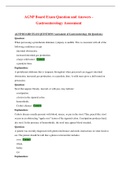
AGNP Board Exam Question and Answers - Gastroenterology Assessment (Correctly answered)
1. When percussing a protuberant abdomen, tympany is audible. This is consistent with all of the following conditions except: 2. Stool that appears bloody, mucoid, or with pus, may indicate: 3. A patient was recently diagnosed with gluten intolerance and needs instructions on what foods to eat. The patient should be told that a gluten restricted diet includes: 4. A patient presents with symptoms of bloody stools, new onset constipation, and weight loss. These symptoms could be associated with...
Precision
Examen
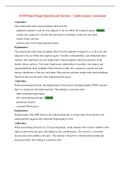
AGNP Board Exam Question and Answers - Cardiovascular Assessment (Verified)
1. The preauricular nodes drain lymphatic fluid from the: 2. When auscultating the heart, the displacement of the point of maximal impulse (PMI) is greater than 10 cm lateral to the midsternal line. This finding is consistent with: 3. When auscultating the heart of a 55-year-old patient, a loud murmur with a thrill is audible in the right second intercostal space that radiates to the carotid arteries. Also noted is a crescendo-decrescendo pitch audible at the apex. The murmur is heard best wit...
Precision
Examen
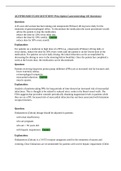
NSG 6320 - AGNP BOARD EXAM QUESTIONS Gastroenterology Prescription
NSG 6320 - AGNP BOARD EXAM QUESTIONS Gastroenterology Prescription GNP BOARD EXAM QUESTIONS Prescription Gastroenterology (85 Questions) Question: A 45-year-old woman has been taking oral omeprazole (Prilosec) 40 mg twice daily for the treatment of gastroesophageal reflux. To discontinue the medication the nurse practitioner would: advise the patient to stop the medication. reduce the dose by 50% every other day. reduce the dose by 50% weekly. Correct reduce dose by 50% every month. E...
NelsonMwema