Behavioural Neurosciences

Rijksuniversiteit Groningen (RuG)

Aquí están los mejores recursos para pasar Behavioural Neurosciences. Encuentra Behavioural Neurosciences guías de estudio, notas, tareas, y mucho más.
21 resultados

Behavioural neurosciences, Biology RUG, 1st year, 2022/2023, summary
  • Resumen

    Behavioural neurosciences, Biology RUG, 1st year, 2022/2023, summary

  • A summary of all the lectures from Behavioural Neurosciences
  • fleurbenneker
    $6.60 Más información
Summary Material Behavioral Neuroscience 1st year course Biology RUG
  • Resumen

    Summary Material Behavioral Neuroscience 1st year course Biology RUG

  • This summary contains all the material for the MC exam of behavioral neuroscience. The exam is a lot about the lectures, so all the important information together with important pictures is put in this document. Together with a nice lay-out :)
  • lunakraaijenzank
    $7.20 Más información
Behavioral neurosciences RUG (Biology; year 1): notities colleges
  • Notas de lectura

    Behavioral neurosciences RUG (Biology; year 1): notities colleges

  • Notities gemaakt tijdens de colleges van het vak behavioral neuroscience; alle lessen staan hier in.
  • gfnoorman
    $4.19 Más información
Behavioural Neurosciences
  • Resumen

    Behavioural Neurosciences

  • This summary contains all the information from the lectures, I had a 7 last year.
  • mjdikken
    $8.28 Más información
Lecture 7&8 Van der Zee
  • Notas de lectura

    Lecture 7&8 Van der Zee

  • Learning objectives - location of place and grid cells - function and features of place and grid cells (see last slide) - one place cell gets input from circa 100 grid cells - the meaning of a “cognitive map” - aging in relation to place cells - 3D place fields and place cells - functional link between place and grid cells - the hexagonal shape (EUREKA moment) - size of modules of grid cells - episodic memory and place cells - link between grid and place cells and Alzheimer’s ...
  • stijnvantrijp
    $4.19 Más información
Lecture 1&2 Van der Zee
  • Notas de lectura

    Lecture 1&2 Van der Zee

  • Learning objectives - misconceptions - 4 brain lobes + gyrus, sulcus, fissure - phrenology (what is it) - ventricular system - brain scanning methods - terminology anatomy - white matter / grey matter + general structure neurons - different types of brain cells + function - how CSF flows through the brain - neurophilosophy (what is it) - Nissl and Golgi stainings (what is the difference) - How to optimize your L&M performance (4 tips)
  • stijnvantrijp
    $4.19 Más información
Lecture 5&6 Van der Zee
  • Notas de lectura

    Lecture 5&6 Van der Zee

  • Learning objectives - Why knowledge of signal transduction is important - principles of the resting membrane potential - principles of action potentials - action potentials in aged neurons - mode of action of lidocaine and cocaine - gap junctions: shape and function - the chemical synapse - classic neurotransmitters and neuropeptides - transmitter release mechanism - the neuromuscular synapse - freeze-etching method and transmitter release mechanism - role of clathrine - classific...
  • stijnvantrijp
    $4.19 Más información
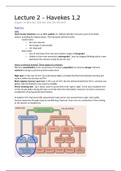
Lecture Havekes 1&2
  • Notas de lectura

    Lecture Havekes 1&2

  • Learning objectives - Reproduce the impact of the medial temporal lobe lesion in patient H.M. on various cognitive aspects (i.e. What forms of learning were affected and which were unaffected? - Reproduce how the delayed-nonmatching to sample task works and what brain regions it requires. - Reproduce the difference between declarative and nondeclarative memories (e.g. explicit and implicit memories) - Reproduce what priming is used for in terms of assessing memory aspects - Reproduce what t...
  • stijnvantrijp
    $4.19 Más información
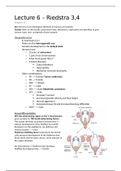
Lecture 3&4 Riedstra
  • Notas de lectura

    Lecture 3&4 Riedstra

  • Learning objectives - What is known about sex and the brain? - Neural machinery that makes reproduction possible - How different are the brains of the two sexes - Is by genetics, brain or behaviour - Anatomy & physiology of the nervous system - Activations and organisational effects of steroid hormone
  • stijnvantrijp
    $4.19 Más información
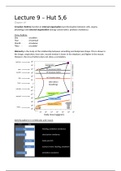
Lecture 5&6 Hut
  • Notas de lectura

    Lecture 5&6 Hut

  • Summary of lecture 5&6 Hut
  • stijnvantrijp
    $4.19 Más información
Lecture 1&2 Riedstra
  • Notas de lectura

    Lecture 1&2 Riedstra

  • Learning objectives - Difference between strength and direction of lateralisation - Differences between individual and population biases - Pro’s and cons of lateralisation - Define lateralisation - Negative frequency dependent selection of lateralisation - Chimera’s
  • stijnvantrijp
    $4.19 Más información
Lecture 3&4 Havekes
  • Notas de lectura

    Lecture 3&4 Havekes

  • Learning objectives - Reproduce the importance of the X, Y chromosome and SRY gene in sex differences - Describe how estradial and testosterone are made - Reproduce the anatomical differences between the male and female brain at the level of the hypothalamus o Differences at the level of nuclei size o Differences at the level of receptor or neurotransmitter expression - Describe how testosterone/ estradiol plays an essential role in sex differences during early development and later stage...
  • stijnvantrijp
    $4.19 Más información
Lecture 5&6 Havekes
  • Notas de lectura

    Lecture 5&6 Havekes

  • Learning objectives - Reproduce the role of hippocampus in specific learning tasks - Reproduce the differences between Pavlovian Conditioning and Operant Conditioning - Reproduce the role of the hippocampus and amygdala in tone-cued fear and contextual fear conditioning - Reproduce how the role of protein synthesis in the consolidation of contextual fear conditioning was studied - Reproduce the difference between the fear conditioning and active shock avoidance - Reproduce how the object...
  • stijnvantrijp
    $4.19 Más información
Lecture 1&2 Hut
  • Notas de lectura

    Lecture 1&2 Hut

  • Summary about lecture 1&2 from Hut.
  • stijnvantrijp
    $4.19 Más información
Lecture 3&4 Hut
  • Notas de lectura

    Lecture 3&4 Hut

  • Summary about lecture 3&4 from Hut.
  • stijnvantrijp
    $4.19 Más información
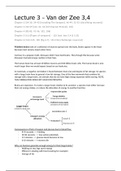
Lecture 3&4 Van der Zee
  • Notas de lectura

    Lecture 3&4 Van der Zee

  • Learning objectives - Organization of primitive brains - evolution of “large brains” - relationship between the brain and energy - storage of fat and the brain - our brain is shrinking, but PFC and cerebellum increase - relationship white matter / grey matter - features of neuronal networks - spine density and functionality - spines and mental health - complexity of the brain - most common cause of stroke - 4 central brain systems (ascending systems; modulatory systems) - h...
  • stijnvantrijp
    $4.19 Más información
Summary Behavioural Neuroscience
  • Resumen

    Summary Behavioural Neuroscience

  • Complete summary with pictures of the lectures given by Havekes, Hut, van der Zee, and Riedstra.
  • myrthe01
    $10.20 Más información
Behavioural neuroscience summary lectures
  • Resumen

    Behavioural neuroscience summary lectures

  • Summary of the lectures of the first year course of behavioural neuroscience from the study of biology on the back. In it all slides of the lectures are summarized in 1 document the information that was told in the lectures.
  • noorbijvang
    $5.99 Más información
Mientras lees esto, un compañero ha ganado otros 4,35 dólares...
¿Cómo lo hizo? Vendiendo sus recursos de estudio en Stuvia. Pruébalo tu mismo.