Escrito por estudiantes que aprobaron Inmediatamente disponible después del pago Leer en línea o como PDF ¿Documento equivocado? Cámbialo gratis 4,6 TrustPilot
logo-home
Notas de lectura

UVA Chemistry 1810 Class Notes

Puntuación
-
Vendido
-
Páginas
312
Subido en
27-12-2025
Escrito en
2025/2026

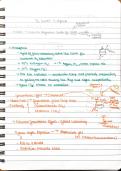
The first part of the course (“Principles and Particles”) introduces the foundations of chemistry by explaining the nature of matter at the atomic level. It covers atomic structure, subatomic particles, isotopes, and how experimental evidence led to modern atomic theory. Key physical principles such as energy, forces, and electrostatics are used to explain how particles interact. This section also introduces early quantum ideas, atomic orbitals, electron configurations, periodic trends, and how these properties determine chemical behavior. The emphasis is on connecting measurable macroscopic properties to microscopic particle models. The quantum mechanics unit builds the mathematical and conceptual framework needed to describe electrons accurately. It introduces wave–particle duality, the Schrödinger equation, quantized energy levels, and atomic orbitals as probability distributions rather than fixed paths. Topics include operators, wavefunctions, normalization, expectation values, and quantum numbers. These ideas are then applied to atoms and molecules to explain bonding, orbital shapes, and electronic structure. This section provides the theoretical basis for why atoms bond the way they do and why molecules have specific shapes and energies. The later units focus on molecules and spectroscopy. Molecular structure is explained through bonding models, molecular orbitals, hybridization, symmetry, and molecular geometry. Energetics, bonding interactions, and electron delocalization are emphasized. Spectroscopy (IR, NMR, and related techniques) is introduced as an experimental tool to probe molecular structure by observing how molecules interact with electromagnetic radiation. Students learn how vibrational, rotational, and nuclear spin transitions produce characteristic spectra that reveal functional groups and molecular environments. Together, these sections connect theory to real experimental data, showing how chemists determine structure and behavior at the molecular level.

Mostrar más Leer menos
Institución
Grado

Vista previa del contenido

8/27
Tuesday, August 27, 2024 7:50 AM


Principals and particles Page 1

,Principals and particles Page 2

,Principals and particles Page 3

, 8/29


Wednesday, August 28, 2024 11:36 PM


Principals and particles Page 4

Escuela, estudio y materia

Institución
Grado

Información del documento

Subido en
27 de diciembre de 2025
Número de páginas
312
Escrito en
2025/2026
Tipo
NOTAS DE LECTURA
Profesor(es)
Dean harman
Contiene
Todas las clases

Temas

$8.79
Accede al documento completo:

¿Documento equivocado? Cámbialo gratis Dentro de los 14 días posteriores a la compra y antes de descargarlo, puedes elegir otro documento. Puedes gastar el importe de nuevo.
Escrito por estudiantes que aprobaron
Inmediatamente disponible después del pago
Leer en línea o como PDF

Conoce al vendedor
Seller avatar
nicolelane3

Conoce al vendedor

Seller avatar
nicolelane3 University Of Virginia
Seguir Necesitas iniciar sesión para seguir a otros usuarios o asignaturas
Vendido
-
Miembro desde
3 meses
Número de seguidores
0
Documentos
4
Última venta
-

0.0

0 reseñas

5
0
4
0
3
0
2
0
1
0

Documentos populares

Recientemente visto por ti

Por qué los estudiantes eligen Stuvia

Creado por compañeros estudiantes, verificado por reseñas

Calidad en la que puedes confiar: escrito por estudiantes que aprobaron y evaluado por otros que han usado estos resúmenes.

¿No estás satisfecho? Elige otro documento

¡No te preocupes! Puedes elegir directamente otro documento que se ajuste mejor a lo que buscas.

Paga como quieras, empieza a estudiar al instante

Sin suscripción, sin compromisos. Paga como estés acostumbrado con tarjeta de crédito y descarga tu documento PDF inmediatamente.

Student with book image

“Comprado, descargado y aprobado. Así de fácil puede ser.”

Alisha Student

Preguntas frecuentes