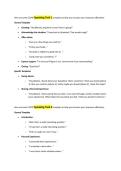
ECON 102 MIDTERM 1 STUDY GUIDE
Economics - Answers -Study of choice under the conditions of scarcity.
Scarcity - Answers -Describes the limited nature of society's resources.
Opportunity Cost - Answers --The OP of an item (or decision) is what must be given up
to maintain that item (or decision).
-The sum of both implicit and explicit costs.
Explicit Cost - Answers --The explicit cost of a choice is the dollars sacrificed - and
actually paid out - for a choice.
-Monetary or accounting cost.
-What one would typically think of cost.
Implicit Cost - Answers --The implicit cost of a choice is the value of something
sacrificed when no direct payment is made.
Ex. Cost of time spent completing a decision.
Rational (people) - Answers -Are people who systematically and purposefully do the
best thing they can do to achieve their objectives.
-Think at the margin.
Marginal Change - Answers -A small incremental adjustment to a plan of action.
-Weigh the additional benefit received from the consumption of an extra unit of a good
vs the additional cost of consuming an extra unit of a good.
Incentive - Answers -Something that induces a person to act.
Command Economy - Answers -Is an economy that allocates resources through
decisions made by a centralized authority.
-Centralized Authority is the gov.
Communist countries: Former USSR, North Korea, Cuba
Market Economy - Answers -An economy that allocates resources through
decentralized decisions made by many firms and households as they interact in markets
for goods and services.
Productivity - Answers -Is the quantity of goods and services produced from each unit
of labor input.
Ex. The more educated the country's citizens the higher the productivity. Therefore, the
country can produce more goods and services which yield to a higher standard of living.
Microeconomics - Answers -Microeconomics is the study of how households and firms
make decisions and how they interact in markets.
, Macroeconomics - Answers -Macroeconomics is the study of the behavior of the overall
economy including inflation, unemployment, and economic growth.
Positive Statements - Answers -Positive statements are descriptive statements.
These are statements that are testable and able to be confirmed or refuted.
Normative Statements - Answers -Normative statements are prescriptive statements.
These are arguments about how the world 'should be.'
These are statements that are not testable and able to be confirmed or refuted.
Scientific Method - Answers -
Mathematical Model - Answers -
Simplifying Assumption - Answers -Any assumption that makes a model simpler
without affecting any of its important conclusions.
Critical Assumption - Answers -Any assumption that affects the conclusion of a model
in an important way
Econometricians - Answers -Type of economist who integrates statistics and
mathematics into economic analysis.
Experimental Economists - Answers -Is the application of experimental methods to
study economic questions
Factor of Production - Answers -A factor of production is anything used to produce a
good or service.
In other words, a factor of production is an input in the production process.
Labor - Answers -The time human beings spend producing goods and services.
Capital - Answers -Any long-lasting tool that is itself produced and helps us make other
goods and services.
Physical Capital - Answers -The part of capital consisting of physical goods like
machinery, equipment and factories.
Human Capital - Answers -The skills and training of the labor force.
Land - Answers -The physical space on which production takes place, as well as the
useful materials - natural resources - found under it. (crude oil, iron, coal, soil, etc)
Entrepreneurship - Answers -The ability (and the willingness to use it) to combine the
other resources into a productive enterprise.
Economics - Answers -Study of choice under the conditions of scarcity.
Scarcity - Answers -Describes the limited nature of society's resources.
Opportunity Cost - Answers --The OP of an item (or decision) is what must be given up
to maintain that item (or decision).
-The sum of both implicit and explicit costs.
Explicit Cost - Answers --The explicit cost of a choice is the dollars sacrificed - and
actually paid out - for a choice.
-Monetary or accounting cost.
-What one would typically think of cost.
Implicit Cost - Answers --The implicit cost of a choice is the value of something
sacrificed when no direct payment is made.
Ex. Cost of time spent completing a decision.
Rational (people) - Answers -Are people who systematically and purposefully do the
best thing they can do to achieve their objectives.
-Think at the margin.
Marginal Change - Answers -A small incremental adjustment to a plan of action.
-Weigh the additional benefit received from the consumption of an extra unit of a good
vs the additional cost of consuming an extra unit of a good.
Incentive - Answers -Something that induces a person to act.
Command Economy - Answers -Is an economy that allocates resources through
decisions made by a centralized authority.
-Centralized Authority is the gov.
Communist countries: Former USSR, North Korea, Cuba
Market Economy - Answers -An economy that allocates resources through
decentralized decisions made by many firms and households as they interact in markets
for goods and services.
Productivity - Answers -Is the quantity of goods and services produced from each unit
of labor input.
Ex. The more educated the country's citizens the higher the productivity. Therefore, the
country can produce more goods and services which yield to a higher standard of living.
Microeconomics - Answers -Microeconomics is the study of how households and firms
make decisions and how they interact in markets.
, Macroeconomics - Answers -Macroeconomics is the study of the behavior of the overall
economy including inflation, unemployment, and economic growth.
Positive Statements - Answers -Positive statements are descriptive statements.
These are statements that are testable and able to be confirmed or refuted.
Normative Statements - Answers -Normative statements are prescriptive statements.
These are arguments about how the world 'should be.'
These are statements that are not testable and able to be confirmed or refuted.
Scientific Method - Answers -
Mathematical Model - Answers -
Simplifying Assumption - Answers -Any assumption that makes a model simpler
without affecting any of its important conclusions.
Critical Assumption - Answers -Any assumption that affects the conclusion of a model
in an important way
Econometricians - Answers -Type of economist who integrates statistics and
mathematics into economic analysis.
Experimental Economists - Answers -Is the application of experimental methods to
study economic questions
Factor of Production - Answers -A factor of production is anything used to produce a
good or service.
In other words, a factor of production is an input in the production process.
Labor - Answers -The time human beings spend producing goods and services.
Capital - Answers -Any long-lasting tool that is itself produced and helps us make other
goods and services.
Physical Capital - Answers -The part of capital consisting of physical goods like
machinery, equipment and factories.
Human Capital - Answers -The skills and training of the labor force.
Land - Answers -The physical space on which production takes place, as well as the
useful materials - natural resources - found under it. (crude oil, iron, coal, soil, etc)
Entrepreneurship - Answers -The ability (and the willingness to use it) to combine the
other resources into a productive enterprise.