

Globus Quiz 2 Questions and Answers Part 1. Top Rated.
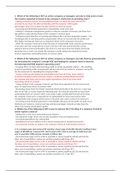
1. Which of the following is NOT an action company co-managers can take to help meet or beat the investor-expected increases in the company's stock price in upcoming years? - Making it company practice to issue additional shares of stock each year and use the proceeds to pay down the debt outstanding until the company's debt-equity percentages reach 20% or lower for debt and 80% or more for equity - Increasing annual dividend payments to shareholders most every year - Making it a frequent management practice to allocate a portion of internal cash flows from operations to repurchasing shares of the company's common stock - Putting increased attention on boosting operating profits in all four geographic regions -- the resulting growth in operating profits companywide will act to increase total net profits and EPS; higher earnings per share are an important driver of the company's stock price - When the company's stock price drops because of unexpectedly weak company performance in the prior year but is expected to recover and rise in the next several decision rounds. opting to borrow money preferably in the form of 1-year loans from the Global Community Bank (but not so much as to impair the company's credit rating) and using the borrowed funds to repurchase outstanding shares of common stock 2. Which of the following is NOT an action company co-managers can take that has good potential for increasing the company's average ROE and helping the company meet or beat the investorexpected ROE targets in upcoming years? - Pursuing efforts to boost total operating profits in all four geographic regions -- the resulting growth in operating profits companywide will increase total net profits (a company's net profits are the numerator in calculating the company's ROE) - Paying a small annual dividend to shareholders (less than $0.50 per share) which is increased annually by about $0.05 per shares; a small but growing dividend provides the company with more cash to fund capital expenditures and/or pay down bank borrowings ahead of schedule - Using a portion of the company's internal cash flows from operations for the next several years to repurchase shares of common stock - Borrowing money from the Global Community Bank (preferably in the form of a 1-year loan that can be fully or mostly repaid the following year) and using the proceeds to repurchase outstanding shares of common stock: such action makes considerable financial sense when the company's stock price is expected to rise substantially in future years and/or when unexpectedly weak company performance in the prior year causes a drop in its stock price - Increasing annual dividend payments to shareholders (because all net profits not paid out as dividends are treated as retained earnings and because bigger retained earnings have the effect of increasing shareholders equity) 3. Which one of the following is NOT a way to improve the P/Q rating of a company's brand of action-capture cameras? - Adding one or two more extra performance features - Increasing the image sensor size and the resolution of the LCD display screen - Increasing expenditures for camera R&D - Spending several more dollars on the camera housing and on included accessories - Increasing the number of models in the company's lineup of multi-featured cameras 4. If a company pays each camera PAT member a base wage of $21,000, thereby resulting in base wages of $84,000 per 4-person PAT, and if camera PATs work an average of 2,000 hours per year to assemble 3,000 cameras annually, it follows that - the hourly base wage cost for a PAT to assemble a camera would be $30.00 and that the labor cost of assembling a camera at overtime would be $60.00 per PAT. - the hourly base wage cost for a PAT to assemble a camera would be $28.00 and that the labor cost of assembling a camera at overtime would be $42.00 per PAT. - the hourly base wage cost for a PAT to assemble a camera would be $24.00 and that the labor cost of assembling a camera at overtime would be $36.00 per PAT. - the hourly base wage cost for a PAT to assemble a camera would be $10.50 and that the labor cost of assembling a camera at overtime would be $15.75 per PAT.
Información del documento
- Subido en
- 22 de febrero de 2021
- Número de páginas
- 23
- Escrito en
- 2020/2021
- Tipo
- Examen
- Contiene
- Preguntas y respuestas

