
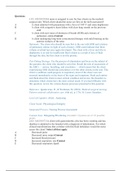
Hesi Exit Exam Module 10. Questions & Answers. With Rationale
1. ID: 4 A nurse is assigned to care for four clients on the medical-surgical unit. Which client should the nurse see first on the shift assessment? A A client admitted with pneumonia with a fever of 100° F and some diaphoresis B A client with congestive heart failure with clear lung sounds on the previous shift C A client with new-onset of shortness of breath (SOB) and a history of pulmonary edema Correct D A client undergoing long-term corticosteroid therapy with mild bruising on the anterior surfaces of the arms Rationale: The client who should be seen first is the one with SOB and a history of pulmonary edema. In light of such a history, SOB could indicate that fluid-volume overload has once again developed. The client with a fever and who is diaphoretic is at risk for insufficient fluid volume as a result of loss of fluid through the skin, but this client is not the priority. Test-Taking Strategy: Use the process of elimination and focus on the subject of the question, the client who should be seen first. Recall the rule of assessment of the ABCs — airway, breathing, and circulation — which means that the client experiencing SOB should take precedence over the other clients on the unit. This client’s condition could progress to respiratory arrest if the client were not assessed immediately on the basis of the signs and symptoms. Read each option and think about the client in most critical condition and review the disorders to determine which clients have the most critical needs. If you had difficulty with this question, review the various disease processes presented in this question. Reference: Ignatavicius, D., & Workman, M. (2010). Medical-surgical nursing: Patient-centered collaborative care. (6th ed., p. 176). St. Louis: Saunders. Level of Cognitive Ability: Analyzing Client Needs: Physiological Integrity Integrated Process: Nursing Process/Assessment Content Area: Delegating/Prioritizing Awarded 1.0 points out of 1.0 possible points.
Información del documento
- Subido en
- 18 de febrero de 2021
- Número de páginas
- 16
- Escrito en
- 2020/2021
- Tipo
- Examen
- Contiene
- Preguntas y respuestas

