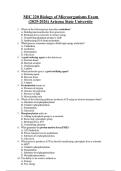
MIC 220 Biology of Microorganisms Exam () Arizona State University
MIC 220 Biology of Microorganisms Exam () Arizona State University 1. Which of the following best describes catabolism? A. Building macromolecules from precursors B. Breaking down molecules to release energy C. Transferring phosphate groups to ADP D. Synthesizing DNA from nucleotides 2. Which process consumes energy to build high-energy molecules? A. Catabolism B. Anabolism C. Fermentation D. Glycolysis 3. A good reducing agent is also known as: A. Electron donor B. Electron acceptor C. Oxidizing agent D. Catalyst 4. Which molecule type is a good oxidizing agent? A. Reducing agent B. Electron donor C. Electron acceptor D. Catalyst 5. Fermentation occurs in: A. Presence of oxygen B. Absence of respiration C. Presence of light D. Mitochondria only 6. Which of the following pathways produces ATP using an electron transport chain? A. Substrate-level phosphorylation B. Oxidative phosphorylation C. Fermentation D. Glycolysis 7. Phosphorylation refers to: A. Adding a phosphate group to a molecule B. Removing a phosphate group C. Breaking down ATP D. Transferring electrons 8. What generates the proton-motive force (PMF)? A. ATP hydrolysis B. Proton transport across membranes C. Substrate-level phosphorylation D. Glycolysis 9. Which process produces ATP by directly transferring a phosphate from a substrate to ADP? A. Oxidative phosphorylation B. Fermentation C. Substrate-level phosphorylation D. Photophosphorylation 10. The ability to do work is defined as: A. Entropy B. Free energy C. Enthalpy D. Energy 11. Entropy measures: A. Energy of motion B. Energy stored in bonds C. Disorder of a system D. Energy available to do work 12. A positive ΔG indicates: A. Spontaneous reaction B. Energy release C. Energy input required D. High entropy 13. An increase in ΔH means: A. Increase in enthalpy B. Decrease in energy C. Increase in disorder D. Decrease in entropy 14. A reducing agent: A. Accepts electrons B. Donates electrons C. Oxidizes other molecules D. Forms hydrogen bonds 15. An oxidizing agent: A. Donates electrons B. Accepts electrons C. Is always reduced D. Is a proton donor 16. In a redox half-reaction, what occurs? A. Both oxidation and reduction happen simultaneously B. Only oxidation or reduction occurs C. Energy is consumed D. ATP is hydrolyzed 17. The redox tower ranks: A. ATP yield from pathways B. Enzymes by activity C. Redox couples by reduction potential D. Membranes by permeability 18. The NAD⁺/NADH pair functions as: A. Proton donor B. Electron carrier C. Energy source D. Catalyst for glycolysis 19. Organisms obtaining energy from chemicals are: A. Phototrophs B. Chemotrophs C. Lithotrophs D. Autotrophs 20. Energy from light is used by: A. Phototrophs B. Chemotrophs C. Fermenters D. Anaerobes 21. Chemoorganotrophs use which type of chemicals for energy? A. Organic B. Inorganic C. Both D. Light 22. Chemolithotrophs use energy from: A. Light B. Organic carbon C. Inorganic compounds D. Oxygen 23. Aerobic respiration requires: A. Light B. Oxygen C. Sulfate D. CO₂ 24. Anaerobic respiration differs from aerobic because it: A. Uses CO₂ as the final electron acceptor B. Does not involve oxygen C. Does not generate ATP D. Uses light 25. Photoheterotrophs use: A. Light for energy and CO₂ for carbon B. Light for energy and organic carbon C. Chemicals for both energy and carbon D. Light only 26. Photoautotrophs: A. Use light and organic carbon B. Use light and fix CO₂ C. Use chemical energy only D. Rely on other organisms for nutrients 27. Glycolysis converts glucose into: A. Acetyl-CoA B. Pyruvate C. CO₂ D. Lactic acid 28. Glycolysis yields per glucose molecule: A. 4 ATP and 4 NADH B. 2 ATP and 2 NADH C. 1 ATP and 1 NADH D. 2 ATP and 4 NADH 29. The citric acid cycle fully oxidizes: A. Glucose B. Acetyl-CoA C. CO₂ D. NADH 30. In eukaryotes, the electron transport chain occurs in the: A. Cytoplasm B. Mitochondrial matrix C. Inner mitochondrial membrane D. Plasma membrane 31. The electrochemical potential across a membrane is established by: A. Enzyme activity B. Proton pumping C. Substrate-level phosphorylation D. ATP hydrolysis 32. The lipid bilayer primarily functions to: A. Produce ATP B. Regulate molecular transport C. Break down fatty acids D. Generate redox potential 33. ATP synthase uses what to generate ATP? A. PMF B. Substrate-level phosphorylation C. NADH oxidation directly D. Light energy 34. Homolactic fermentation produces: A. Ethanol and CO₂ B. Lactic acid only C. Acetate and formate D. Mixed acids 35. Ethanolic fermentation produces: A. 2 ethanol + 2 CO₂ B. 2 lactate C. 1 ethanol + 1 CO₂ D. 2 acetate 36. Heterolactic fermentation produces: A. 2 lactate B. Lactate, ethanol, and CO₂ C. Acetate and succinate D. Ethanol and formate 37. Mixed-acid fermentation can produce: A. Only lactic acid B. Acetate, formate, lactate, succinate, ethanol, H₂, CO₂ C. Pyruvate and ethanol D. CO₂ only 38. Prokaryotes differ from eukaryotes in that they: A. Have a nucleus B. Lack membrane-bound organelles C. Perform oxidative phosphorylation in mitochondria D. Have linear chromosomes 39. The mitochondrion evolved from: A. Viruses B. Archaea C. Bacteria D. Chloroplasts 40. Archaea differ from bacteria in their: A. Cell wall chemistry and membrane lipids B. Lack of ribosomes
Información del documento
- Subido en
- 7 de diciembre de 2025
- Número de páginas
- 25
- Escrito en
- 2025/2026
- Tipo
- Examen
- Contiene
- Preguntas y respuestas