Exam (elaborations) NUR2349
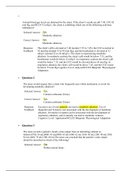
Arterial blood gas levels are obtained for the client. If the client’s results are pH 7.48, CO2 42 mm Hg, and HCO3 32 mEq/L, the client is exhibiting which one of the following acid-base imbalances? Selected Answer: D. Metabolic alkalosis Correct Answer: D. Metabolic alkalosis Response Feedback: The client’s pH is elevated at 7.48 (normal 7.35 to 7.45), the CO2 is normal at 42 mm Hg (normal 35 to 45 mm Hg), and the bicarbonate is elevated at 32 mEq/L (normal 22 to 26 mEq/L). The client is experiencing metabolic alkalosis. In metabolic acidosis the client’s pH would be below 7.35, and the bicarbonate would be below 22 mEq/L. In respiratory acidosis the client’s pH would be below 7.35, and the CO2 would be elevated above 45 mm Hg. In respiratory alkalosis the client’s pH would be above 7.45, and the CO2 would be below 35 mm Hg.Cognitive Level: analysisNCLEX Blueprint: Physiological Adaptation Question 2 The nurse would suspect that a client who frequently uses which medication is at risk for developing metabolic alkalosis? Selected Answer: A. Calcium carbonate (Tums) Correct Answer: A. Calcium carbonate (Tums) Response Feedback: Excessive use of oral antacids can lead to metabolic alkalosis. Use of ibuprofen and Tylenol is not associated with the development of metabolic alkalosis. Overdoses of aspirin can be associated with the development of respiratory alkalosis, and eventually can lead to metabolic acidosis. Cognitive Level: ApplicationNCLEX Blueprint: Physiological Adaptation Question 3 The nurse records a patient’s hourly urine output from an indwelling catheter as follows:0700: 36 mL0800: 45 mL0900: 85 mL1000: 62 mL1100: 50 mL1200: 48 mL1300: 94 mL1400: 78 mL1500: 60 mLThe nurse can conclude that the patient’s urine output should be described as which of the following? Selected Answer: B. Within normal limits Correct Answer: B. Within normal limits Response Feedback: Urine accounts for the greatest amount of fluid loss. Normal urine output for an average-sized adult is approximately 1,500 mL in 24 hr. Urine output varies according to intake and activity but should remain at least 30 to 50 mL per hour. The patient’s urine output is within the normal range. This patient has an indwelling catheter, which will result in continual flow of urine.Cognitive level: analysisNCLEX Blueprint: basic care and comfort Question 4 A client is admitted with severe diarrhea. Arterial blood gas (ABG) results are pH 7.33; PaCO 2 42; HCO 3 – 20. The nurse concludes this client has which acid–base imbalance? Selected Answer: A. Uncompensated metabolic acidosis Correct Answer: A. Uncompensated metabolic acidosis Response Feedback: The pH and HCO3– are decreased, indicating metabolic acidosis. The PaCO2 is normal, indicating that compensatory mechanisms have not started working. Compensated or uncompensated respiratory acidosis is incorrect because the primary disturbance is metabolic, as indicated by the low bicarbonate level. Compensated metabolic acidosis is incorrect because with compensation, a decrease in PaCO2 to restore balance would be expected. Cognitive Level: AnalyzingNCLEX Blueprint: Physiological Adaptation Question 5 Identify the appropriate intervention(s) for a patient with hypovolemia. Choose all that apply. B. Monitor I&O daily. C. Encourage fluid intake. D. Monitor electrolyte balance. Correct Answers: B. Monitor I&O daily. C. Encourage fluid intake. D. Monitor electrolyte balance. Response Feedback: Hypovolemia occurs when more fluid is lost than is taken into the body. Monitoring I&O provides information to evaluate the status of the problem. Encouraging fluid intake helps to correct the problem. It is good to monitor electrolytes because electrolyte imbalance can occur with hypovolemia (although it may not occur at first). Deep-breathing techniques do not address fluid balance; there is no evidence that the patient has a respiratory disorder.Cognitive level: ApplicationNCLEX Blueprint: physiological adaptation Question 6 While caring for a patient preparing for a kidney transplant, the nurse knows that the patient understands teaching on immunosuppression when she states which of the following? Selected Answer: C. "The medications that I take will help prevent my body from attacking my new kidney." Correct Answer: C. "The medications that I take will help prevent my body from attacking my new kidney." Response Feedback: Immunosuppressant therapy is initiated to inhibit optimal immune response. This is necessary in the case of transplantation, because the normal immune response would cause the body to recognize the new tissue as foreign and attack it. The body will identify the new kidney as foreign and will not treat it as the original kidney. While patients with transplants must be careful about exposure to others, especially those who are or might be ill, and practice adequate and consistent infection control techniques, they don't have to avoid people or social interaction. The new kidney brings foreign cells regardless of relationship between donor and recipient.Cognitive Level: ApplicationNCLEX Blueprint: Health promotion and Maintenance Question 7 The nurse assessed four patients at the beginning of the shift. Which finding should the nurse report most urgently to the physician? Selected Answer: A. Swollen ankles in patient with compensated heart failure Correct Answer: B. Positive Chvostek's sign in patient with acute pancreatitis Response Feedback: Positive Chvostek's sign indicates increased neuromuscular excitability, which can progress to dangerous laryngospasm or seizures and thus needs to be reported first. The other assessment findings are less urgent and need further assessment. Bilateral ankle edema is a sign of ECV excess, and follow-up is needed, but the situation is not immediately life-threatening. Dry mucous membranes in a patient taking a diuretic may be associated with ECV deficit; however, additional assessments of ECV deficit are required before reporting to the physician. Constipation has many causes, including hypercalcemia and opioid analgesics, and it needs action, but not as urgently as a positive Chvostek's sign.Cognitive level: applicationNCLEX Blueprint: reduction of risk potential Question 8 The nurse is completing a physical assessment with a client. Which of the following findings could be caused by impaired immune function in the client? Selected Answer: C. Leg rash Correct Answer: C. Leg rash Response Feedback: Of the assessment findings provided, leg rash could be caused by impaired immune function in the client. Jugular vein distention, neck pain, and hip pain would most likely have another cause.Cognitive Level: AnalysisNCLEX Blueprint: Physiological Adaptation
Información del documento
- Subido en
- 10 de febrero de 2021
- Número de páginas
- 24
- Escrito en
- 2020/2021
- Tipo
- Examen
- Contiene
- Preguntas y respuestas