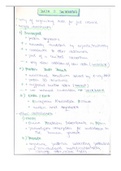
Introduction to MAS
Agent
- Sensors (to perceive) policy (agent program) actuators (to act)
- Autonomous Decision making relying on own perception instead of prior knowledge
- Rational optimize appropriate performance measures
Multi-agent system = ABM = Distributed AI
- Agents + environment
- Collective behavior > sum of individual behaviors
Characteristics of MAS
1. Agent design physical vs programmatic, heterogeneous vs homogeneous
2. Environment dynamic vs static
3. Perception distributed (spatially, temporally or semantically), partial observability,
sensor fusion
4. Control decentralized (efficient + robust), some coordination still needed
5. Knowledge different levels of common knowledge for different agetns
6. Communication two-way, can be coordination among cooperative agents/negotiation
among self-interested agents, what network protocols and language to use
Agent types
- Simple reflex agents
- Model-based reflex agents
- Goal-based agents
- Utility-based agents
- Learning agents
Why MAS in social science?
- Society as dynamical and complex system Behavior of the system as a whole cannot
be determined by decomposing the system and understanding the behavior of each part of
it
- Path dependence + non-linear interactions of individuals emergence (social
institutions and phenomena at a system level that arise from but are not specifically
encoded in the units of society at an individual level)
- Deductive approach 6 cost of data collection
- Impossible/unethical social stimulation
How to develop good ABM
- Validation parameters reflect statistical properties of observed behaviors
- Workflow: setting objective / RQ building a simple model conducting theoretical
research & making assumptions, designing stimulation by defining objects, attributes,
environment & dynamics setting up user interface unit testing & debugging
, Agent Decisions; Modelling social sciences
Policy
- Memory-expensive
memory space + computational cost (intractability)
- Memoryless policy reflex agent
Markov property: the world for the current state provides a complete characterization of
the history before the current time, i.e. predictions based on current state only
Rational decision in a Markov world maximize expected utility/get optimal Q-value
Utility =/= payoff
Factors:
- Fully vs partially observable noise, perceptual aliasing (e.g. two doors in the same
corridor look the same to a sensor)
- Deterministic vs stochastic state-action pairs to single new states vs probability
distribution over states | goals & planning vs utilities and preferences
Game Theory
Premises:
1. Rational agents
2. Strategic reasoning also consider other agents’ decisions
Strategic game
- Single-shot game act simultaneously and independently
- Strictly competitive, zero-sum
- Fixed, fully observable world state common knowledge shared by all agents
(know the existence, action sets and payoffs of each other)
Extensive game (⨉ discussed in this course)
- Can change their actions throughout the game
Principles for strategic games:
1. Iterated Elimination of Strictly Dominated Actions (IESDA)
- ai is strictly dominated by ai’: if a-i = cooperate / defect u(ai’,a-i) > u(ai,a-i)?
- Eliminate strictly dominated actions until no more actions are strictly dominated
consider one agent at a time
Agent
- Sensors (to perceive) policy (agent program) actuators (to act)
- Autonomous Decision making relying on own perception instead of prior knowledge
- Rational optimize appropriate performance measures
Multi-agent system = ABM = Distributed AI
- Agents + environment
- Collective behavior > sum of individual behaviors
Characteristics of MAS
1. Agent design physical vs programmatic, heterogeneous vs homogeneous
2. Environment dynamic vs static
3. Perception distributed (spatially, temporally or semantically), partial observability,
sensor fusion
4. Control decentralized (efficient + robust), some coordination still needed
5. Knowledge different levels of common knowledge for different agetns
6. Communication two-way, can be coordination among cooperative agents/negotiation
among self-interested agents, what network protocols and language to use
Agent types
- Simple reflex agents
- Model-based reflex agents
- Goal-based agents
- Utility-based agents
- Learning agents
Why MAS in social science?
- Society as dynamical and complex system Behavior of the system as a whole cannot
be determined by decomposing the system and understanding the behavior of each part of
it
- Path dependence + non-linear interactions of individuals emergence (social
institutions and phenomena at a system level that arise from but are not specifically
encoded in the units of society at an individual level)
- Deductive approach 6 cost of data collection
- Impossible/unethical social stimulation
How to develop good ABM
- Validation parameters reflect statistical properties of observed behaviors
- Workflow: setting objective / RQ building a simple model conducting theoretical
research & making assumptions, designing stimulation by defining objects, attributes,
environment & dynamics setting up user interface unit testing & debugging
, Agent Decisions; Modelling social sciences
Policy
- Memory-expensive
memory space + computational cost (intractability)
- Memoryless policy reflex agent
Markov property: the world for the current state provides a complete characterization of
the history before the current time, i.e. predictions based on current state only
Rational decision in a Markov world maximize expected utility/get optimal Q-value
Utility =/= payoff
Factors:
- Fully vs partially observable noise, perceptual aliasing (e.g. two doors in the same
corridor look the same to a sensor)
- Deterministic vs stochastic state-action pairs to single new states vs probability
distribution over states | goals & planning vs utilities and preferences
Game Theory
Premises:
1. Rational agents
2. Strategic reasoning also consider other agents’ decisions
Strategic game
- Single-shot game act simultaneously and independently
- Strictly competitive, zero-sum
- Fixed, fully observable world state common knowledge shared by all agents
(know the existence, action sets and payoffs of each other)
Extensive game (⨉ discussed in this course)
- Can change their actions throughout the game
Principles for strategic games:
1. Iterated Elimination of Strictly Dominated Actions (IESDA)
- ai is strictly dominated by ai’: if a-i = cooperate / defect u(ai’,a-i) > u(ai,a-i)?
- Eliminate strictly dominated actions until no more actions are strictly dominated
consider one agent at a time