

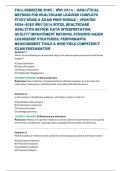
Fall SemeSter 2025 | WGU D514 – analytical
methoDS For healthcare leaDerS complete
StUDy GUiDe & exam prep BUnDle | UpDateD
2024–2025 WGU D514 noteS, healthcare
analyticS revieW, Data interpretation,
QUality improvement methoDS, eviDence-BaSeD
leaDerShip StrateGieS, perFormance
meaSUrement toolS & hiGh-yielD competency
exam preparation
Question 1:
Which of the following is an essential step in the data analysis process for healthcare
leaders?
A) Data Collection
B) Policy Formation
C) Resource Allocation
D) Stakeholder Engagement
CORRECT ANSWER: A) Data Collection
Rationale: Data collection is fundamental for effective analysis, as it provides the
information necessary to identify trends and make informed decisions.
Question 2:
In the context of healthcare analytics, what does "metrics" refer to?
A) Qualitative data analysis
B) Performance indicators
C) Financial models
D) Strategic planning
CORRECT ANSWER: B) Performance indicators
Rationale: Metrics are specific measures used to assess the performance and quality
of services in healthcare, helping leaders to gauge effectiveness and efficiency.
Question 3:
Which analytical method is best suited for predicting future patient admission rates?
A) Descriptive Statistics
B) Predictive Analytics
C) Qualitative Analysis
D) Financial Analysis
,CORRECT ANSWER: B) Predictive Analytics
Rationale: Predictive analytics utilizes historical data and statistical algorithms to
forecast future outcomes, such as patient admission rates.
Question 4:
What is the primary benefit of using a balanced scorecard in healthcare management?
A) It emphasizes financial performance exclusively.
B) It provides a single perspective on organizational performance.
C) It helps align business activities to the vision and strategy of the organization.
D) It focuses solely on customer satisfaction.
CORRECT ANSWER: C) It helps align business activities to the vision and strategy of
the organization.
Rationale: The balanced scorecard integrates various performance measures, ensuring
that all aspects of organizational performance align with strategic goals.
Question 5:
What is the significance of regression analysis in healthcare?
A) Increases patient satisfaction directly.
B) Helps identify relationships between variables.
C) Minimizes costs in healthcare operations.
D) Measures patient compliance accurately.
CORRECT ANSWER: B) Helps identify relationships between variables.
Rationale: Regression analysis is used to examine the relationship between dependent
and independent variables, aiding in understanding how various factors affect
healthcare outcomes.
Question 6:
What is the primary goal of healthcare informatics?
A) To reduce healthcare costs
B) To improve the quality of patient care
C) To enhance marketing strategies
D) To comply with regulations
CORRECT ANSWER: B) To improve the quality of patient care
Rationale: Healthcare informatics aims to improve patient care by optimizing the use of
information technology.
, Question 7:
Which analytical method focuses on understanding the reasons behind patient
outcomes?
A) Quantitative Analysis
B) Qualitative Analysis
C) Financial Analysis
D) Trend Analysis
CORRECT ANSWER: B) Qualitative Analysis
Rationale: Qualitative analysis seeks to understand the underlying reasons and
motivations affecting patient outcomes.
Question 8:
What does "descriptive statistics" primarily help healthcare leaders to do?
A) Predict future trends
B) Evaluate financial forecasts
C) Summarize and describe data
D) Allocate resources efficiently
CORRECT ANSWER: C) Summarize and describe data
Rationale: Descriptive statistics help summarize data sets, making it easier to
understand patterns and trends in healthcare.
Question 9:
Which of the following is NOT a component of the Triple Aim in healthcare?
A) Improving patient experience
B) Reducing costs
C) Enhancing employee satisfaction
D) Improving population health
CORRECT ANSWER: C) Enhancing employee satisfaction
Rationale: The Triple Aim focuses on patient experience, cost reduction, and
population health, while employee satisfaction is not a primary focus.
Question 10:
What is the primary function of a healthcare dashboard?
A) To manage human resources
B) To provide real-time data visualization
C) To conduct financial audits
D) To develop strategic plans
methoDS For healthcare leaDerS complete
StUDy GUiDe & exam prep BUnDle | UpDateD
2024–2025 WGU D514 noteS, healthcare
analyticS revieW, Data interpretation,
QUality improvement methoDS, eviDence-BaSeD
leaDerShip StrateGieS, perFormance
meaSUrement toolS & hiGh-yielD competency
exam preparation
Question 1:
Which of the following is an essential step in the data analysis process for healthcare
leaders?
A) Data Collection
B) Policy Formation
C) Resource Allocation
D) Stakeholder Engagement
CORRECT ANSWER: A) Data Collection
Rationale: Data collection is fundamental for effective analysis, as it provides the
information necessary to identify trends and make informed decisions.
Question 2:
In the context of healthcare analytics, what does "metrics" refer to?
A) Qualitative data analysis
B) Performance indicators
C) Financial models
D) Strategic planning
CORRECT ANSWER: B) Performance indicators
Rationale: Metrics are specific measures used to assess the performance and quality
of services in healthcare, helping leaders to gauge effectiveness and efficiency.
Question 3:
Which analytical method is best suited for predicting future patient admission rates?
A) Descriptive Statistics
B) Predictive Analytics
C) Qualitative Analysis
D) Financial Analysis
,CORRECT ANSWER: B) Predictive Analytics
Rationale: Predictive analytics utilizes historical data and statistical algorithms to
forecast future outcomes, such as patient admission rates.
Question 4:
What is the primary benefit of using a balanced scorecard in healthcare management?
A) It emphasizes financial performance exclusively.
B) It provides a single perspective on organizational performance.
C) It helps align business activities to the vision and strategy of the organization.
D) It focuses solely on customer satisfaction.
CORRECT ANSWER: C) It helps align business activities to the vision and strategy of
the organization.
Rationale: The balanced scorecard integrates various performance measures, ensuring
that all aspects of organizational performance align with strategic goals.
Question 5:
What is the significance of regression analysis in healthcare?
A) Increases patient satisfaction directly.
B) Helps identify relationships between variables.
C) Minimizes costs in healthcare operations.
D) Measures patient compliance accurately.
CORRECT ANSWER: B) Helps identify relationships between variables.
Rationale: Regression analysis is used to examine the relationship between dependent
and independent variables, aiding in understanding how various factors affect
healthcare outcomes.
Question 6:
What is the primary goal of healthcare informatics?
A) To reduce healthcare costs
B) To improve the quality of patient care
C) To enhance marketing strategies
D) To comply with regulations
CORRECT ANSWER: B) To improve the quality of patient care
Rationale: Healthcare informatics aims to improve patient care by optimizing the use of
information technology.
, Question 7:
Which analytical method focuses on understanding the reasons behind patient
outcomes?
A) Quantitative Analysis
B) Qualitative Analysis
C) Financial Analysis
D) Trend Analysis
CORRECT ANSWER: B) Qualitative Analysis
Rationale: Qualitative analysis seeks to understand the underlying reasons and
motivations affecting patient outcomes.
Question 8:
What does "descriptive statistics" primarily help healthcare leaders to do?
A) Predict future trends
B) Evaluate financial forecasts
C) Summarize and describe data
D) Allocate resources efficiently
CORRECT ANSWER: C) Summarize and describe data
Rationale: Descriptive statistics help summarize data sets, making it easier to
understand patterns and trends in healthcare.
Question 9:
Which of the following is NOT a component of the Triple Aim in healthcare?
A) Improving patient experience
B) Reducing costs
C) Enhancing employee satisfaction
D) Improving population health
CORRECT ANSWER: C) Enhancing employee satisfaction
Rationale: The Triple Aim focuses on patient experience, cost reduction, and
population health, while employee satisfaction is not a primary focus.
Question 10:
What is the primary function of a healthcare dashboard?
A) To manage human resources
B) To provide real-time data visualization
C) To conduct financial audits
D) To develop strategic plans

