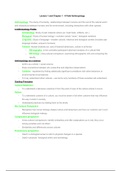
Lecture 1 and Chapter 1 - 4 Field Anthropology
Anthropology: The study of humanity, relationships between humans and the rest of the natural world
and interactions between humans and the environment, including interactions with other species.
4 Anthropology Fields:
Archaeology: Study of past material culture (ex. fossil fuels, artifacts, etc.)
Biological: Study of human biology + evolution (study “races”, biological variation)
Linguistic: Study of language - broader cultural, historical and biological context (includes ape
language studies, unique to humans)
Cultural: Human diversity (ex. sets of learned behaviours, culture in all forms)
- Ethnography: is the controlled participant-observant analysis of a cultural field
- Ethnology: cross-cultural comparison, examining ethnographic info and comparing the
results.
Anthropology as a science
- Anthro as a whole = social science
- Draw connections between etic (value-free and objective) observations
- Customs - explained by finding statistically significant correlations with other behaviors or
environmental circumstances
- To truly understand other cultures - use terms only members of those societies will understand
Guiding Principles
Cultural Relativism:
- To understand a behaviour examine it from the point of view of the culture where it occurs
Holism
- To understand customs of a culture, you must be aware of all other customs that may influence
the way it works in society.
- Understand practices by relating them to the whole.
Bio-Cultural Perspective
- Recognize how human biology shapes culture and behaviours and how our customs can in-turn
influence biological makeup.
Comparative perspective
- Cross-cultural comparisons: identify similarities and offer explanations as to why they occur
among societies and not others
- Similarities and differences across cultures
Evolutionary perspective
- Used in a biological sense to refer to physical changes in a species
- Used in physical / biological anthro and archeology
, Lecture 2 and Chapter 2 - Evolutionary Theory
Middle Ages (10th-15th century)
Mindset of the people
- Everything was present since creation and nothing could be added or removed (so no new
species/evolution and no extinction fixity of species)
- God was perfect and he created a perfect world
- Concept of change was inconceivable
The Great Chain of Being
- Created by Aristotle
- Hierarchical structure that included everything from god to animals
Hypotheses about environmental and biological change could not be created due to no proof
Age of Discovery (15th-18th Century)
- Discovered the world was not "fixed"
- Fossils or proof of life before god was written off as remains of animals in Noah's ark flood
- Nicholas Steno and John Ray tried to make sense of the fossils and concluded that the earth was
very old and some fossils were before Noah's flood
John Ray (1627-1705)
- First person to produce a biological definition of species
- First person to use genus
Nicholas Steno (1638-1686)
- Theorized/discovered that fossils and crystals must have solidified before their host rock had
been formed
Age of Reason (18th-19th Century)
- Balanced science and religion by using "natural philosophy"
- Carolus Linnaues (1707- 1778) organized species into hierarchical series, ranked on distance
from perfection of the divine
- Classified humans into categories, recognized 4 human races: Americanus, Asiaticus,
Africanus & Europeans
- Known as the father of taxonomy
- Binomial taxonomy: in 1735 he assigned Latin tags to every animal and plant
- Hugh Falconer, examie stone tools, was convinced they were older than 4004yrs
- Sir Charles Lyell, book acknowledging prehistory
Geology
Comte de Buffon
- Suggested Earth had been shaped over millions of yrs by natural processes
James Hutton
- Described the earth as a decaying and self-renewing machine