

Escrito por estudiantes que aprobaron Inmediatamente disponible después del pago Leer en línea o como PDF ¿Documento equivocado? Cámbialo gratis 4,6 TrustPilot
logo-home
Document preview thumbnail
Vista previa 2 fuera de 7 páginas
Examen

Biology 115 Midterm Exam 2025

Document preview thumbnail
Vista previa 2 fuera de 7 páginas

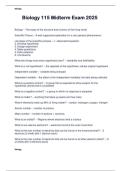
Biology 115 Midterm Exam 2025 Biology - -The study of the structure and function of the living world Scientific Theory - -A well supported explanation for a very general phenomenon List steps of the scientific process - -1. observation/question 2. Develop hypothesis 3. Design experiment 4. Make predictions 5. Data collection 6. Conclusions What two things must every hypothesis have? - -testability and falsifiability What is a null hypothesis? - -the opposite of the hypothesis; refutes original hypothesis Independent variable - -variable being changed Dependent variable - -the effect of the independent variables; the data being collected What is a positive control? - -A group that is expected to show support for the hypothesis (shows that it is possible) What is a negative control? - -a group in which no response is expected What is matter? - -anything that takes up space and has mass What 4 elements make up 96% of living matter? - -carbon, hydrogen, oxygen, nitrogen Atomic number - -number of protons Mass number - -number of protons + neutrons What is an orbital? - -Regions where electrons orbit a nucleus What is are valence electrons? - -electrons found at the outer-most shell What is the max number of electrons that can be found on the innermost shell? - -2 electrons (2 shells with 1 electron each) What is the max number of electrons that can be found on all other electron shells? - -8 (2 shells with 4 electrons each) Biology Biology Biology What is a covalent bond? - -When atoms share electrons What is a non-polar covalent bond? - -electrons are shared equally. They are hydrophobic because of this. What is a polar covalent bond? - -electrons are not shared equally. creates partial charges on atoms. What is an ionic bond? - -complete transfer of electrons Cation - -positively charged ion due to loss of electrons Anion - -negatively charged ion due to gaining electrons What is a hydrogen bond? - -A weak bond formed by the partial charges of polar molecules Why does water expand as it freezes? - -Lower temperature forces the hydrogen bonds to become stable, which pushes the water molecules farther apart from each other than when in a liquid state. How does cohesion and adhesion of water form a meniscus when in a tube? - Adhesion bonds the molecules to the sides of the container, while cohesion pulls the middle of the water to the bottom. What is pH? - -the "potential of hydrogen", or the measurement of the concentrations of H+ ions in a liquid What is a condensation reaction? - -A covalent bond between monomers that produces a water molecule. What is hydrolysis? - -Separation of monomers by adding a water molecule What is the monomer of proteins? - -amino acids What are the 6 functions of proteins? - -enzymes, transportation, structure, signaling, antibodies, and movement What is an example of how proteins transport things? - -hemoglobin transports oxygen; sodium-potassium pump What are the main components of the structure of an amino acid? - -A central carbon, an amino group, a carboxyl group, and the R side chain What is the significance of the R group in amino acids? - -It determines which of the 20 amino acids it will be, as well as its properties, like charge and polarity. Biology Biology What is the N-terminus and C-terminus? - -The N terminus is the end with the amino group, and the C-terminus is the end with the carboxyl group. What is a peptide bond? - -a covalent bond between the N and C terminus of 2 amino acids What is the difference in a peptide and a polypeptide? - -a peptide has less than 50 amino acids, and a polypeptide has more than 50 amino acids. What is the monomer of a nucleic acid? - -nucleotide What is the function of DNA? - -stores genetic information What is the function of RNA? - -It copies information from DNA and uses it to make proteins. What are the 3 components of a nucleotide? - -sugar, phosphate, nitrogenous base What is the difference in the sugars of DNA and RNA? - -DNA has deoxyribose and RNA has ribose. deoxyribose has one less oxygen atom than ribose. What nitrogenous bases does DNA contain? - -A, G, C, and T. (adenine, guanine, cytosine, and thymine) What nitrogenous bases does RNA have? - -A, G, C, and U. (adenine, guanine, cytosine, and uracil) Which end of a nucleotide is the 3' end and which is the 5' end? - -3' end is the sugar, and the 5' end is the phosphate What is a phosphodiester bond? - -covalent bond between the 3' and 5' ends of nucleotides What causes DNA to be double stranded? - -hydrogen bonds between cytosine & guanine and adenine and thymine. What are 3 functions of carbohydrates? - -energy storage, structure, cell identity What forms of energy storage do plants and animals use? - -plants use starch, and animals use glycogen What is the monomer of a carbohydrate? - -monosaccharides Biology Biology What is the difference between an aldose sugar and a ketose sugar - -aldose sugars have a carbonyl group attached to the end of the chain, and ketose sugars have the carbonyl group attached to an interior C What type of bond do carbohydrates have? - -glycosidic bond What makes lipids hydrophobic? - -the high number of hydrocarbon bonds, which have no partial charges What is the monomer of lipids? - -glycerol and fatty acids What is a saturated fat? - -contains only single bonds in hydrocarbon chains. What is an unsaturated fat? - -the fatty acid chains contain one or more double bonds between H-C What type of bond bonds lipids together? - -Ester bonds What is the primary structure of a protein? - -the sequence of amino acids What makes up the secondary structure of proteins? - -hydrogen bonds forming between amino acids, forming alpha helices and beta pleated sheets. What is the tertiary structure of a protein? - -The whole 3-D model of the protein, formed by folding of the chain, caused by hydrogen bonds, ionic bonds, and hydrophobic effects. What is the quaternary structure of a protein? - -two or more polypeptide chains joined to form a larger protein What is denaturation of a protein and how can it happen? - -when it loses its shape or structure. can be caused by changes in pH or increasing temperature. What is a prion? - -improperly folded proteins that cause infectious diseases (like mad cow disease) What is a substrate? - -a reactant substance that bonds to an enzyme How do enzymatic reactions work? - -a substrate binds to a specific active site on the enzyme, a chemical change occurs, then the products are released. Enzyme remains unchanged. What is competitive inhibition? - -a substance competes for the active site of the enzyme, so it lowers the amount of substrate that bonds to the enzyme. Biology Biology What is non-competitive inhibition? - -a substance binds to an enzyme not on the active site, and changes the shape of the enzyme, which deactivates it. What is feedback inhibition? - -The products of a reaction allosterically bind to the enzyme to deactivate the reactions. What 2 types of starch do plants use as energy storage? - -amylose and amylopectin Whats the structural difference between amylose and amylopectin? - -amylose is unbranched; amylopectin is slightly branched. What is the structure of glycogen? - -a highly branched molecule What types of carbohydrates does plants, fungi, and bacteria use as structural support? - -plants use cellulose, fungi uses chitin, and bacteria uses peptidoglycan What are the main differences between DNA and RNA? - -type of sugar, types of nitrogenous bases, and the number of strands What is the primary structure of DNA and RNA? - -the long sequence of nucleotides What is the secondary structure of DNA? - -the double helix What is the secondary structure of RNA? - -loops and helices called "stems" Who was the original researcher who discovered the structure of DNA? - -rosalind franklin, who's work was stolen by watson and crick What does ATP stand for? - -adenosine triphosphate How does ATP create energy? - -breaking off phosphate groups by hydrolysis releases energy What can the phosphates that break off from ATP do? - -they can be used as allosteric inhibitors (or activators) of enzymes. What makes up the head of a phospholipid? - -choline, phosphate, and glycerol Which part of a phospholipid is hydrophobic? - -the fatty acid tails What is a micelle? - -A sphere 1 layer of phospholipids thick that contain no water on the inside. What is a liposome? - -A phospholipid bilayer that contains water on the inside.

Vista previa del contenido

Biology


Biology 115 Midterm Exam 2025

Biology - -The study of the structure and function of the living world

Scientific Theory - -A well supported explanation for a very general phenomenon

List steps of the scientific process - -1. observation/question
2. Develop hypothesis
3. Design experiment
4. Make predictions
5. Data collection
6. Conclusions

What two things must every hypothesis have? - -testability and falsifiability

What is a null hypothesis? - -the opposite of the hypothesis; refutes original hypothesis

Independent variable - -variable being changed

Dependent variable - -the effect of the independent variables; the data being collected

What is a positive control? - -A group that is expected to show support for the
hypothesis (shows that it is possible)

What is a negative control? - -a group in which no response is expected

What is matter? - -anything that takes up space and has mass

What 4 elements make up 96% of living matter? - -carbon, hydrogen, oxygen, nitrogen

Atomic number - -number of protons

Mass number - -number of protons + neutrons

What is an orbital? - -Regions where electrons orbit a nucleus

What is are valence electrons? - -electrons found at the outer-most shell

What is the max number of electrons that can be found on the innermost shell? - -2
electrons (2 shells with 1 electron each)

What is the max number of electrons that can be found on all other electron shells? - -8
(2 shells with 4 electrons each)


Biology

, Biology


What is a covalent bond? - -When atoms share electrons

What is a non-polar covalent bond? - -electrons are shared equally. They are
hydrophobic because of this.

What is a polar covalent bond? - -electrons are not shared equally. creates partial
charges on atoms.

What is an ionic bond? - -complete transfer of electrons

Cation - -positively charged ion due to loss of electrons

Anion - -negatively charged ion due to gaining electrons

What is a hydrogen bond? - -A weak bond formed by the partial charges of polar
molecules

Why does water expand as it freezes? - -Lower temperature forces the hydrogen bonds
to become stable, which pushes the water molecules farther apart from each other than
when in a liquid state.

How does cohesion and adhesion of water form a meniscus when in a tube? - -
Adhesion bonds the molecules to the sides of the container, while cohesion pulls the
middle of the water to the bottom.

What is pH? - -the "potential of hydrogen", or the measurement of the concentrations of
H+ ions in a liquid

What is a condensation reaction? - -A covalent bond between monomers that produces
a water molecule.

What is hydrolysis? - -Separation of monomers by adding a water molecule

What is the monomer of proteins? - -amino acids

What are the 6 functions of proteins? - -enzymes, transportation, structure, signaling,
antibodies, and movement

What is an example of how proteins transport things? - -hemoglobin transports oxygen;
sodium-potassium pump

What are the main components of the structure of an amino acid? - -A central carbon,
an amino group, a carboxyl group, and the R side chain

What is the significance of the R group in amino acids? - -It determines which of the 20
amino acids it will be, as well as its properties, like charge and polarity.

Biology

Información del documento

Subido en
22 de noviembre de 2025
Número de páginas
7
Escrito en
2025/2026
Tipo
Examen
Contiene
Preguntas y respuestas
$25.29

¿Documento equivocado? Cámbialo gratis Dentro de los 14 días posteriores a la compra y antes de descargarlo, puedes elegir otro documento. Puedes gastar el importe de nuevo.
Escrito por estudiantes que aprobaron
Inmediatamente disponible después del pago
Leer en línea o como PDF

Seller avatar
Los indicadores de reputación están sujetos a la cantidad de artículos vendidos por una tarifa y las reseñas que ha recibido por esos documentos. Hay tres niveles: Bronce, Plata y Oro. Cuanto mayor reputación, más podrás confiar en la calidad del trabajo del vendedor.
AlexScorer
2.5
(2)
Vendido
11
Seguidores
0
Artículos
1800
Última venta
2 semanas hace


Por qué los estudiantes eligen Stuvia

Creado por compañeros estudiantes, verificado por reseñas

Calidad en la que puedes confiar: escrito por estudiantes que aprobaron y evaluado por otros que han usado estos resúmenes.

¿No estás satisfecho? Elige otro documento

¡No te preocupes! Puedes elegir directamente otro documento que se ajuste mejor a lo que buscas.

Paga como quieras, empieza a estudiar al instante

Sin suscripción, sin compromisos. Paga como estés acostumbrado con tarjeta de crédito y descarga tu documento PDF inmediatamente.

Student with book image

“Comprado, descargado y aprobado. Así de fácil puede ser.”

Alisha Student

Preguntas frecuentes