100% de satisfacción garantizada Inmediatamente disponible después del pago Tanto en línea como en PDF No estas atado a nada 4,6 TrustPilot
logo-home
Examen

WVU BIO 115 FINAL EXAM 2025

Puntuación
-
Vendido
-
Páginas
14
Grado
A+
Subido en
22-11-2025
Escrito en
2025/2026

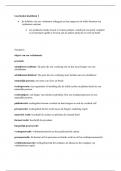
WVU BIO 115 FINAL EXAM 2025 Scientific theory - -a well-tested concept that explains a wide range of observations. - can be revised when new scientific evidence is introduced Spontaneous generation hypothesis - -Hypothesis stating that life could arise from nonliving matter. All-cells-from-cells hypothesis - -cells are produced only when preexisting cells grow and divide Louis Pasteur – -A French chemist, this man discovered that heat could kill bacteria that otherwise spoiled liquids including milk, wine, and beer. - straight neck flask ended up with cells growing. - swan neck flask had no cells due to blockage from condensation. Alternative hypothesis - -The hypothesis that states there is a difference between two or more sets of data. Null hypothesis - -the hypothesis that there is no significant difference between specified populations, any observed difference being due to sampling or experimental error. experimental group - -In an experiment, the group that is exposed to the treatment, that is, to one version of the independent variable. control group - -In an experiment, the group that is not exposed to the treatment; contrasts with the experimental group and serves as a comparison for evaluating the effect of the treatment. independent variable - -The experimental factor that is manipulated; the variable whose effect is being studied. dependent variable - -The outcome factor; the variable that may change in response to manipulations of the independent variable. Matter - -Anything that has mass and takes up space Element - -A pure substance made of only one kind of atom; cannot be broken down further What 4 elements make up 96% of the human body? - -oxygen, carbon, hydrogen, nitrogen Biology Compound - -A substance made up of atoms of two or more different elements joined by chemical bonds Protons - -Positively charged particles Neutrons - -the particles of the nucleus that have no charge Electrons - -Negatively charged particles atomic number - -the number of protons in the nucleus of an atom mass number - -the sum of the number of neutrons and protons in an atomic nucleus Orbital - -where electrons move around a nucleus electron shell - -an energy level of electrons at a characteristic average distance from the nucleus of an atom valence electrons - -Electrons on the outermost energy level of an atom covalent bond - -A chemical bond that involves sharing a pair of electrons between atoms in a molecule polar covalent bond - -A covalent bond in which electrons are not shared equally nonpolar covalent bond - -a covalent bond in which the electrons are shared equally by the two atoms ionic bond - -Formed when one or more electrons are transferred from one atom to another Cation - -A positively charged ion Anion - -A negatively charged ion hydrogen bond - -weak attraction between a hydrogen atom and another atom What are the properties of water? - -cohesion, adhesion, high specific heat, high heat of vaporization, less dense as a solid Prions - -infectious protein particles that do not have a genome Enzymes - -Catalysts for chemical reactions in living things; lowers activation energy. Biology Biology Biology if you wanted to slow down or stop an enzymatic reaction, what could you do? - -change pH and raise temperature to denature the protein. Competitive inhibitors - -bind to the active site of an enzyme, competing with the substrate ex: medications, drugs, alcohol. Allosteric inhibitor - -changes shape of enzyme so it cannot bind to substrate; reaction will not take place. Allosteric activator - -kick out allosteric inhibitors so the active site can accept the substrate, allowing the reaction to take place. Increasing the substrate concentration in an enzymatic reaction could overcome which of the following? - -competitive inhibition Condensation reaction - -monomers link to form polymers through a chemical reaction of covalent bonds. also called dehydration reactions. Hydrolysis - -2 monomers are separated by a water molecule proteins - -Chains of amino acids functions of proteins - --metabolism, -transportation -structure -defense -movement what do proteins look like? - - bonds in amino acids - -peptide bonds nucleic acids - -nucleotides function of nucleic acids - -store and transmit genetic information DNA - -deoxyribonucleic acid, a self-replicating material present in nearly all living organisms as the main constituent of chromosomes. It is the carrier of genetic information. - double stranded -held together by hydrogen bonds -enclosed in the nucleus -have T as a base RNA - -A single-stranded nucleic acid that passes along genetic messages Biology -can leave the nucleus into the cytoplasm for protein synthesis -has -OH group -U base Central Dogma of Molecular Biology - -DNA -> RNA -> Protein Nucleic acid structure - - Pyrimidines - -cytosine, thymine, uracil Purines - -adenine and guanine Nucleic acid bond - -phosphodiester bond Carbohydrate - -repeating chain of monosaccharides Function of carbohydrates - -main source of energy Structure of carbohydrates - - Bonds in carbohydrates? - -glycosidic bonds What type of polymer is ATP - -nucleic acid Starch - -Storage polysaccharide of plants. Glycogen - -storage polysaccharide in animals Cellulose - -polysaccharide consisting of glucose monomers that reinforces plant-cell walls; has hydrogen bonds. Chitin - -A structural polysaccharide, consisting of amino sugar monomers, found in many fungal cell walls and in the exoskeletons of all arthropods. Peptidoglycan - -A type of polymer in bacterial cell walls consisting of modified sugars cross-linked by short polypeptides. Lipids - -Energy-rich organic compounds, such as fats, oils, and waxes, that are made of carbon, hydrogen, and oxygen. Monomers of lipids - -glycerol and fatty acids Bonds in lipids - -ester bonds What kinds of molecules pass through a cell membrane most easily? - -small, non polar, uncharged molecules Biology Biology Biology Saturated fats - -fats that are solid at room temperature; single bonded. Less permeable. unsaturated fats - -A fat that is liquid at room temperature and found in vegetable oils, nuts, and seeds; has kinks and is double bonded. More permeable. what decreases permeability? - -cholesterol and cold temperature Diffusion - -Movement of molecules from an area of higher concentration to an area of lower concentration. Osmosis - -diffusion of water across a selectively permeable membrane passive transport - -Requires NO energy, Movement of molecules from high to low concentration, Moves with the concentration gradient. (Osmosis and diffusion) active transport - -Energy-requiring process that moves material across a cell membrane against a concentration difference (protein pumps) facilitated diffusion - -process of diffusion in which molecules pass across the membrane through cell membrane channels (sodium and potassium pump), active transport. hypertonic solution - -a solution that causes a cell to shrink because of osmosis. more solution outside the cell than inside. Outside= hypertonic Inside = hypotonic hypotonic solution - -A solution in which the concentration of solutes is less than that of the cell that resides in the solution. The cell swells. Outside: hypotonic Inside: hypertonic isotonic solution - -A solution in which the concentration of solutes is essentially equal to that of the cell which resides in the solution Similarities between prokaryotes and eukaryotes - -cell membrane, DNA, ribosomes, cytoplasm Differences between plant and animal cells - -Plant cells have chloroplasts, a cell wall, and vacuoles while animal cells do not. Eukaryote - -multicellular organisms, with a nucleus and organelles. Membrane bound, complex. Biology Biology prokaroyte characteristics - -no nucleus, no organelles, small ribosomes, have cell walls. simple. signal hypothesis - -Proteins that leave the cytosol have intrinsic sorting signals that direct them to the appropriate organelle Kinesin - -A large family of motor proteins that uses the energy of ATP hydrolysis to move toward the plus end of a microtubule. Mitochondria - -An organelle found in large numbers in most cells, in which the biochemical processes of respiration and energy production occur. Chloroplast - -An organelle found in plant and algae cells where photosynthesis occurs Lysosomes - -cell organelle filled with enzymes needed to break down certain materials in the cell Rough Endoplasmic Reticulum - -System of internal membranes within the cytoplasm. Membranes are rough due to the presence of ribosomes. functions in transport of substances such as proteins within the cytoplasm Smooth Endoplasmic Reticulum - -An endomembrane system where lipids are synthesized, calcium levels are regulated, and toxic substances are broken down. Ribosomes - -site of protein synthesis binary fission - -A form of asexual reproduction in single-celled organisms by which one cell divides into two cells of the same size Plasmodesmata - -An open channel in the cell wall of plants through which strands of cytosol connect from adjacent cells Gap junctions - -Points that provide cytoplasmic channels from one cell to another with special membrane proteins. Also called communicating junctions. Glycolysis - -the breakdown of glucose by enzymes, releasing energy and pyruvic acid. happens in the cytoplasm. does not require oxygen. Inputs of Glycolysis - -glucose, 2 ATP, 2 NAD+ Outputs of Glycolysis - -2 pyruvate, 2 ATP, 2 NADH Alcoholic fermentation - -the anaerobic process by which yeasts and other microorganisms break down sugars to form carbon dioxide and ethanol

Mostrar más Leer menos
Institución
WVU BIO 115
Grado
WVU BIO 115


Ups! No podemos cargar tu documento ahora. Inténtalo de nuevo o contacta con soporte.

Escuela, estudio y materia

Institución
WVU BIO 115
Grado
WVU BIO 115

Información del documento

Subido en
22 de noviembre de 2025
Número de páginas
14
Escrito en
2025/2026
Tipo
Examen
Contiene
Preguntas y respuestas

Temas

Vista previa del contenido

Biology


WVU BIO 115 FINAL EXAM 2025

Scientific theory - -a well-tested concept that explains a wide range of observations.
- can be revised when new scientific evidence is introduced

Spontaneous generation hypothesis - -Hypothesis stating that life could arise from
nonliving matter.

All-cells-from-cells hypothesis - -cells are produced only when preexisting cells grow
and divide

Louis Pasteur –
-A French chemist, this man discovered that heat could kill bacteria that otherwise
spoiled liquids including milk, wine, and beer.
- straight neck flask ended up with cells growing.
- swan neck flask had no cells due to blockage from condensation.

Alternative hypothesis - -The hypothesis that states there is a difference between two or
more sets of data.

Null hypothesis - -the hypothesis that there is no significant difference between
specified populations, any observed difference being due to sampling or experimental
error.

experimental group - -In an experiment, the group that is exposed to the treatment, that
is, to one version of the independent variable.

control group - -In an experiment, the group that is not exposed to the treatment;
contrasts with the experimental group and serves as a comparison for evaluating the
effect of the treatment.

independent variable - -The experimental factor that is manipulated; the variable whose
effect is being studied.

dependent variable - -The outcome factor; the variable that may change in response to
manipulations of the independent variable.

Matter - -Anything that has mass and takes up space

Element - -A pure substance made of only one kind of atom; cannot be broken down
further

What 4 elements make up 96% of the human body? - -oxygen, carbon, hydrogen,
nitrogen
Biology

, Biology


Compound - -A substance made up of atoms of two or more different elements joined
by chemical bonds

Protons - -Positively charged particles

Neutrons - -the particles of the nucleus that have no charge

Electrons - -Negatively charged particles

atomic number - -the number of protons in the nucleus of an atom

mass number - -the sum of the number of neutrons and protons in an atomic nucleus

Orbital - -where electrons move around a nucleus

electron shell - -an energy level of electrons at a characteristic average distance from
the nucleus of an atom

valence electrons - -Electrons on the outermost energy level of an atom

covalent bond - -A chemical bond that involves sharing a pair of electrons between
atoms in a molecule

polar covalent bond - -A covalent bond in which electrons are not shared equally

nonpolar covalent bond - -a covalent bond in which the electrons are shared equally by
the two atoms

ionic bond - -Formed when one or more electrons are transferred from one atom to
another

Cation - -A positively charged ion

Anion - -A negatively charged ion

hydrogen bond - -weak attraction between a hydrogen atom and another atom

What are the properties of water? - -cohesion, adhesion, high specific heat, high heat of
vaporization, less dense as a solid

Prions - -infectious protein particles that do not have a genome

Enzymes - -Catalysts for chemical reactions in living things; lowers activation energy.


Biology

$28.49
Accede al documento completo:

100% de satisfacción garantizada
Inmediatamente disponible después del pago
Tanto en línea como en PDF
No estas atado a nada

Conoce al vendedor
Seller avatar
AlexScorer
4.0
(1)

Conoce al vendedor

Seller avatar
AlexScorer Chamberlain College Of Nursing
Seguir Necesitas iniciar sesión para seguir a otros usuarios o asignaturas
Vendido
5
Miembro desde
1 año
Número de seguidores
0
Documentos
1566
Última venta
4 meses hace
Best Scorers Review Guide

Hesitate not to get 100% Recent updated and Verified Documents .Total Guarantee to success

4.0

1 reseñas

5
0
4
1
3
0
2
0
1
0

Recientemente visto por ti

Por qué los estudiantes eligen Stuvia

Creado por compañeros estudiantes, verificado por reseñas

Calidad en la que puedes confiar: escrito por estudiantes que aprobaron y evaluado por otros que han usado estos resúmenes.

¿No estás satisfecho? Elige otro documento

¡No te preocupes! Puedes elegir directamente otro documento que se ajuste mejor a lo que buscas.

Paga como quieras, empieza a estudiar al instante

Sin suscripción, sin compromisos. Paga como estés acostumbrado con tarjeta de crédito y descarga tu documento PDF inmediatamente.

Student with book image

“Comprado, descargado y aprobado. Así de fácil puede ser.”

Alisha Student

Preguntas frecuentes