
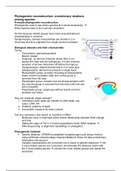
Phylogenetic reconstruction: evolutionary relations
among species
Principle phylogenetic reconstruction
Phylogenetic used to see where species fit in whole biodiversity
follow species back to find common ancestors
Do this because related groups have many acquired/derived
characteristics in common
Synapomorphy: derived characterises are shared in 2 or
more taxa and thus originate from single common ancestor
Biological datasets and their characteristic
Terms:
- Taxon(taxa): species/population
- Branch (clade)
- Outgroup: no derived character states (this is not
always the case see the workgroup). It is the common
ancestor of all taxa. Branches off before the ingroup
- Synapomorphy; shared derived trait in 2 or more taxa
- Autapomorphy: derived trait present in single taxon
- Monophyletic group; ancestor including all descendants;
share common ancestor (with one cut the group is
removed from the tree)
- Paraphyletic group; ancestor but not all descendants (with
two cuts the group is removed from the tree) (still only one
set is included)
- Polyphyletic group; subgroups without recent common
ancestor (cut twice)
How are character states ordered?
1. Unordered; each state can transfer to other state; eye
colour, DNA, AA
2. Ordered; anatomy of teeth
3. Irreversible; measure for brain content
Can you calculate a tree based on mutation in DNA?
- Molecular clock in mammals (time) (linear relationship between DNA change
and time
- Dating the origin of HIV-1 in human populations (time) (DNA isolation
DNA sequencing alignment (opstelling) phylogeny)
Phylogenetic methods
Genetic distance: UPGMA (unweighted (ongedwongen) pair group method
using arithmetic (rekenkundige) means(middelen)): Does not take evolutionary
information into account
Variable characteristics are converted into a matrix of genetic distances the
2 most related species are connected recalculate the distance matrix with
the 2 most related species connect the most related groups and repeat the
procedure

