Learning Unit 4: Data Communication
Introduction to Data Communication Systems
Data communication refers to the electronic transfer of data from one location to another
Data communication systems are essential because they:
Enable fast and accurate information sharing
Support decisions that can impact the success of a business or the effectiveness of daily
choices
The Application of Data Communication Systems
Data communication systems:
Enable efficient data transfer between locations
Support flexible data collection
Form the foundation of virtual organisations
Facilitate collaboration across distributed teams
Enable communication between organisations
Key Benefits in the Workplace
Data communication systems:
Allow just-in-time (JIT) delivery of goods and services – reducing inventory costs
Allow for online training, helping organisations cut costs
Ensures employees stay updated on latest trends and innovations
Enable remote collaboration through tools like video conferencing
Knowledge Areas Managers Must Understand:
Basics of data communication and networking
The Internet, intranets, and extranets
Wired and wireless networks
Network security: threats and solutions
Organisational & social impacts of data communication
Globalisation issues
Practical applications of data communication systems
Components of a Data Communication System
Core Components:
1. Sender and Receiver Devices
2. Modems or Routers
3. Communication Medium (Channel)
Page 1 of 14
, Important Terminology
Bandwidth: Data transferred per second (e.g., Mbps, Gbps). Determines transmission speed
and efficiency
Attenuation: Power loss of signal as it travels from sending to receiving device
Impacts transmission quality and strength.
Should be minimized to maintain signal integrity
Data transmission channel types:
Broadband: Transfer multiple data pieces simultaneously to increase transmission rate
(25 Mbps/3 Mbps)
Narrowband: Voice-grade transmission channel, max capacity of 56 Kbps
– limiting amount of info that can be transferred within a specific time period
Synchronization: Ensures devices begin/end communication at the same point for seamless
data transfer
Protocols: Manage synchronization process, rules that manage data communication (error
detection, message length, transmission speed, and compatibility between devices)
Sender and Receiver Devices
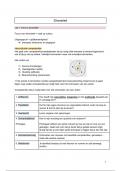
Device Type Description
Input / Output Devices (Thin Clients) Send and receive information only
No processing capabilities
Smart Terminals Limited processing (e.g., assembly lines - collect and
transfer data to main computer systems)
Intelligent Terminals/ PCs/ Can process data independently or remotely
Workstations More advanced than smart terminals
Netbook computers Low-cost, diskless
Use server-based storage and software
Declining in use due to tablets
Minicomputers, Mainframes, High processing power
Supercomputers Can process and transmit/receive data
Used in complex computing environments
Smartphones Advanced mobile devices with email, browsing, etc.
Modems and Routers
Modems (Modulator–Demodulator)
Bridge connecting users to the internet
Required for certain connections especially DSL or cable connections
Analog Modem
Convert digital signals to analogue for phone lines
Rarely used today due to broadband availability
DSL Modem
Use standard phone lines for high-speed internet
Speeds: up to 7.1 Mbps download / ~1 Mbps upload
Page 2 of 14
Introduction to Data Communication Systems
Data communication refers to the electronic transfer of data from one location to another
Data communication systems are essential because they:
Enable fast and accurate information sharing
Support decisions that can impact the success of a business or the effectiveness of daily
choices
The Application of Data Communication Systems
Data communication systems:
Enable efficient data transfer between locations
Support flexible data collection
Form the foundation of virtual organisations
Facilitate collaboration across distributed teams
Enable communication between organisations
Key Benefits in the Workplace
Data communication systems:
Allow just-in-time (JIT) delivery of goods and services – reducing inventory costs
Allow for online training, helping organisations cut costs
Ensures employees stay updated on latest trends and innovations
Enable remote collaboration through tools like video conferencing
Knowledge Areas Managers Must Understand:
Basics of data communication and networking
The Internet, intranets, and extranets
Wired and wireless networks
Network security: threats and solutions
Organisational & social impacts of data communication
Globalisation issues
Practical applications of data communication systems
Components of a Data Communication System
Core Components:
1. Sender and Receiver Devices
2. Modems or Routers
3. Communication Medium (Channel)
Page 1 of 14
, Important Terminology
Bandwidth: Data transferred per second (e.g., Mbps, Gbps). Determines transmission speed
and efficiency
Attenuation: Power loss of signal as it travels from sending to receiving device
Impacts transmission quality and strength.
Should be minimized to maintain signal integrity
Data transmission channel types:
Broadband: Transfer multiple data pieces simultaneously to increase transmission rate
(25 Mbps/3 Mbps)
Narrowband: Voice-grade transmission channel, max capacity of 56 Kbps
– limiting amount of info that can be transferred within a specific time period
Synchronization: Ensures devices begin/end communication at the same point for seamless
data transfer
Protocols: Manage synchronization process, rules that manage data communication (error
detection, message length, transmission speed, and compatibility between devices)
Sender and Receiver Devices
Device Type Description
Input / Output Devices (Thin Clients) Send and receive information only
No processing capabilities
Smart Terminals Limited processing (e.g., assembly lines - collect and
transfer data to main computer systems)
Intelligent Terminals/ PCs/ Can process data independently or remotely
Workstations More advanced than smart terminals
Netbook computers Low-cost, diskless
Use server-based storage and software
Declining in use due to tablets
Minicomputers, Mainframes, High processing power
Supercomputers Can process and transmit/receive data
Used in complex computing environments
Smartphones Advanced mobile devices with email, browsing, etc.
Modems and Routers
Modems (Modulator–Demodulator)
Bridge connecting users to the internet
Required for certain connections especially DSL or cable connections
Analog Modem
Convert digital signals to analogue for phone lines
Rarely used today due to broadband availability
DSL Modem
Use standard phone lines for high-speed internet
Speeds: up to 7.1 Mbps download / ~1 Mbps upload
Page 2 of 14