100% de satisfacción garantizada Inmediatamente disponible después del pago Tanto en línea como en PDF No estas atado a nada 4.2 TrustPilot
logo-home
Examen

CCI CCT Exam Study Guide (Section A)

Puntuación
-
Vendido
-
Páginas
5
Grado
A+
Subido en
10-11-2025
Escrito en
2025/2026

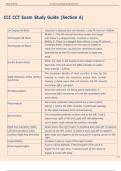
1st Degree AV Block impulsed is delayed and not blocked. Long PR interval >200ms 2nd Degree AB Block Mobitz 1 - The PR interval becomes longer and longer until there is a skipped beat. Cyclical in nature. Mobitz II- There is a skipped beat without a long PR interval. 3rd Degree AV Block Complete block, impulse from the atria is unable to reach the ventricles. Causing the ventricles to pace themselves as the SA node continues to pace the atria. Bundle Branch Block Either the right or left bundle branch delays impulse to their side. This will cause the QRS complex to wider than normal >120ms Wolff-Parkinson-White (WPW) Syndrome The accessory Bundle of Kent provides a way for the impulse to reach the ventricles sooner than normal, causing a delta wave that will shorten the PR internal and widen QRS complex. AV Dissociation Atria and ventricles are being paced seperately, P waves and QRS complexes will not be consistent with each other. Pacemakers Will create a diphasic spike before the p wave (atrial pacing ), before the QRS complex (ventricular pacing) or the spike between both is dual pacing. Normal Axis The conduction pathway is down and to the left. Lead 1 determines right or left and Lead aVF will determine up or down. both should be positive normally. Right Axis Deviation (RAD) Down and to the right Lead 1 is negative and Lead aVF is positive. Left Axis Deviation (LAD) Up and to the left. Lead 1 is positive and Lead aVF is negative. Extreme Right Axis Deviation Both leads are negative as the conduction is going up and to the right. Hypertrophy increase in size or mass of the heart muscle. Atrial Hypertrophy P wave will be diphasic, if the first part of the wave is bigger its the right atria. if second part of the wave is bigger it is the left atria. 11/9/25, 2:04 PM CCI CCT Exam Study Guide (Section A) Ventricular Hypertrophy Ischemia Right ventricle hypertrophy will show a large R wave in V1 and a if the height of the R wave in lead one + the depth of the S wave in V5 is greater than 35mm Will show inverted T waves the EKG. Injury Elevated ST segment on the EKG. Infarction Death of muscle, Will show significant Q waves and elevated ST Lateral Infarction St elevation and or Q waves in lead aVL and Lead I Inferior Infarction Elevated ST segment and or Q wavs in the leads II, III, and aVF Anterior Infarction Posterior Infarctions Elevated ST segment and or Q waves in Leads V1, V2, V3, and V4 Large R wave with depressed ST segments in lead V1 p wave atrial depolarization, <3mm high. <.12secs or 120ms 2/5 / 11/9/25, 2:04 PM CCI CCT Exam Study Guide (Section A) / 3/5 PR interval measured from the beginning of the P wave to the beginning of the Q wave. should be < 200ms, result of delay in conduction at AV node QRS Complex Ventricular depolarization, should be <120ms ST Segment Measured from the end of the S wave to the beginning of the T wave. M.I., muscle injury or pericarditis will elevate. Myocardial ischemia will depress. T wave Ventricular repolarization. < 5mm high in limb leads and <10mm high in precordial leads. tall or spiked = hyperkalemia. short or flat = hypokalemia. Rate -Normal adult rate: 60-99bpm -Bradycardia < 60bpm -Tachycardia:100-250bpm -Flutter:250-350bpm -Fibrillation:350-450bpm Rate -SA node: 60-100bpm -Atria:60-80bpm -AV node: 40-60bpm -Bundle branches: 40-60bpm -Ventricles<40bpm Sinus Rhythm Electrical impulse originates from the SA node. Will always produce an upright P wave in lead II. Normal Sinus Rhythm Equal spacing between each beat and the rate is anywhere from 60-99bpm. Sinus Bradycardia The rhythm is sinus, the rate is <60bpm Sinus Tachycardia The rhythm is sinus and the rate is greater than or equal to 100bpm Sinus Arrhythmia the rhythm is sinus, all p waves are the same shape yet the beats are not equally spaced. Wandering Pacemaker All p waves have different shapes Atrial Fibrillation No discernable P waves, irregular baseline. Paroxysmal Atrial Tachycardia (PAT) Rapid firing of an ectopic focus in the atria. P waves are present. HR between 100- 250bpm. Paroxysmal Junctional Tachycardia (PJT) rapid firing of an ectopic focus in the AV node. No P waves. HR is between 100- 250bpm. Paroxysmal Ventricular Tachycardia rapid firing of an ectopic focus in the ventricles. There are no P waves and the QRS complex is wide. HR 100 11/9/25, 2:04 PM CCI CCT Exam Study Guide (Section A) 250bpm Atrial Flutter "saw tooth formation" single ectopic focus in the atria rapidly firing. creating multiple identical P waves. Ventricular Flutter Rapid firing ectopic focus in the ventricles. There are no P waves and wide QRS complex is wide. Atrial Fibrillation ectopic foci located in the atria. No P waves and the QRS complexes are irregular. Complete distortion of the QRS complex. multiple Ventricular Fibrillation ectopic foci firing in the ventricles. Premature Atrial Contraction (PAC) Atrial ectopic focus fires before the SA node fires. P waves will appear different than all other P waves and the QRS will be the same. Premature Junctional Contraction (PJC) Ectopic focus in the AV node fires before the SA node. No P waves and the QRS complex will appear normal. Premature Ventricular Contraction (PVC) Ectopic focus in the ventricles fires before the SA node. No P wave and very wide QRS 4/5 / 11/9/25, 2:04 PM CCI CCT Exam Study Guide (Section A) Atrial Escape Beat SA node does not fire and an ectopic focus in the atria eventually fires. There will be a pause in the normal rhythm, P wave will look different QRS will look the same. Junctional Escape Beat SA node does not fire and an ectopic focus in the AV node does instead. A pause in normal rhythm with no P wave and a normal QRS complex Ventricular Escape Beat SA node does not fire and the ventricles do instead. Pause in the normal rhythm with no P wave and a wide and abnormal QRS complex. Sinus Block SA node fails to fire causing one or more skipped beats. P waves same as before when rhythm resumes. AV Block will delay or completely stop the impulse. Three types, 1st, 2nd, and 3rd degree AV blocks.

Mostrar más Leer menos
Institución
CCI CCT
Grado
CCI CCT


Ups! No podemos cargar tu documento ahora. Inténtalo de nuevo o contacta con soporte.

Escuela, estudio y materia

Institución
CCI CCT
Grado
CCI CCT

Información del documento

Subido en
10 de noviembre de 2025
Número de páginas
5
Escrito en
2025/2026
Tipo
Examen
Contiene
Preguntas y respuestas

Temas

Vista previa del contenido

11/9/25, 2:04 PM CCI CCT Exam Study Guide (Section A)


CCI CCT Exam Study Guide (Section A)

1st Degree AV Block impulsed is delayed and not blocked. Long PR interval >200ms
Mobitz 1 - The PR interval becomes longer and longer
2nd Degree AB Block until there is a skipped beat. Cyclical in nature.
Mobitz II- There is a skipped beat without a long PR interval.
Complete block, impulse from the atria is unable to
3rd Degree AV Block
reach the ventricles. Causing the ventricles to pace
themselves as the SA node continues to pace the
atria.
Either the right or left bundle branch delays impulse to
Bundle Branch Block
their side. This will cause the QRS complex to wider
than normal >120ms
The accessory Bundle of Kent provides a way for the
Wolff-Parkinson-White (WPW) impulse to reach the ventricles sooner than normal,
Syndrome
causing a delta wave that will shorten the PR internal
and widen QRS complex.
Atria and ventricles are being paced seperately, P
AV Dissociation
waves and QRS complexes will not be consistent with
each other.
Will create a diphasic spike before the p wave (atrial
Pacemakers
pacing ), before the QRS complex (ventricular pacing)
or the spike between both is dual pacing.
The conduction pathway is down and to the left. Lead 1
Normal Axis
determines right or left and Lead aVF will determine
up or down. both should be positive normally.
Right Axis Deviation (RAD) Down and to the right Lead 1 is negative and Lead aVF is positive.
Left Axis Deviation (LAD) Up and to the left. Lead 1 is positive and Lead aVF is negative.
Extreme Right Axis Deviation Both leads are negative as the conduction is going up and to the
right.
Hypertrophy increase in size or mass of the heart muscle.
P wave will be diphasic, if the first part of the wave is
Atrial Hypertrophy
bigger its the right atria. if second part of the wave is
bigger it is the left atria.
/ 1/5

, 11/9/25, 2:04 PM CCI CCT Exam Study Guide (Section A)

Right ventricle hypertrophy will show a large R wave in
Ventricular Hypertrophy
V1 and a if the height of the R wave in lead one + the
depth of the S wave in V5 is greater than 35mm
Ischemia Will show inverted T waves the EKG.
Injury Elevated ST segment on the EKG.
Infarction Death of muscle, Will show significant Q waves and elevated ST
Lateral Infarction St elevation and or Q waves in lead aVL and Lead I
Inferior Infarction Elevated ST segment and or Q wavs in the leads II, III, and aVF
Anterior Infarction Elevated ST segment and or Q waves in Leads V1, V2, V3, and V4
Posterior Infarctions Large R wave with depressed ST segments in lead V1


p wave atrial depolarization, <3mm high. <.12secs or 120ms


/ 2/5
$9.49
Accede al documento completo:

100% de satisfacción garantizada
Inmediatamente disponible después del pago
Tanto en línea como en PDF
No estas atado a nada


Documento también disponible en un lote

Conoce al vendedor

Seller avatar
Los indicadores de reputación están sujetos a la cantidad de artículos vendidos por una tarifa y las reseñas que ha recibido por esos documentos. Hay tres niveles: Bronce, Plata y Oro. Cuanto mayor reputación, más podrás confiar en la calidad del trabajo del vendedor.
wanjohipeter Johns Hopkins University
Seguir Necesitas iniciar sesión para seguir a otros usuarios o asignaturas
Vendido
12
Miembro desde
8 meses
Número de seguidores
0
Documentos
2344
Última venta
5 días hace
POWELL'S CITY BOOKSHOP

I'm committed in delivering , engaging and informative content.Having a passion for academic writing. I excel in structuring papers and presenting information creatively.Client satisfaction is my priority where I provide quality work. I focus on client requirement by ensuring fresh ideas , consistent structure and adhere to academic rules . I provide all document, package and Flashcards with updated and Latest questions and accurate Answers .(VERIFIED ANSWERS) All the documents are Graded A+ Your Satisfaction Drives my Dedication to excellence!!!!! Welcome all !!!!

Lee mas Leer menos
4.0

4 reseñas

5
1
4
2
3
1
2
0
1
0

Recientemente visto por ti

Por qué los estudiantes eligen Stuvia

Creado por compañeros estudiantes, verificado por reseñas

Calidad en la que puedes confiar: escrito por estudiantes que aprobaron y evaluado por otros que han usado estos resúmenes.

¿No estás satisfecho? Elige otro documento

¡No te preocupes! Puedes elegir directamente otro documento que se ajuste mejor a lo que buscas.

Paga como quieras, empieza a estudiar al instante

Sin suscripción, sin compromisos. Paga como estés acostumbrado con tarjeta de crédito y descarga tu documento PDF inmediatamente.

Student with book image

“Comprado, descargado y aprobado. Así de fácil puede ser.”

Alisha Student

Preguntas frecuentes