
Interpersonal Relationships
Lecture 1 – Relationships and well-being:
Low marital satisfaction & low social integration is related to higher mortality/lower
immune system
Social integration is associated with physical and psychological well-being:
Social support:
- Emotional support: someone showing he cares for you and is there for you
- Instrumental support: someone showing he is there for you/helping you
- Visible (explicit) and invisible (subtle) support
- Direct effect-hypothesis (main effect hypothesis): social support makes people
to take better care of themselves (less smoking, more exercise, healthier diet);
social influence/norms experience more positive affect
- Stress-buffering hypothesis: social support reduces stress under potentially
stressful circumstances directly related to health via cardio-vascular and
immune system (cortisol); stress spill over effect (if individual has difficulty
coping with stress, this can spill over to other relationships)
- Social acceptance: other people signalling that they wish to include you in
their groups and relationships (tolerating another person’s presence, actively
pursuing someone as a relationship partner)
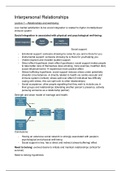
Strength and strain model of marriage and health:
Conclusions:
- Having an extensive social network is strongly associated with people’s
psychological and physical well-being
- Social support is key; has a direct and indirect (stress-buffering) effect
Need to belong: evolved desire to initiate and maintain relationships (critical for
survival)
Need to belong-hypothesis:
, - Changes in ‘belongingness’ evoke strong effects: inclusion/social integration
(healthy & happy) & exclusion/loneliness (unhealthy & unhappy)
- Initiating social interactions seems innate (humans form social relationships
really easily): universal, minimal group research, mere proximity lead to
relationships, attachment, innate focus on others (face perceptual system)
Ostracism threatens fundamental needs:
- Lower sense of belonging, loss of control, lower sense of meaningfulness,
lower self-esteem (sociometer theory)
- Lowers heart rate & increases cortisol release
- Coping: aggression, religion, striving to form new bonds, producing (implicitly)
strong positive emotional responses
Need-threat model of ostracism:
Pain overlap theory:
- Similar neural systems involved in both social and physical pain (sensitivity to
both social and physical pain is linked by a common gene)
- Similar psychological responses: social and physical pain lead to loss of
control, lowered self-esteem, aggression (regain control over situation, get
attention, basal reaction, believe it’ll make them feel better)
- Dissimilarity: social pain is more long-term than physical pain
Paracetamol even works for social pain
Lecture 2 – Evolutionary perspectives on love:
Evolution: variation (mutation in genes) heritability (more adaptive so passing on
to offspring) selection
Socio-biology:
- Certain behaviours (just like certain physical traits) have more survival- and
reproduction (adaptive/fitness) value than other behaviours genes
associated with certain behaviour will increase in population over generations
- Predisposed avoidance (fear for potentially deadly animals) & Predisposed
approach (preference for certain foods)
- Interpersonal mate preferences/attraction: men are designed to be attracted to
women with certain features that correspond with fertility (youth, smooth skin,
hour-glass shape; attraction for certain traits evolved because it was adaptive)
Lecture 1 – Relationships and well-being:
Low marital satisfaction & low social integration is related to higher mortality/lower
immune system
Social integration is associated with physical and psychological well-being:
Social support:
- Emotional support: someone showing he cares for you and is there for you
- Instrumental support: someone showing he is there for you/helping you
- Visible (explicit) and invisible (subtle) support
- Direct effect-hypothesis (main effect hypothesis): social support makes people
to take better care of themselves (less smoking, more exercise, healthier diet);
social influence/norms experience more positive affect
- Stress-buffering hypothesis: social support reduces stress under potentially
stressful circumstances directly related to health via cardio-vascular and
immune system (cortisol); stress spill over effect (if individual has difficulty
coping with stress, this can spill over to other relationships)
- Social acceptance: other people signalling that they wish to include you in
their groups and relationships (tolerating another person’s presence, actively
pursuing someone as a relationship partner)
Strength and strain model of marriage and health:
Conclusions:
- Having an extensive social network is strongly associated with people’s
psychological and physical well-being
- Social support is key; has a direct and indirect (stress-buffering) effect
Need to belong: evolved desire to initiate and maintain relationships (critical for
survival)
Need to belong-hypothesis:
, - Changes in ‘belongingness’ evoke strong effects: inclusion/social integration
(healthy & happy) & exclusion/loneliness (unhealthy & unhappy)
- Initiating social interactions seems innate (humans form social relationships
really easily): universal, minimal group research, mere proximity lead to
relationships, attachment, innate focus on others (face perceptual system)
Ostracism threatens fundamental needs:
- Lower sense of belonging, loss of control, lower sense of meaningfulness,
lower self-esteem (sociometer theory)
- Lowers heart rate & increases cortisol release
- Coping: aggression, religion, striving to form new bonds, producing (implicitly)
strong positive emotional responses
Need-threat model of ostracism:
Pain overlap theory:
- Similar neural systems involved in both social and physical pain (sensitivity to
both social and physical pain is linked by a common gene)
- Similar psychological responses: social and physical pain lead to loss of
control, lowered self-esteem, aggression (regain control over situation, get
attention, basal reaction, believe it’ll make them feel better)
- Dissimilarity: social pain is more long-term than physical pain
Paracetamol even works for social pain
Lecture 2 – Evolutionary perspectives on love:
Evolution: variation (mutation in genes) heritability (more adaptive so passing on
to offspring) selection
Socio-biology:
- Certain behaviours (just like certain physical traits) have more survival- and
reproduction (adaptive/fitness) value than other behaviours genes
associated with certain behaviour will increase in population over generations
- Predisposed avoidance (fear for potentially deadly animals) & Predisposed
approach (preference for certain foods)
- Interpersonal mate preferences/attraction: men are designed to be attracted to
women with certain features that correspond with fertility (youth, smooth skin,
hour-glass shape; attraction for certain traits evolved because it was adaptive)

