

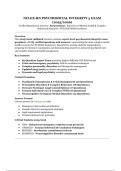
NCLEX-RN PSYCHOSOCIAL INTEGRITY 3 EXAM
(2025/2026)
Verified Questions & Answers | 85 Questions | Expert-Level Mental Health & Complex
Behavioral Scenarios | NCLEX®-RN® Excellence
Overview
This 2025/2026 validated resource contains expert-level psychosocial integrity exam
questions with 85 verified questions and answers, representing the most complex mental
health scenarios for NCLEX® dominance. Essential for nursing students and graduates
preparing for licensure examination and demonstrating mastery in advanced psychiatric care
and complex behavioral health management.
Key Features
● 85-Question Expert Exam matching highest-difficulty NCLEX® format
● Crisis and emergency psychiatry with de-escalation techniques
● Complex personality disorders and therapeutic management
● Updated 2025/2026 psychiatric emergency protocols
● Forensic and legal psychiatry considerations
Content Domains
● Psychiatric Emergencies & Crisis Management (20 Questions)
● Personality Disorders & Complex Behaviors (18 Questions)
● Forensic Nursing & Legal Considerations (17 Questions)
● Trauma-Informed Care & Complex PTSD (16 Questions)
● Neurocognitive & Organic Mental Disorders (14 Questions)
Answer Format
Correct answers in bold green with:
● Emergency intervention prioritization
● Complex behavior management strategies
● Legal requirement applications
● Trauma-informed care principles
Critical Updates 2025/2026
● NEW - Behavioral emergency response team protocols
● UPDATED - Trauma-informed de-escalation techniques
● REVISED - Involuntary commitment criteria
● MODIFIED - Neurocognitive disorder assessment tools
,PSYCHIATRIC EMERGENCIES & CRISIS MANAGEMENT (Questions
1–20)
1. Agitated delirium: HR 138, T 39.8°C, picking at air. First drug?
a) Haloperidol 5 mg IM
b) Lorazepam 2 mg IM
c) Ketamine 4 mg/kg IM
d) Dexmedetomidine
c) Ketamine 4 mg/kg IM
Priority: BERT protocol: rapid tranquilization in hyperactive delirium.
2. Excited delirium syndrome: Cocaine, restraint, sudden death. Cause?
a) Positional asphyxia
b) Catecholamine surge
c) Both
d) Hyperkalemia
c) Both
Update 2025: ACEP: avoid prone restraint.
3. Catastrophic agitation: Smashing windows, 300 lbs. Sequence?
a) Verbal → show of force → chemical → physical
b) Chemical first
c) Physical first
d) Call police
a) Verbal → show of force → chemical → physical
Technique: PMDB: least restrictive.
4. Suicide by cop: Gun to head, demands police. Role?
a) Negotiator
b) Clear scene
c) Both
d) Shoot
b) Clear scene
Priority: Nurse: safety, not engagement.
5. Command hallucination: “Kill the nurse.” Immediate action?
a) 1:1 observation
b) Seclusion
c) IM antipsychotic
d) All
d) All
Priority: Imminent risk protocol.
6. Serotonin syndrome: SSRI + tramadol, rigidity. Hunter criteria?
a) Clonus
b) Hyperreflexia
, c) Both
d) Fever
c) Both
Rationale: Inducible clonus + agitation = diagnostic.
7. Thyrotoxic crisis: HR 172, T 40.1°C, psychosis. Sequence?
a) PTU → beta → iodine → cooling
b) Iodine first
c) Steroids
d) Intubation
a) PTU → beta → iodine → cooling
Priority: Block synthesis, release, peripheral.
8. NMS: Olanzapine, CPK 45,000. Drug?
a) Bromocriptine 5 mg q6h
b) Dantrolene 1 mg/kg
c) Both
d) ECT
c) Both
Rationale: DA agonist + muscle relaxant.
9. Akathisia: Pacing, “bugs under skin.” Treatment?
a) Propranolol 10 mg TID
b) Benztropine
c) Switch to quetiapine
d) All
d) All
Priority: Dose reduction first.
10. QTc 620 on haloperidol. Next?
a) Stop
b) MgSO₄ 2 g
c) Telemetry
d) All
d) All
Update: Zayas criteria: >500 ms = discontinue.
11. Anaphylaxis to IM med: Stridor, BP 68/30. Sequence?
a) Epi 0.3 mg IM → NS → H1/H2
b) Intubate first
c) Steroids
d) Call code
a) Epi 0.3 mg IM → NS → H1/H2
Priority: AAAI: IM epinephrine first.
(2025/2026)
Verified Questions & Answers | 85 Questions | Expert-Level Mental Health & Complex
Behavioral Scenarios | NCLEX®-RN® Excellence
Overview
This 2025/2026 validated resource contains expert-level psychosocial integrity exam
questions with 85 verified questions and answers, representing the most complex mental
health scenarios for NCLEX® dominance. Essential for nursing students and graduates
preparing for licensure examination and demonstrating mastery in advanced psychiatric care
and complex behavioral health management.
Key Features
● 85-Question Expert Exam matching highest-difficulty NCLEX® format
● Crisis and emergency psychiatry with de-escalation techniques
● Complex personality disorders and therapeutic management
● Updated 2025/2026 psychiatric emergency protocols
● Forensic and legal psychiatry considerations
Content Domains
● Psychiatric Emergencies & Crisis Management (20 Questions)
● Personality Disorders & Complex Behaviors (18 Questions)
● Forensic Nursing & Legal Considerations (17 Questions)
● Trauma-Informed Care & Complex PTSD (16 Questions)
● Neurocognitive & Organic Mental Disorders (14 Questions)
Answer Format
Correct answers in bold green with:
● Emergency intervention prioritization
● Complex behavior management strategies
● Legal requirement applications
● Trauma-informed care principles
Critical Updates 2025/2026
● NEW - Behavioral emergency response team protocols
● UPDATED - Trauma-informed de-escalation techniques
● REVISED - Involuntary commitment criteria
● MODIFIED - Neurocognitive disorder assessment tools
,PSYCHIATRIC EMERGENCIES & CRISIS MANAGEMENT (Questions
1–20)
1. Agitated delirium: HR 138, T 39.8°C, picking at air. First drug?
a) Haloperidol 5 mg IM
b) Lorazepam 2 mg IM
c) Ketamine 4 mg/kg IM
d) Dexmedetomidine
c) Ketamine 4 mg/kg IM
Priority: BERT protocol: rapid tranquilization in hyperactive delirium.
2. Excited delirium syndrome: Cocaine, restraint, sudden death. Cause?
a) Positional asphyxia
b) Catecholamine surge
c) Both
d) Hyperkalemia
c) Both
Update 2025: ACEP: avoid prone restraint.
3. Catastrophic agitation: Smashing windows, 300 lbs. Sequence?
a) Verbal → show of force → chemical → physical
b) Chemical first
c) Physical first
d) Call police
a) Verbal → show of force → chemical → physical
Technique: PMDB: least restrictive.
4. Suicide by cop: Gun to head, demands police. Role?
a) Negotiator
b) Clear scene
c) Both
d) Shoot
b) Clear scene
Priority: Nurse: safety, not engagement.
5. Command hallucination: “Kill the nurse.” Immediate action?
a) 1:1 observation
b) Seclusion
c) IM antipsychotic
d) All
d) All
Priority: Imminent risk protocol.
6. Serotonin syndrome: SSRI + tramadol, rigidity. Hunter criteria?
a) Clonus
b) Hyperreflexia
, c) Both
d) Fever
c) Both
Rationale: Inducible clonus + agitation = diagnostic.
7. Thyrotoxic crisis: HR 172, T 40.1°C, psychosis. Sequence?
a) PTU → beta → iodine → cooling
b) Iodine first
c) Steroids
d) Intubation
a) PTU → beta → iodine → cooling
Priority: Block synthesis, release, peripheral.
8. NMS: Olanzapine, CPK 45,000. Drug?
a) Bromocriptine 5 mg q6h
b) Dantrolene 1 mg/kg
c) Both
d) ECT
c) Both
Rationale: DA agonist + muscle relaxant.
9. Akathisia: Pacing, “bugs under skin.” Treatment?
a) Propranolol 10 mg TID
b) Benztropine
c) Switch to quetiapine
d) All
d) All
Priority: Dose reduction first.
10. QTc 620 on haloperidol. Next?
a) Stop
b) MgSO₄ 2 g
c) Telemetry
d) All
d) All
Update: Zayas criteria: >500 ms = discontinue.
11. Anaphylaxis to IM med: Stridor, BP 68/30. Sequence?
a) Epi 0.3 mg IM → NS → H1/H2
b) Intubate first
c) Steroids
d) Call code
a) Epi 0.3 mg IM → NS → H1/H2
Priority: AAAI: IM epinephrine first.

