
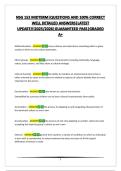
WELL DETAILED ANSWERS|LATEST
UPDATE!!!2025/2026|GUARANTEED PASS|GRADED
Multiculturalism - ANSWER many cultures and subcultures coexisting within a given
society in which no one culture dominates
Ethnic groups - ANSWER common characteristics including nationality, language,
values, and customs, and they share a cultural heritage
Cultural humility - ANSWER the ability to maintain an interpersonal stance that is
other-oriented (or open to the other) in relation to aspects of cultural identity that are most
important to the person
Enculturation - ANSWER also known as cultural transmission
Exemplified by a process children use to learn cultural characteristics from adults
Assimilation - ANSWER the process of adapting to and integrating characteristics of
the dominant culture as one's own
Acculturation - ANSWER the process of not only adapting to another culture but also
accepting the majority group's culture as one's own
Intersex - ANSWER general term used for a variety of conditions in which an individual
is born with a reproductive or sexual anatomy that does not seem to fit the typical
definitions of female or male
1
,Classism - ANSWER the oppression of groups of people based on their socioeconomic
status
Heterosexism - ANSWER view of heterosexuality as the only correct sexual orientation
Ageism - ANSWER discrimination against older adults
Vulnerable population - ANSWER groups of people in our culture who are at greater
risk for diseases and reduced lifespan due to lack of resources and exposure to more risk
factors
Health disparity - ANSWER a particular type of health difference that is closely linked
with social, economic, and/or environmental disadvantage
Cultural competence - ANSWER the ability to apply the knowledge and skills needed
to provide high-quality, evidence-based care to patients of diverse backgrounds and beliefs
to overcome barriers and access resources promoting health and wellness
LEARN model - ANSWER helps nurses include cultural behaviors in a patient's
healthcare
Listen to patient's perception
Explain your perception of the problem
Acknowledge and discuss differences
Review ordered treatments
Negotiate agreement
Family - ANSWER two or more individuals who are joined together by marriage, birth,
or adoption and are residing in the same house-hold
2
,Family systems theory - ANSWER within a family each individual is interconnected
with and interdependent on the other members, both as individuals and as a group
Open system family - ANSWER able to exchange information (for example, by
discussion and modeling acceptable behaviors) and resources (such as personal energy
necessary to accomplish tasks) to meet problems and find solutions
Closed system family - ANSWER view change as a threat and have difficulty adapting
to or overcoming change
Family-centered care - ANSWER partnership between nurses and family
Nurse respects family's role, strengths, and experiences with the healthcare system
Nuclear family - ANSWER a family structure of a mother and father and their offspring
Binuclear - ANSWER when two biological parents divorce but continue to raise their
children in partnership with one another
Extended-kin network family - ANSWER specific form of an extended family in which
two nuclear families of primary or unmarried kin live in proximity to each other
Two-career families - ANSWER both partners are employed by choice or by necessity
Duvall's 8 stage family life cycle - ANSWER stage 1 : beginning family, newly married
couples
Stage 2 : childbearing family (oldest child is an infant through 30 months of age)
Stage 3 : families with preschool children (oldest child is between 2.5 and 6 years of age)
Stage 4 : families with schoolchildren (oldest child is between 6 and 13 years of age)
Stage 5 : families with teenagers (oldest child is between 13 and 20 years of age)
3
, Stage 6 : families launching young adults (all children leave home)
Stage 7 : middle-aged parents (empty nest through retirement)
Stage 8 : family in retirement and old age (retirement to death of both spouses)
Family cohesion - ANSWER the emotional bonding between family members
What increases the resilience of a family - ANSWER having resources and adaptive
abilities
Communication
Limit setting - ANSWER established rules or guidelines for behavior
Characteristics of high level parenting attributes - ANSWER warm, nurturing
Expressing affection and smiling at children frequently
Limiting criticism, punishment
Expressing approval of child
Restrictive control of behavior
Surveying and enforcing compliance with rules
Encouraging children to fulfill their responsibilities
Sometimes limiting freedom of expression
Characteristics of low level parenting attributes - ANSWER cool, hostile
Quick to criticize or punish
Ignoring children
Rarely expressing affection or approval
Sometimes rejecting children
4
UPDATE!!!2025/2026|GUARANTEED PASS|GRADED
Multiculturalism - ANSWER many cultures and subcultures coexisting within a given
society in which no one culture dominates
Ethnic groups - ANSWER common characteristics including nationality, language,
values, and customs, and they share a cultural heritage
Cultural humility - ANSWER the ability to maintain an interpersonal stance that is
other-oriented (or open to the other) in relation to aspects of cultural identity that are most
important to the person
Enculturation - ANSWER also known as cultural transmission
Exemplified by a process children use to learn cultural characteristics from adults
Assimilation - ANSWER the process of adapting to and integrating characteristics of
the dominant culture as one's own
Acculturation - ANSWER the process of not only adapting to another culture but also
accepting the majority group's culture as one's own
Intersex - ANSWER general term used for a variety of conditions in which an individual
is born with a reproductive or sexual anatomy that does not seem to fit the typical
definitions of female or male
1
,Classism - ANSWER the oppression of groups of people based on their socioeconomic
status
Heterosexism - ANSWER view of heterosexuality as the only correct sexual orientation
Ageism - ANSWER discrimination against older adults
Vulnerable population - ANSWER groups of people in our culture who are at greater
risk for diseases and reduced lifespan due to lack of resources and exposure to more risk
factors
Health disparity - ANSWER a particular type of health difference that is closely linked
with social, economic, and/or environmental disadvantage
Cultural competence - ANSWER the ability to apply the knowledge and skills needed
to provide high-quality, evidence-based care to patients of diverse backgrounds and beliefs
to overcome barriers and access resources promoting health and wellness
LEARN model - ANSWER helps nurses include cultural behaviors in a patient's
healthcare
Listen to patient's perception
Explain your perception of the problem
Acknowledge and discuss differences
Review ordered treatments
Negotiate agreement
Family - ANSWER two or more individuals who are joined together by marriage, birth,
or adoption and are residing in the same house-hold
2
,Family systems theory - ANSWER within a family each individual is interconnected
with and interdependent on the other members, both as individuals and as a group
Open system family - ANSWER able to exchange information (for example, by
discussion and modeling acceptable behaviors) and resources (such as personal energy
necessary to accomplish tasks) to meet problems and find solutions
Closed system family - ANSWER view change as a threat and have difficulty adapting
to or overcoming change
Family-centered care - ANSWER partnership between nurses and family
Nurse respects family's role, strengths, and experiences with the healthcare system
Nuclear family - ANSWER a family structure of a mother and father and their offspring
Binuclear - ANSWER when two biological parents divorce but continue to raise their
children in partnership with one another
Extended-kin network family - ANSWER specific form of an extended family in which
two nuclear families of primary or unmarried kin live in proximity to each other
Two-career families - ANSWER both partners are employed by choice or by necessity
Duvall's 8 stage family life cycle - ANSWER stage 1 : beginning family, newly married
couples
Stage 2 : childbearing family (oldest child is an infant through 30 months of age)
Stage 3 : families with preschool children (oldest child is between 2.5 and 6 years of age)
Stage 4 : families with schoolchildren (oldest child is between 6 and 13 years of age)
Stage 5 : families with teenagers (oldest child is between 13 and 20 years of age)
3
, Stage 6 : families launching young adults (all children leave home)
Stage 7 : middle-aged parents (empty nest through retirement)
Stage 8 : family in retirement and old age (retirement to death of both spouses)
Family cohesion - ANSWER the emotional bonding between family members
What increases the resilience of a family - ANSWER having resources and adaptive
abilities
Communication
Limit setting - ANSWER established rules or guidelines for behavior
Characteristics of high level parenting attributes - ANSWER warm, nurturing
Expressing affection and smiling at children frequently
Limiting criticism, punishment
Expressing approval of child
Restrictive control of behavior
Surveying and enforcing compliance with rules
Encouraging children to fulfill their responsibilities
Sometimes limiting freedom of expression
Characteristics of low level parenting attributes - ANSWER cool, hostile
Quick to criticize or punish
Ignoring children
Rarely expressing affection or approval
Sometimes rejecting children
4

