

Lecture 13 Long term memory II (cognitive) Goldstein & van Hooff H8 & H9
Perception
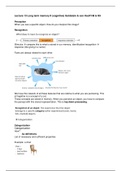
When you see a specific object. How do you interpret this image?
Recognition
Stimulus compare this to what is stored in our memory, identification/recognition
response (like giving it a name)
Facts are always related to each other.
We have this network of all these features that are relative to what you are perceiving. This
all together is a concept of a cat.
These concepts are stored in memory. When you perceive an object, you have to compare
the percept with this stored representation. This is top down processing.
Categorization
Categorization
How?
- As definitions:
List of necessary and sufficient properties
Example: a chair
,Neurons in the inferior temporal cortex can distinguish male and female faces.
- As prototypes:
Central representation of a category: the “average”, or “center of gravity” of all earlier
experienced objects of that category.
Graded representation: membership of an object to a category depends on the similarity
(distance) to the prototype.
Method: rating scale participants rate the typicality of a certain example for a category.
Method: sentence verification “apple is a fruit” (true/false)
You are quicker to respond if the object is closer to the prototype.
,Method: priming in same/different judgment
Memory is drawn towards prototype
Memory changes towards a prototype.
Prototypical environments and events
Schemata: general knowledge about situations, e.g. schema for a kitchen or a museum.
When we store specific memories of events these memories are effected by our schematic
knowledge.
Scripts: general knowledge about a sequence of events, e.g. make a tea or take a metro.
- As exemplars:
Representation of each actual experience.
When we see a new animal we compare it with each exemplar that we have stored in our
memory.
, Compare prototype vs. Exemplar approach
Prototype approach
One prototype. Just calculate in average.
• Advantage: very efficient storage
• Disadvantages:
- requires separate storage of unique exemplars, e.g. “my dog Bella”. (So how do you
know Bella is a dog?)
There are different types of dogs. It is not helpful for recognizing individuals.
Exemplar approach
Store every individual item of a specific category.
• Advantages:
- unique exemplars are stored as any other exemplar
- no categorization problem
• Disadvantage: a lot of capacity required for storage.
Organization of semantic memory
Semantic memory seems to be structured
• One fact triggers the retrieval of related facts (Australia + capital = Canberra)
• Mistakes are often near-misses (e.g. Melbourne, Sydney)
What is the structure of semantic memory like?
• Semantic network: the hierarchical model
• Multiple-trace theory (in addition to the book)
• Parallel distributed processing
Hierarchical model
Properties:
Nodes: are structured hierarchically. Those are the concepts.
Activation: semantic memory is associative. So if you activate one of the nodes this
activation will spread. If you will activate for example canary you will also activate bird and
animal.
Links: properties or examples
Inheritance: lower nodes inherit properties of higher nodes.
Cognitive economy: each property is represented in a single place in the tree.
Canary does not directly have the properties “has wings”, “can fly”. It inherits that from the
concepts that higher up in the hierarchy. The way that these properties are stored is
economical.
Perception
When you see a specific object. How do you interpret this image?
Recognition
Stimulus compare this to what is stored in our memory, identification/recognition
response (like giving it a name)
Facts are always related to each other.
We have this network of all these features that are relative to what you are perceiving. This
all together is a concept of a cat.
These concepts are stored in memory. When you perceive an object, you have to compare
the percept with this stored representation. This is top down processing.
Categorization
Categorization
How?
- As definitions:
List of necessary and sufficient properties
Example: a chair
,Neurons in the inferior temporal cortex can distinguish male and female faces.
- As prototypes:
Central representation of a category: the “average”, or “center of gravity” of all earlier
experienced objects of that category.
Graded representation: membership of an object to a category depends on the similarity
(distance) to the prototype.
Method: rating scale participants rate the typicality of a certain example for a category.
Method: sentence verification “apple is a fruit” (true/false)
You are quicker to respond if the object is closer to the prototype.
,Method: priming in same/different judgment
Memory is drawn towards prototype
Memory changes towards a prototype.
Prototypical environments and events
Schemata: general knowledge about situations, e.g. schema for a kitchen or a museum.
When we store specific memories of events these memories are effected by our schematic
knowledge.
Scripts: general knowledge about a sequence of events, e.g. make a tea or take a metro.
- As exemplars:
Representation of each actual experience.
When we see a new animal we compare it with each exemplar that we have stored in our
memory.
, Compare prototype vs. Exemplar approach
Prototype approach
One prototype. Just calculate in average.
• Advantage: very efficient storage
• Disadvantages:
- requires separate storage of unique exemplars, e.g. “my dog Bella”. (So how do you
know Bella is a dog?)
There are different types of dogs. It is not helpful for recognizing individuals.
Exemplar approach
Store every individual item of a specific category.
• Advantages:
- unique exemplars are stored as any other exemplar
- no categorization problem
• Disadvantage: a lot of capacity required for storage.
Organization of semantic memory
Semantic memory seems to be structured
• One fact triggers the retrieval of related facts (Australia + capital = Canberra)
• Mistakes are often near-misses (e.g. Melbourne, Sydney)
What is the structure of semantic memory like?
• Semantic network: the hierarchical model
• Multiple-trace theory (in addition to the book)
• Parallel distributed processing
Hierarchical model
Properties:
Nodes: are structured hierarchically. Those are the concepts.
Activation: semantic memory is associative. So if you activate one of the nodes this
activation will spread. If you will activate for example canary you will also activate bird and
animal.
Links: properties or examples
Inheritance: lower nodes inherit properties of higher nodes.
Cognitive economy: each property is represented in a single place in the tree.
Canary does not directly have the properties “has wings”, “can fly”. It inherits that from the
concepts that higher up in the hierarchy. The way that these properties are stored is
economical.

