
• ¿Documento equivocado? Cámbialo gratis
  • Escrito por estudiantes que aprobaron
  • Inmediatamente disponible después del pago
  • Leer en línea o como PDF
Vender
¿Dónde estudias?
Tu idioma
Document preview thumbnail
Vista previa 2 fuera de 6 páginas
Caso

Case Studies

Document preview thumbnail
Vista previa 2 fuera de 6 páginas

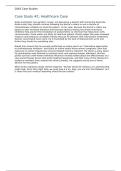
Case Study #1: Healthcare Case Anika and Daniel, two geriatric nurses, are discussing a patient with worsening dementia. Anika insists they should continue following the doctor's orders to use a mixture of cholinesterase inhibitors to treat the patient. In her view, because the doctor's orders are based on peer-reviewed literature and because rigorous testing has shown that these inhibitors help prevent the breakdown of acetylcholine (a chemical that helps brain cells communicate), these orders are likely to help their patient. Daniel judges this peer-reviewed research and testing as unreliable merely because he believes that mainstream treatments doctors recommend never work. He is frustrated by the lack of improvement so far and thinks they should try something else. Daniel then shares that he recently performed an online search on "alternative approaches to cholinesterase inhibitors" and found an online health forum where caregivers claim that exposure to certain frequencies of sound helped memory retention. He shares a story about his grandmother who listened to classical music and seemed sharper afterward. He then points out that a well-known wellness influencer recently talked about the effectiveness of a new sound therapy device that emits healing frequencies, and that many of the influencer's audience members have ordered the device already. He suggests buying one of these devices for the patient. When Anika expresses doubt, Daniel responds, "Nurses should be willing to try anything that might help. Since this might help, we must give it a try. Also, you are from the Midwest, so it is clear that your medical reasoning should not be trusted."   Case Study #2: Business Case Fatima, a stay-at-home mother of two children, has decided to start a small business to make some extra money. She is excited about her product idea but feels uncertain about the financial side of things. One evening, she expresses her concerns over coffee with friends. One of her friends, Jack, points out that according to research from the Harvard Business Review, she should hire a financial advisor to help with payroll and, because they understand current tax laws, would be able to help her with her business taxes each year. Her friend Amanda, who runs a small online shop, disagrees with Jack. She thinks that Fatima could handle the financial side herself. "Think about it—you handle grocery budgets, bills, and savings for a family of four. That's way harder than tracking business expenses. If you can handle your personal finances, then of course you can do the business finances yourself. Plus, I just left a conference for small-business owners who handle their business finances themselves just fine, and you remind me a lot of them. If they can do it, so can you!" When Jack points out that there are significant differences between personal and business expenses, Amanda shrugs. "At the end of the day, you can either believe in yourself and do this, or you can give up and hire someone else to do everything for you. I just believe that Fatima can do this, regardless of what the folks at Harvard say. So, I don't think Fatima needs a financial advisor."   Case Study #3: Education Case Nora, a third-grade teacher at a public elementary school, is concerned about the recent budget cuts that have been proposed in her school district. One of the recommended cuts is the removal of arts education classes from the curriculum. In an attempt to persuade the school board that these classes should not be cut, Nora has decided to write the following letter: I am writing today to express my opposition to the school board's proposal that arts education classes be discontinued in elementary schools in our district. I'm worried that the increase in student test scores that our neighboring district has seen after dropping art education has played an outsized role in the board's decision-making process in this case. It isn't fair to generalize from one very different district's success to conclude that the same approach will work in all districts and at all schools. The neighboring district was already performing far better on standardized tests before arts education was cut, so their data shouldn't be used to determine what's best for other schools. I ask that you please consider the benefits that arts education can have. When looking to support this position, I found many articles and studies published in scientific journals such as Psychology Today and Nature outlining the importance of arts education for improving academic performance and aiding cognitive development. It's also the case that schools have made it a priority to include elements of arts education for hundreds of years. In addition, I worry that cutting these classes will set a dangerous precedent. If we get rid of art classes, what's next? In the future, if test scores improve, the board could decide to cut out literature and science courses as well. Eventually, perhaps recess and lunch will be found to be unnecessary. Then school will become just a place where kids memorize math formulas in order to pass a test. Is that really what we consider education?

Vista previa del contenido

D265 Case Studies


Case Study #1: Healthcare Case
Anika and Daniel, two geriatric nurses, are discussing a patient with worsening dementia.
Anika insists they should continue following the doctor's orders to use a mixture of
cholinesterase inhibitors to treat the patient. In her view, because the doctor's orders are
based on peer-reviewed literature and because rigorous testing has shown that these
inhibitors help prevent the breakdown of acetylcholine (a chemical that helps brain cells
communicate), these orders are likely to help their patient. Daniel judges this peer-reviewed
research and testing as unreliable merely because he believes that mainstream treatments
doctors recommend never work. He is frustrated by the lack of improvement so far and
thinks they should try something else.

Daniel then shares that he recently performed an online search on "alternative approaches
to cholinesterase inhibitors" and found an online health forum where caregivers claim that
exposure to certain frequencies of sound helped memory retention. He shares a story about
his grandmother who listened to classical music and seemed sharper afterward. He then
points out that a well-known wellness influencer recently talked about the effectiveness of a
new sound therapy device that emits healing frequencies, and that many of the influencer's
audience members have ordered the device already. He suggests buying one of these
devices for the patient.
When Anika expresses doubt, Daniel responds, "Nurses should be willing to try anything that
might help. Since this might help, we must give it a try. Also, you are from the Midwest, so it
is clear that your medical reasoning should not be trusted."

, D265 Case Studies


Case Study #2: Business Case
Fatima, a stay-at-home mother of two children, has decided to start a small business to
make some extra money. She is excited about her product idea but feels uncertain about
the financial side of things.
One evening, she expresses her concerns over coffee with friends.
One of her friends, Jack, points out that according to research from the Harvard Business
Review, she should hire a financial advisor to help with payroll and, because they
understand current tax laws, would be able to help her with her business taxes each year.
Her friend Amanda, who runs a small online shop, disagrees with Jack. She thinks that
Fatima could handle the financial side herself. "Think about it—you handle grocery budgets,
bills, and savings for a family of four. That's way harder than tracking business expenses. If
you can handle your personal finances, then of course you can do the business finances
yourself. Plus, I just left a conference for small-business owners who handle their business
finances themselves just fine, and you remind me a lot of them. If they can do it, so can
you!"
When Jack points out that there are significant differences between personal and business
expenses, Amanda shrugs. "At the end of the day, you can either believe in yourself and do
this, or you can give up and hire someone else to do everything for you. I just believe that
Fatima can do this, regardless of what the folks at Harvard say. So, I don't think Fatima
needs a financial advisor."


Información del documento

Subido en
20 de octubre de 2025
Número de páginas
6
Escrito en
2025/2026
Tipo
Caso
Profesor(es)
Bob
Grado
A+
$8.49

¿Documento equivocado? Cámbialo gratis Dentro de los 14 días posteriores a la compra y antes de descargarlo, puedes elegir otro documento. Puedes gastar el importe de nuevo.
Escrito por estudiantes que aprobaron
Inmediatamente disponible después del pago
Leer en línea o como PDF

Vendido
7
Seguidores
0
Artículos
350
Última venta
1 semana hace


Por qué los estudiantes eligen Stuvia

Creado por compañeros estudiantes, verificado por reseñas

Calidad en la que puedes confiar: escrito por estudiantes que aprobaron y evaluado por otros que han usado estos resúmenes.

¿No estás satisfecho? Elige otro documento

¡No te preocupes! Puedes elegir directamente otro documento que se ajuste mejor a lo que buscas.

Paga como quieras, empieza a estudiar al instante

Sin suscripción, sin compromisos. Paga como estés acostumbrado con tarjeta de crédito y descarga tu documento PDF inmediatamente.

Student with book image

“Comprado, descargado y aprobado. Así de fácil puede ser.”

Alisha Student

Preguntas frecuentes