

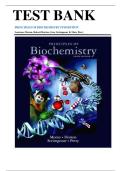
TEST BANK
PRINCIPLES OF BIOCHEMISTRY 5TH EDITION
Laurence Moran, Robert Horton, Gray Scrimgeour & Marc Perry
,Principles of Biochemistry, 5th Edition Test Bank By: Moran, Horton, Scrimgeour, Perry
Contents:
Chapter 1 Introduction to Biochemistry 1
Chapter 2 Water 10
Chapter 3 Amino Acids and the Primary Structures of Proteins 27
Chapter 4 Proteins: Three-Dimensional Structure and Function 46
Chapter 5 Properties of Enzymes 65
Chapter 6 Mechanisms of Enzymes 85
Chapter 7 Coenzymes and Vitamins 104
Chapter 8 Carbohydrates 119
Chapter 9 Lipids and Membranes 137
Chapter 10 Introduction to Metabolism 153
Chapter 11 Glycolysis 169
Chapter 12 Gluconeogenesis, The Pentose Phosphate Pathway,
and Glycogen Metabolism 185
Chapter 13 The Citric Acid Cycle 199
Chapter 14 Electron Transport and Oxidative Phosphorylation 213
Chapter 15 Photosynthesis 227
Chapter 16 Lipid Metabolism 241
Chapter 17 Amino Acid Metabolism 256
Chapter 18 Nucleotide Metabolism 269
Chapter 19 Nucleic Acids 284
Chapter 20 DNA Replication, Repair, and Recombination 300
Chapter 21 Transcription and RNA Processing 315
Chapter 22 Protein Synthesis 330
Chapter 23 Recombinant DNA Technology 348
,Chapter 1 Introduction to Biochemistry
1) Which elements account for more than 97% of the weight of most organisms?
A) C, H, N, Mg, O, S
B) C, H, N, O, P, S
C) C, H, N
D) Fe, C, H, O, P
E) Ca2+, K+, Na+, Mg2+, Cl-
Answer: B
Page Ref: Section 2
2) Proteins in biological membranes may be
A) porous.
B) attached to the membrane surface.
C) span the membrane.
D) All of the above
E) B and C only
Answer: D
Page Ref: Section 3
3) Which statement about cellulose is false?
A) It is the most abundant polysaccharide in nature.
B) Its monomers are joined by glycosidic bonds.
C) It is present in the stems of flowering plants.
D) The hydroxyl groups of neighboring cellulose molecules interact to form strong, insoluble
fibers.
E) It is a branched polymer of glucose.
Answer: E
Page Ref: Section 3
1
, 4) When sKeq sof sa s reaction s= s1, sthen
A) the sforward sreaction sis sfaster s than s the sreverse s reaction.
B) the sreverse s reaction sis sfaster s than s the sforward sreaction.
C) the sforward sand sreverse s reaction srate sconstants sare sequal.
D) more s products sare s formed sthan s reactants.
E) fewer s products sare s formed sthan s reactants.
Answer: s C
Page sRef: s Section s 4
5) Which sstatement sis strue sabout s a s reaction swith san sequilibrium sconstant, s Keq, sequal s to s1000?
A) The s forward srate sconstant s is s1000 stimes sgreater s than s the sreverse s rate sconstant.
B) The sforward srate sconstant s is s3 s times sgreater s than sreverse s rate sconstant.
C) The s forward srate sconstant s is s1000 stimes ssmaller sthan sthe sreverse s rate sconstant.
D) The s forward srate sconstant s is s3 s times ssmaller sthan sthe sreverse s rate sconstant.
E) There sis snot s enough s information s given sto scompare sthe sforward sand sreverse s rate
sconstants.
Answer: s A
Page sRef: s Section s 4
6) The s study s of sthe senergy s changes s during s metabolic sreactions s is scalled .
A) bioinformatics
B) metabodynamics
C) thermometrics
D) bioenergetics
E) biological sheat s dynamics
Answer: s D
Page sRef: s Section s 4
7) A sspontaneous s chemical s reaction salways s has s a change.
A) positive s Gibbʹs sfree s energy
B) negative sGibbʹs sfree s energy
C) positive senthalpy
D) negative senthalpy
E) positive sentropy
Answer: s B
Page sRef: s Section s 4
2
PRINCIPLES OF BIOCHEMISTRY 5TH EDITION
Laurence Moran, Robert Horton, Gray Scrimgeour & Marc Perry
,Principles of Biochemistry, 5th Edition Test Bank By: Moran, Horton, Scrimgeour, Perry
Contents:
Chapter 1 Introduction to Biochemistry 1
Chapter 2 Water 10
Chapter 3 Amino Acids and the Primary Structures of Proteins 27
Chapter 4 Proteins: Three-Dimensional Structure and Function 46
Chapter 5 Properties of Enzymes 65
Chapter 6 Mechanisms of Enzymes 85
Chapter 7 Coenzymes and Vitamins 104
Chapter 8 Carbohydrates 119
Chapter 9 Lipids and Membranes 137
Chapter 10 Introduction to Metabolism 153
Chapter 11 Glycolysis 169
Chapter 12 Gluconeogenesis, The Pentose Phosphate Pathway,
and Glycogen Metabolism 185
Chapter 13 The Citric Acid Cycle 199
Chapter 14 Electron Transport and Oxidative Phosphorylation 213
Chapter 15 Photosynthesis 227
Chapter 16 Lipid Metabolism 241
Chapter 17 Amino Acid Metabolism 256
Chapter 18 Nucleotide Metabolism 269
Chapter 19 Nucleic Acids 284
Chapter 20 DNA Replication, Repair, and Recombination 300
Chapter 21 Transcription and RNA Processing 315
Chapter 22 Protein Synthesis 330
Chapter 23 Recombinant DNA Technology 348
,Chapter 1 Introduction to Biochemistry
1) Which elements account for more than 97% of the weight of most organisms?
A) C, H, N, Mg, O, S
B) C, H, N, O, P, S
C) C, H, N
D) Fe, C, H, O, P
E) Ca2+, K+, Na+, Mg2+, Cl-
Answer: B
Page Ref: Section 2
2) Proteins in biological membranes may be
A) porous.
B) attached to the membrane surface.
C) span the membrane.
D) All of the above
E) B and C only
Answer: D
Page Ref: Section 3
3) Which statement about cellulose is false?
A) It is the most abundant polysaccharide in nature.
B) Its monomers are joined by glycosidic bonds.
C) It is present in the stems of flowering plants.
D) The hydroxyl groups of neighboring cellulose molecules interact to form strong, insoluble
fibers.
E) It is a branched polymer of glucose.
Answer: E
Page Ref: Section 3
1
, 4) When sKeq sof sa s reaction s= s1, sthen
A) the sforward sreaction sis sfaster s than s the sreverse s reaction.
B) the sreverse s reaction sis sfaster s than s the sforward sreaction.
C) the sforward sand sreverse s reaction srate sconstants sare sequal.
D) more s products sare s formed sthan s reactants.
E) fewer s products sare s formed sthan s reactants.
Answer: s C
Page sRef: s Section s 4
5) Which sstatement sis strue sabout s a s reaction swith san sequilibrium sconstant, s Keq, sequal s to s1000?
A) The s forward srate sconstant s is s1000 stimes sgreater s than s the sreverse s rate sconstant.
B) The sforward srate sconstant s is s3 s times sgreater s than sreverse s rate sconstant.
C) The s forward srate sconstant s is s1000 stimes ssmaller sthan sthe sreverse s rate sconstant.
D) The s forward srate sconstant s is s3 s times ssmaller sthan sthe sreverse s rate sconstant.
E) There sis snot s enough s information s given sto scompare sthe sforward sand sreverse s rate
sconstants.
Answer: s A
Page sRef: s Section s 4
6) The s study s of sthe senergy s changes s during s metabolic sreactions s is scalled .
A) bioinformatics
B) metabodynamics
C) thermometrics
D) bioenergetics
E) biological sheat s dynamics
Answer: s D
Page sRef: s Section s 4
7) A sspontaneous s chemical s reaction salways s has s a change.
A) positive s Gibbʹs sfree s energy
B) negative sGibbʹs sfree s energy
C) positive senthalpy
D) negative senthalpy
E) positive sentropy
Answer: s B
Page sRef: s Section s 4
2

