

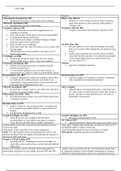
1865-1900
Positive Negative
Emancipation Proclamation 1863 Black Codes 1865-66
declared all slaves free in those states still in rebellion banned AA’s from voting, serving on juries, testifying
Thirteenth Amendment 1865 again white people in court, marrying white people or
abolished slavery in the United States. carrying a gun.
Freedmen’s Bureau 1865 Freedmen’s Bureau 1865
initially created for one year but a supplementary act Congress closed down the Freedmen’s Bureau in 1872
extended its existence
army officers and civilian agents were given responsibility
of aiding freed blacks to find work.
set up schools and colleges including Colleges of Higher
Education such as Fisk and Howard
black churches were established. Ku Klux Klan 1866
black men could vote, stand for election, serve on juries and the main objective was to stop black people from using
become judges their vote to ensure white, Democratic governments were
700 000 black men were enrolled to vote, there were 22 restore
black Congressmen began to also undermine the economic power of blacks
Civil Rights Act 1866 successful black businessmen were attacked and attempts
declared that all persons born in the US were citizens, to form black trade unions were quickly dealt with.
without regard to race, colour, or previous condition. was revived in 1915
Fourteenth Amendment 1867 Johnson
defined citizenship and ensured citizenship would be opposed Civil Rights legislation
extended to freed slaves
if a state denied suffrage to any of its male citizens, its
representation in Congress would be proportionally reduced
Reconstruction Acts 1867 Reconstruction Acts 1867
Congress suspended all southern governments and divided with the exception of Tennessee, all former Confederate
the south into five military districts, each district was states rejected the Fourteenth Amendment
controlled by a major general who oversaw elections with
freed male slaves being allowed to vote
Fifteenth Amendment 1869 share-cropping
declared that a citizens’ right to vote ‘shall not be denied by replaced slavery and meant freed slaves worked the land
any state on account of race, colour’ for a share of the crop but this system often kept blacks in
Enforcement Acts 1870 + 1871 poverty and debt as whites paid low prices for crops or
provided protection of black voters and Federal supervision deliberately cheated them
of Southern elections.
Klu Klux Klan Act 1871
made it a crime for ‘two or more persons’ to conspire and
go ‘in disguise upon public highway or upon premises of
another’.
Klu Klux Klan disappeared for a while
Second Civil Rights Act 1875 Second Civil Rights Act 1875
stated all persons were entitled to full and equal declared unconstitutional in 1883
accommodation in ‘inns, public conveyances on land or US vs Reece 1875
water, theatres and other places of public amusement’ supported Kentucky officials that turned away black voters
northern blacks did not face such extreme discrimination as those states rights- enabled white southerners to retain their old way life
living in the south. and limit the rights of African Americans
black ghetto- In the north, there was no legal segregation courts frequently upheld the removal of black civil rights
north- AA’s had a greater chance of exercising their right to vote black ghetto- frequently experienced discrimination
and their combined vote was capable of determining the outcome of
elections in some local areas
Strauder vs West Virginia 1879
stated that the 14th Amendment/ Second Civil Rights Act
meant that courts could not have a system that only allowed
white juries
decision of 8 southern states to introduce formal segregation on southern state governments felt free to disenfranchise black males
trains helped segregation to grow rapidly between 1887 and 1891. by exploiting loopholes in the Fifteenth Amendment by imposed
additional voting requirements which were technically non-racial
Positive Negative
Emancipation Proclamation 1863 Black Codes 1865-66
declared all slaves free in those states still in rebellion banned AA’s from voting, serving on juries, testifying
Thirteenth Amendment 1865 again white people in court, marrying white people or
abolished slavery in the United States. carrying a gun.
Freedmen’s Bureau 1865 Freedmen’s Bureau 1865
initially created for one year but a supplementary act Congress closed down the Freedmen’s Bureau in 1872
extended its existence
army officers and civilian agents were given responsibility
of aiding freed blacks to find work.
set up schools and colleges including Colleges of Higher
Education such as Fisk and Howard
black churches were established. Ku Klux Klan 1866
black men could vote, stand for election, serve on juries and the main objective was to stop black people from using
become judges their vote to ensure white, Democratic governments were
700 000 black men were enrolled to vote, there were 22 restore
black Congressmen began to also undermine the economic power of blacks
Civil Rights Act 1866 successful black businessmen were attacked and attempts
declared that all persons born in the US were citizens, to form black trade unions were quickly dealt with.
without regard to race, colour, or previous condition. was revived in 1915
Fourteenth Amendment 1867 Johnson
defined citizenship and ensured citizenship would be opposed Civil Rights legislation
extended to freed slaves
if a state denied suffrage to any of its male citizens, its
representation in Congress would be proportionally reduced
Reconstruction Acts 1867 Reconstruction Acts 1867
Congress suspended all southern governments and divided with the exception of Tennessee, all former Confederate
the south into five military districts, each district was states rejected the Fourteenth Amendment
controlled by a major general who oversaw elections with
freed male slaves being allowed to vote
Fifteenth Amendment 1869 share-cropping
declared that a citizens’ right to vote ‘shall not be denied by replaced slavery and meant freed slaves worked the land
any state on account of race, colour’ for a share of the crop but this system often kept blacks in
Enforcement Acts 1870 + 1871 poverty and debt as whites paid low prices for crops or
provided protection of black voters and Federal supervision deliberately cheated them
of Southern elections.
Klu Klux Klan Act 1871
made it a crime for ‘two or more persons’ to conspire and
go ‘in disguise upon public highway or upon premises of
another’.
Klu Klux Klan disappeared for a while
Second Civil Rights Act 1875 Second Civil Rights Act 1875
stated all persons were entitled to full and equal declared unconstitutional in 1883
accommodation in ‘inns, public conveyances on land or US vs Reece 1875
water, theatres and other places of public amusement’ supported Kentucky officials that turned away black voters
northern blacks did not face such extreme discrimination as those states rights- enabled white southerners to retain their old way life
living in the south. and limit the rights of African Americans
black ghetto- In the north, there was no legal segregation courts frequently upheld the removal of black civil rights
north- AA’s had a greater chance of exercising their right to vote black ghetto- frequently experienced discrimination
and their combined vote was capable of determining the outcome of
elections in some local areas
Strauder vs West Virginia 1879
stated that the 14th Amendment/ Second Civil Rights Act
meant that courts could not have a system that only allowed
white juries
decision of 8 southern states to introduce formal segregation on southern state governments felt free to disenfranchise black males
trains helped segregation to grow rapidly between 1887 and 1891. by exploiting loopholes in the Fifteenth Amendment by imposed
additional voting requirements which were technically non-racial

