

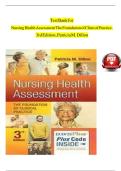
Test Bank for
| | |
Nursing Health Assessment The Foundation of Clinical Practice,
| | | | | | |
3rd Edition, Patricia M. Dillon
| | | | |
,Table of Contents
| |
1. Introduction to Assessment
| | |
2. Assessing the Integumentary System
| | | |
3. Assessing the Head, Face and Neck
| | | | | |
4. Assessing Eyes and the Ears
| | | | |
5. Assessing the Respiratory System
| | | |
6. Assessing the Cardiovascular System
| | | |
7. Assessing the Peripheral -Vascular and Lymphatic Systems
| | | | | | |
8. Assessing the Breasts
| | |
9. Assessing the Abdomen
| | |
10. Assessing the Female Genitourinary
| | | |
11. Assessing the Male Genitourinary
| | | |
12. Assessing the Motor Musculoskeletal System
| | | | |
13. Assessing the Sensory Neurological System
| | | | |
14. Assessing the Mother to Be
| | | | |
15. Assessing the Newborn and Infant
| | | | |
16. Assessing the Toddler and Preschooler
| | | | |
17. Assessing the School-Age Child and Adolescent
| | | | | |
18. Assessing the Older Adult
| | | |
19. Assessing the Homeless Person
| | | |
20. Assessing Pain
| |
,21. Approach to the Mental Health Assessment
| | | | | |
22. Assessing Nutrition
| |
23. Assessing Spirituality
| |
24. Assessing Culture
| |
25. Assessing the Patient’s Environment
| | | |
26. Assessing Abuse
| |
27. Assessing the Dying Patient—new
| | | |
, Chapter 01: The Complete Health Assessment
| | | | |
Multiple |Choice
Identify |the |choice |that |best |completes |the |statement |or |answers |the |question.
1. Which |critical |thinking |skill |allows |the |nurse |to |think |outside |of |the |box |when |assessing |a |patient?
1) Divergent |thinking
2) Reasoning
3) Creativity
4) Reflection
2. The |primary |level |of |preventive |health |care |focuses |on |which |topic?
1) Health |promotion
2) Early |detection
3) Promotion |intervention
4) End-of-life |care
3. The |nurse |is |prioritizing |data |collected |during |the |health |assessment. |Which |data |is |primary?
1) Pain |rating |of |4 |on |a |1 |to |10 |numeric |scale
2) New |diagnosis |of |type |2 |diabetes |mellitus |(DM)
3) Blood |pressure |of |130/90 |mmHg
4) Pulse |oximetry |reading |of |73%
4. Which |type |of |skill |is |most |important |when |performing |a |physical |assessment?
1) Psychomotor
2) Interpersonal
3) Ethical
4) Affective
5. Which |activity |is |an |example |of |secondary |prevention?
1) Wound |débridement
2) Immunization
3) Preoperative |teaching
4) Long-term |nasogastric |feedings
6. Which |assessment |data |is |considered |a |symptom?
1) Rapid |respirations
2) Sweaty |palms
3) Belching
4) Feelings |of |anxiety
7. Who |or |what |is |considered |the |primary |data |source |for |a |toddler-age |patient?
1) The |toddler
2) A |parent
3) The |medical |record
4) Other |healthcare |providers
8. Which |part |of |the |assessment |provides |the |most |subjective |data?
1) Health |history
2) Physical |assessment
3) Review |of |medical |records
4) Medication |record
| | |
Nursing Health Assessment The Foundation of Clinical Practice,
| | | | | | |
3rd Edition, Patricia M. Dillon
| | | | |
,Table of Contents
| |
1. Introduction to Assessment
| | |
2. Assessing the Integumentary System
| | | |
3. Assessing the Head, Face and Neck
| | | | | |
4. Assessing Eyes and the Ears
| | | | |
5. Assessing the Respiratory System
| | | |
6. Assessing the Cardiovascular System
| | | |
7. Assessing the Peripheral -Vascular and Lymphatic Systems
| | | | | | |
8. Assessing the Breasts
| | |
9. Assessing the Abdomen
| | |
10. Assessing the Female Genitourinary
| | | |
11. Assessing the Male Genitourinary
| | | |
12. Assessing the Motor Musculoskeletal System
| | | | |
13. Assessing the Sensory Neurological System
| | | | |
14. Assessing the Mother to Be
| | | | |
15. Assessing the Newborn and Infant
| | | | |
16. Assessing the Toddler and Preschooler
| | | | |
17. Assessing the School-Age Child and Adolescent
| | | | | |
18. Assessing the Older Adult
| | | |
19. Assessing the Homeless Person
| | | |
20. Assessing Pain
| |
,21. Approach to the Mental Health Assessment
| | | | | |
22. Assessing Nutrition
| |
23. Assessing Spirituality
| |
24. Assessing Culture
| |
25. Assessing the Patient’s Environment
| | | |
26. Assessing Abuse
| |
27. Assessing the Dying Patient—new
| | | |
, Chapter 01: The Complete Health Assessment
| | | | |
Multiple |Choice
Identify |the |choice |that |best |completes |the |statement |or |answers |the |question.
1. Which |critical |thinking |skill |allows |the |nurse |to |think |outside |of |the |box |when |assessing |a |patient?
1) Divergent |thinking
2) Reasoning
3) Creativity
4) Reflection
2. The |primary |level |of |preventive |health |care |focuses |on |which |topic?
1) Health |promotion
2) Early |detection
3) Promotion |intervention
4) End-of-life |care
3. The |nurse |is |prioritizing |data |collected |during |the |health |assessment. |Which |data |is |primary?
1) Pain |rating |of |4 |on |a |1 |to |10 |numeric |scale
2) New |diagnosis |of |type |2 |diabetes |mellitus |(DM)
3) Blood |pressure |of |130/90 |mmHg
4) Pulse |oximetry |reading |of |73%
4. Which |type |of |skill |is |most |important |when |performing |a |physical |assessment?
1) Psychomotor
2) Interpersonal
3) Ethical
4) Affective
5. Which |activity |is |an |example |of |secondary |prevention?
1) Wound |débridement
2) Immunization
3) Preoperative |teaching
4) Long-term |nasogastric |feedings
6. Which |assessment |data |is |considered |a |symptom?
1) Rapid |respirations
2) Sweaty |palms
3) Belching
4) Feelings |of |anxiety
7. Who |or |what |is |considered |the |primary |data |source |for |a |toddler-age |patient?
1) The |toddler
2) A |parent
3) The |medical |record
4) Other |healthcare |providers
8. Which |part |of |the |assessment |provides |the |most |subjective |data?
1) Health |history
2) Physical |assessment
3) Review |of |medical |records
4) Medication |record

