

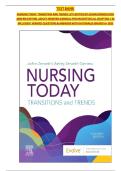
TESTBANK
NURSING TODAY: TRANSITION AND TRENDS 11TH EDITION BY JOANN ZERWEKH EDD
Q MSN RN (EDITOR), ASHLEY ZERWEKH GARNEAU PHD RN (EDITOR) ALL CHAPTERS
Q INCLUDED| VERIFIED QUESTIONS & ANSWERS WITH RATIONALES GRADED A+
,TABLE OF CONTENT q q
UNIT I: PROFESSIONAL GROWTH AND TRANSITION
q q q q q
1. Role Transitions
q q
2. Personal Management: Time and Self-Care Strategies
q q q q q q
3. Mentorship, Preceptorship, and Nurse Residency Programs
q q q q q q
4. Employment Considerations:Opportunities, Resumes, and Interviewing
q q q q q
5. NCLEX-RN Exam® and the New Graduate
q q q q q q
UNIT II: NURSING: A DEVELOPING PROFESSION
q q q q q
6. Historical Perspectives: Influences on the Present
q q q q q q
7. Nursing Education
q q
8. Nursing Theories
q q
9. Professional Image of Nursing
q q q q
UNIT III: NURSING MANAGEMENT
q q q
10. Challenges of Nursing Management and Leadership
q q q q q q
11. Building Nursing Management Skills
q q q q
12. Effective Communication, Team Building, and Interprofessional Practice
q q q q q q q
13. Conflict Management
q q
14. Delegation in the Clinical Setting
q q q q q
UNIT IV: CURRENT ISSUES IN HEALTH CARE
q q q q q q
15. The Health Care Organization and Patterns of Nursing Care Delivery
q q q q q q q q q q
16. Economics of the Health Care Delivery System
q q q q q q q
17. Political Action in Nursing, 397
q q q q q
18. Collective Bargaining: Traditional (Union) and Nontraditional Approaches
q q q q q q q
19. Ethical Issues
q q
20. Legal Issues
q q
UNIT V: CONTEMPORARY NURSING PRACTICE
q q q q
21. Cultural and Spiritual Awareness
q q q q
22. Quality Patient Care
q q q
23. Nursing Informatics
q q
24. Using Evidence-Based Practice and Nursing Research
q q q q q q
25. Workplace Issues
q q
26. Emergency Preparedness
q q
,Chapter 01: Role Transitions
q q q
MULTIPLE CHOICE q
1. A graduate nurse has been hired as a nurse at a local h o spiat bai lr b. . T
q
c ohme/ t ens et w nurse is in the
q q q q q q q q q q q
q
q q q q
honeymoon phase of role transition when making which of the following statements?
q q q q q q q q q q q q
a. “I am so nervous about being on my own as a nurse.”
q q q q q q q q q q q
b. “This will be a great learning experience.” q q q q q q
c. “I can’t wait to have a steady paycheck.”
q q q q q q q
d. “This job is perfect. I can finally do things my own way.” q q q q q q q q q q q
ANS: D q
The honeymoon phase is when the student nurse sees the world of nursing as quite rosy. Often, the
q q q q q q q q q q q q q q q q q
new graduate is fascinated with the thrill of arriving in the profession. Reality shock occurs when
q q q q q q q q q q q q q q q q
one moves into the workforce after several years of educational preparation. Recovery and
q q q q q q q q q q q q q
resolutionoccur whenthe gr a d aubai rtbe. c no mu /rt se es t is able to laugh at encountered situations. During this
q q q q q
q
q q q q q q q q
time, tension decreases, perception increases, and the nurse is able to grow as a person.
q q q q q q q q q q q q q q q
PTS: 1 DIF: Cognitive Level: Application/Applying
q q q
REF: Table 1.1
q OBJ: Identify the characteristics of reality shock.
q q q q q q q q
TOP: Reality shock q MSC: NCLEX®: Safe and effective care environment q q q q q q q
2. Which of the following actions by the graduate nurse is an inappropriate methodology to
q q q q q q q q q q q q q
recover from reality shock?
q q q q
a. Networking
b. Obtaining a mentor q q
c. Returning to school q q
d. Joining a support group q q q
ANS: C q
The transition period is successfully managed when the graduate is able to evaluate the work
q q q q q q q q q q q q q q
situation objectively and predict effectively the actions and reactions of other staff. Nurturing the
q q q q q q q q q q q q q q
ability to see humor in a situation maybe a first step. Ra bei tr bu. rc no mi n/ t ge s tt o school is a positive stepafter the
q q q q q q q q q q q q q q q q q q q q
graduate has worked through role transition, has some clinical experience, and is ready to focus
q q q q q q q q q q q q q q q
on a new career objective. Networking, obtaining a mentor, and joining a
q q q q q q q q q q q q
support group would give the graduate nurse an opportuniatyb i rtbo.c ot mal/ ktestto others experiencing the
q q q q q q q q q q q
stress associated with reality shock. The nurse would benefit from “talking through” issues and
q q q q q q q q q q q q q q
learning how to cope.
q q q q
PTS: q 1
q DIF: Cognitive Level: Application/Appalbyiribn.gcom/test q q
REF: q p. 9 OBJ: Describe methods to promote a successful transition.
q q q q q q q q
TOP:
q q Reality shock q
MSC: q NCLEX®: Safe and effective care environment Not applicable q q q q q q q
3. A nurse is trying to avoid burnout. Which of the following actions is a valid way to achieve this?
q q q q q q q q q q q q q q q q q q
a. Refusing to constantly work extra shifts q q q q q
b. Withdrawing from peer support group q q q q
, c. “Going native” q
d. Changing jobs every 6 to 12 months q q q q q q
ANS: A q
One of the quickest ways to experience burnout is to “overwork the overtime.” Set priorities with
q q q q q q q q q q q q q q q
your mental and physical health being the highest priority. Learning to say “no” to extra shifts is a
q q q q q q q q q q q q q q q q q q
positive means of coping of avoiding burnout. “aGbiorbi.ncogmn/taestitve” is the term thatdescribes how
q q q q q q q q q q q q q q q
recent graduates begin to copy and identify the reality of their role-transition experience by
q q q q q q q q q q q q q q
rejecting the values from nursing school and functioning more like a team member at their place of
q q q q q q q q q q q q q q q q q
employment. Withdrawing from peer support groups, “going native,”
q q q q q q q q
a bi rb .c o m /t es t
and changing jobs every 6 to 12 months would increase th e c h a n c e o f the nurse experiencing
q
q q q q q q q q q q q q q
burnout. The nurse should instead focus on his/her practice and seek out support from other nurses.
q q q q q q q q q q q q q q q
PTS: q 1
q DIF: Cognitive Level: Application/Applying q q
REF: q p. 7 OBJ: Describe methods to promote a successful transition.
q q q q q q q q
TOP:
q q Reality shock q
MSC: q NCLEX®: Safe and effective care environment Not appalibcirabb.cloem/test q q q q q q q
4. Which of the following statements by the graduate nurse shows an understanding of reality
q q q q q q q q q q q q q
shock as it applies to nursing?
q q q q q q
a. “Reality shock is the period when a person moves from school into the q q q q q q q q q q q q
workforce.” q
b. “Reality shock is the realization that practice and education are not the same.” q q q q q q q q q q q q
c. “Realityshock is the period from graduation to becomai bni gr b.ac onme/txespt erienced nurse.” q q q q q q q q q
d. “Reality shock is a transition phase that new graduates go through before changing q q q q q q q q q q q q
jobs.” q
ANS: A q
“Reality shock” is a term often used to describe the reaction experienced when one moves into the
q q q q q q q q q q q q q q q q
workforce after several years of educational preparation. The new graduate is caught in the situation
q q q q q q q q q q q q q q q
ofmoving from afamiliar, comfortableedu cat i o na bai lr be. cno vmi/ treosnt ment into anew rolein
q q q q q q q
q
q q q q q
the workforce where the expectations are not clearly defined or may not even be realistic. The
q q q q q q q q q q q q q q q
realization that practice and nursing school are not the same is often associated with “going q q q q q q q q q q q q q q
native.” When nurses move from one position to another, they have already experienced reality
q q q q q q q q q q q q q q
shock. Becoming an experienced nurse takes time aanb idr b .icso mn /ot et s pt art of the definition ofreality
q q q q q q q q
q
q q q q q
shock.
q
PTS: 1 DIF: Cognitive Level: Application/Applying
q q q
a b i rb . c o m /t est
REF: p. 5
q OBJ: Identify the characteristics of reali t y s h o ck .
q q q q q q q
TOP: Reality shock q MSC: NCLEX®: Not applicable q q q q
5. A student in the last semester of nursing school has establiasbhi r eb .dc oam /gt eos at l of making a successfulrole
q q q q q q q q q q q q q q q q
transition to graduate nurse. Which statement by the student indicates his/her understanding of
q q q q q q q q q q q q q
how to achieve this goal?
q q q q q
a. “Ishould care for increased numbers of patients to enhance work organization
q q q q q q q q q q q
skills.”
b. “I will observe staff nurses as they perform nursing procedures to refine
q q q q q q q q q q q
technique.” q
c. “Ishould seek increasingly close guidance from the nuarbsi ribn. cgo mi n/ t se ts rt uctor to reduce
q q q q q q q q q q q
errors.” q
abirb.com/test
NURSING TODAY: TRANSITION AND TRENDS 11TH EDITION BY JOANN ZERWEKH EDD
Q MSN RN (EDITOR), ASHLEY ZERWEKH GARNEAU PHD RN (EDITOR) ALL CHAPTERS
Q INCLUDED| VERIFIED QUESTIONS & ANSWERS WITH RATIONALES GRADED A+
,TABLE OF CONTENT q q
UNIT I: PROFESSIONAL GROWTH AND TRANSITION
q q q q q
1. Role Transitions
q q
2. Personal Management: Time and Self-Care Strategies
q q q q q q
3. Mentorship, Preceptorship, and Nurse Residency Programs
q q q q q q
4. Employment Considerations:Opportunities, Resumes, and Interviewing
q q q q q
5. NCLEX-RN Exam® and the New Graduate
q q q q q q
UNIT II: NURSING: A DEVELOPING PROFESSION
q q q q q
6. Historical Perspectives: Influences on the Present
q q q q q q
7. Nursing Education
q q
8. Nursing Theories
q q
9. Professional Image of Nursing
q q q q
UNIT III: NURSING MANAGEMENT
q q q
10. Challenges of Nursing Management and Leadership
q q q q q q
11. Building Nursing Management Skills
q q q q
12. Effective Communication, Team Building, and Interprofessional Practice
q q q q q q q
13. Conflict Management
q q
14. Delegation in the Clinical Setting
q q q q q
UNIT IV: CURRENT ISSUES IN HEALTH CARE
q q q q q q
15. The Health Care Organization and Patterns of Nursing Care Delivery
q q q q q q q q q q
16. Economics of the Health Care Delivery System
q q q q q q q
17. Political Action in Nursing, 397
q q q q q
18. Collective Bargaining: Traditional (Union) and Nontraditional Approaches
q q q q q q q
19. Ethical Issues
q q
20. Legal Issues
q q
UNIT V: CONTEMPORARY NURSING PRACTICE
q q q q
21. Cultural and Spiritual Awareness
q q q q
22. Quality Patient Care
q q q
23. Nursing Informatics
q q
24. Using Evidence-Based Practice and Nursing Research
q q q q q q
25. Workplace Issues
q q
26. Emergency Preparedness
q q
,Chapter 01: Role Transitions
q q q
MULTIPLE CHOICE q
1. A graduate nurse has been hired as a nurse at a local h o spiat bai lr b. . T
q
c ohme/ t ens et w nurse is in the
q q q q q q q q q q q
q
q q q q
honeymoon phase of role transition when making which of the following statements?
q q q q q q q q q q q q
a. “I am so nervous about being on my own as a nurse.”
q q q q q q q q q q q
b. “This will be a great learning experience.” q q q q q q
c. “I can’t wait to have a steady paycheck.”
q q q q q q q
d. “This job is perfect. I can finally do things my own way.” q q q q q q q q q q q
ANS: D q
The honeymoon phase is when the student nurse sees the world of nursing as quite rosy. Often, the
q q q q q q q q q q q q q q q q q
new graduate is fascinated with the thrill of arriving in the profession. Reality shock occurs when
q q q q q q q q q q q q q q q q
one moves into the workforce after several years of educational preparation. Recovery and
q q q q q q q q q q q q q
resolutionoccur whenthe gr a d aubai rtbe. c no mu /rt se es t is able to laugh at encountered situations. During this
q q q q q
q
q q q q q q q q
time, tension decreases, perception increases, and the nurse is able to grow as a person.
q q q q q q q q q q q q q q q
PTS: 1 DIF: Cognitive Level: Application/Applying
q q q
REF: Table 1.1
q OBJ: Identify the characteristics of reality shock.
q q q q q q q q
TOP: Reality shock q MSC: NCLEX®: Safe and effective care environment q q q q q q q
2. Which of the following actions by the graduate nurse is an inappropriate methodology to
q q q q q q q q q q q q q
recover from reality shock?
q q q q
a. Networking
b. Obtaining a mentor q q
c. Returning to school q q
d. Joining a support group q q q
ANS: C q
The transition period is successfully managed when the graduate is able to evaluate the work
q q q q q q q q q q q q q q
situation objectively and predict effectively the actions and reactions of other staff. Nurturing the
q q q q q q q q q q q q q q
ability to see humor in a situation maybe a first step. Ra bei tr bu. rc no mi n/ t ge s tt o school is a positive stepafter the
q q q q q q q q q q q q q q q q q q q q
graduate has worked through role transition, has some clinical experience, and is ready to focus
q q q q q q q q q q q q q q q
on a new career objective. Networking, obtaining a mentor, and joining a
q q q q q q q q q q q q
support group would give the graduate nurse an opportuniatyb i rtbo.c ot mal/ ktestto others experiencing the
q q q q q q q q q q q
stress associated with reality shock. The nurse would benefit from “talking through” issues and
q q q q q q q q q q q q q q
learning how to cope.
q q q q
PTS: q 1
q DIF: Cognitive Level: Application/Appalbyiribn.gcom/test q q
REF: q p. 9 OBJ: Describe methods to promote a successful transition.
q q q q q q q q
TOP:
q q Reality shock q
MSC: q NCLEX®: Safe and effective care environment Not applicable q q q q q q q
3. A nurse is trying to avoid burnout. Which of the following actions is a valid way to achieve this?
q q q q q q q q q q q q q q q q q q
a. Refusing to constantly work extra shifts q q q q q
b. Withdrawing from peer support group q q q q
, c. “Going native” q
d. Changing jobs every 6 to 12 months q q q q q q
ANS: A q
One of the quickest ways to experience burnout is to “overwork the overtime.” Set priorities with
q q q q q q q q q q q q q q q
your mental and physical health being the highest priority. Learning to say “no” to extra shifts is a
q q q q q q q q q q q q q q q q q q
positive means of coping of avoiding burnout. “aGbiorbi.ncogmn/taestitve” is the term thatdescribes how
q q q q q q q q q q q q q q q
recent graduates begin to copy and identify the reality of their role-transition experience by
q q q q q q q q q q q q q q
rejecting the values from nursing school and functioning more like a team member at their place of
q q q q q q q q q q q q q q q q q
employment. Withdrawing from peer support groups, “going native,”
q q q q q q q q
a bi rb .c o m /t es t
and changing jobs every 6 to 12 months would increase th e c h a n c e o f the nurse experiencing
q
q q q q q q q q q q q q q
burnout. The nurse should instead focus on his/her practice and seek out support from other nurses.
q q q q q q q q q q q q q q q
PTS: q 1
q DIF: Cognitive Level: Application/Applying q q
REF: q p. 7 OBJ: Describe methods to promote a successful transition.
q q q q q q q q
TOP:
q q Reality shock q
MSC: q NCLEX®: Safe and effective care environment Not appalibcirabb.cloem/test q q q q q q q
4. Which of the following statements by the graduate nurse shows an understanding of reality
q q q q q q q q q q q q q
shock as it applies to nursing?
q q q q q q
a. “Reality shock is the period when a person moves from school into the q q q q q q q q q q q q
workforce.” q
b. “Reality shock is the realization that practice and education are not the same.” q q q q q q q q q q q q
c. “Realityshock is the period from graduation to becomai bni gr b.ac onme/txespt erienced nurse.” q q q q q q q q q
d. “Reality shock is a transition phase that new graduates go through before changing q q q q q q q q q q q q
jobs.” q
ANS: A q
“Reality shock” is a term often used to describe the reaction experienced when one moves into the
q q q q q q q q q q q q q q q q
workforce after several years of educational preparation. The new graduate is caught in the situation
q q q q q q q q q q q q q q q
ofmoving from afamiliar, comfortableedu cat i o na bai lr be. cno vmi/ treosnt ment into anew rolein
q q q q q q q
q
q q q q q
the workforce where the expectations are not clearly defined or may not even be realistic. The
q q q q q q q q q q q q q q q
realization that practice and nursing school are not the same is often associated with “going q q q q q q q q q q q q q q
native.” When nurses move from one position to another, they have already experienced reality
q q q q q q q q q q q q q q
shock. Becoming an experienced nurse takes time aanb idr b .icso mn /ot et s pt art of the definition ofreality
q q q q q q q q
q
q q q q q
shock.
q
PTS: 1 DIF: Cognitive Level: Application/Applying
q q q
a b i rb . c o m /t est
REF: p. 5
q OBJ: Identify the characteristics of reali t y s h o ck .
q q q q q q q
TOP: Reality shock q MSC: NCLEX®: Not applicable q q q q
5. A student in the last semester of nursing school has establiasbhi r eb .dc oam /gt eos at l of making a successfulrole
q q q q q q q q q q q q q q q q
transition to graduate nurse. Which statement by the student indicates his/her understanding of
q q q q q q q q q q q q q
how to achieve this goal?
q q q q q
a. “Ishould care for increased numbers of patients to enhance work organization
q q q q q q q q q q q
skills.”
b. “I will observe staff nurses as they perform nursing procedures to refine
q q q q q q q q q q q
technique.” q
c. “Ishould seek increasingly close guidance from the nuarbsi ribn. cgo mi n/ t se ts rt uctor to reduce
q q q q q q q q q q q
errors.” q
abirb.com/test

