

ARM 401 – 4 UPDATED ACTUAL Questions and CORRECT Answers
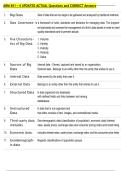
1. Big Data Sets of data that are too large to be gathered and analyzed by traditional methods.
2. Data Governance Is a framework of rules, standards and decisions for managing data. The program
set standards and oversee the management of a firm's data assets in order to meet
quality standards and to prevent abuse.
3. Five Characteris- 1. Volume
tics of Big Data 2. Variety
3. Velocity
4. Veracity
5. Value
4. Sources of Big Internal data - Owned, captured and stored by an organization.
Data External data - Belongs to an entity other than the entity that wishes to use it.
5. Internal Data Data owned by the entity that uses it.
6. External Data Belongs to an entity other than the entity that wishes to use it.
7. Structured Data Is data organized into databases
with defined fields and links between and among
databases.
8. Unstructured Is data that is not organized and
Data that often consists of text, images, and nontraditional media.
9. Third-party data Geo-demographic data (classification of population), economic data (interest
includes rates, assets prices, exchange rates and consumer pricing index) and credit rating
10. Economic data. Includes interest rates, asset prices, exchange rates, and the consumer price index
11. Geodemograph- Regards classifications of population groups.
ic data
, 12. Big Data Cate- 1. External and structured - telematics, financial data, labor statistics.
gories 2. External and unstructured - Social media, new reports and internet videos.
3. Internal and Structured - Policy information, claims history and customer data.
4. Internal and unstructured - Adjusters notes, customer voice recordings and
surveillance videos.
13. Predictive Model- Uses a defined target variable to predict or estimate an unknown outcome. Used
ing to predict future values and estimate unknown past or present values.
14. Target Variable Is the attribute whose value is being predicted in a data analytical model.
15. Seven Steps in 1. Gather historic data.
Building a Predic- 2. Divide date into training data and holdout data.
tive Model 3. Build the model using the training data.
4. Apply the model using the training data.
5. Use performance metrics to evaluate the model.
6. Use feedback to adjust the model, repeating Steps 3, 4 and 5 as needed.
7. Put the model into production and reevaluate as needed.
16. Training a Predic- Using existing data to create predictive models that help them anticipate behaviors.
tive Model
17. Training Data Data that is used to train a predictive model and that therefore must have known
values for the target variable of the model.
18. Overfitting Occurs when the model is so closely tailored to the training data that it is not
effective on other, new data.
19. Holdout Data Existing data with a known target variable that is held back and not used as part of
the training data. The data is used to test the model to make sure that it performs
well on known data.
20. Generalization A model's ability to apply itself to data outside the training data.
2/6
1. Big Data Sets of data that are too large to be gathered and analyzed by traditional methods.
2. Data Governance Is a framework of rules, standards and decisions for managing data. The program
set standards and oversee the management of a firm's data assets in order to meet
quality standards and to prevent abuse.
3. Five Characteris- 1. Volume
tics of Big Data 2. Variety
3. Velocity
4. Veracity
5. Value
4. Sources of Big Internal data - Owned, captured and stored by an organization.
Data External data - Belongs to an entity other than the entity that wishes to use it.
5. Internal Data Data owned by the entity that uses it.
6. External Data Belongs to an entity other than the entity that wishes to use it.
7. Structured Data Is data organized into databases
with defined fields and links between and among
databases.
8. Unstructured Is data that is not organized and
Data that often consists of text, images, and nontraditional media.
9. Third-party data Geo-demographic data (classification of population), economic data (interest
includes rates, assets prices, exchange rates and consumer pricing index) and credit rating
10. Economic data. Includes interest rates, asset prices, exchange rates, and the consumer price index
11. Geodemograph- Regards classifications of population groups.
ic data
, 12. Big Data Cate- 1. External and structured - telematics, financial data, labor statistics.
gories 2. External and unstructured - Social media, new reports and internet videos.
3. Internal and Structured - Policy information, claims history and customer data.
4. Internal and unstructured - Adjusters notes, customer voice recordings and
surveillance videos.
13. Predictive Model- Uses a defined target variable to predict or estimate an unknown outcome. Used
ing to predict future values and estimate unknown past or present values.
14. Target Variable Is the attribute whose value is being predicted in a data analytical model.
15. Seven Steps in 1. Gather historic data.
Building a Predic- 2. Divide date into training data and holdout data.
tive Model 3. Build the model using the training data.
4. Apply the model using the training data.
5. Use performance metrics to evaluate the model.
6. Use feedback to adjust the model, repeating Steps 3, 4 and 5 as needed.
7. Put the model into production and reevaluate as needed.
16. Training a Predic- Using existing data to create predictive models that help them anticipate behaviors.
tive Model
17. Training Data Data that is used to train a predictive model and that therefore must have known
values for the target variable of the model.
18. Overfitting Occurs when the model is so closely tailored to the training data that it is not
effective on other, new data.
19. Holdout Data Existing data with a known target variable that is held back and not used as part of
the training data. The data is used to test the model to make sure that it performs
well on known data.
20. Generalization A model's ability to apply itself to data outside the training data.
2/6

