
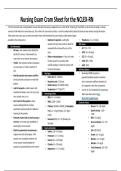
Nursing Exam Cram Sheet for the NCLEX-RN
The final mountain that nursing students must summit before becoming a registered nurse is the NCLEX. Preparing for the NCLEX can be stressful as taking in colossal
amounts of information has never been easy. This is where this cram sheet can help-- it contains condensed facts about the licensure exam and key nursing information.
When exam time comes, you can write and transfer these vital information from your head to a blank sheet of paper
provided by the testing center. • Rephrase the question—putting the • Phosphorus: 2.5—4.5 mEq/L
question into your own words can pluck the 5. ABG Values
1. Test Information • pH: 7.36—7.45
unneeded info and reveal the core of the
• Six hours—the maximum time allotted for
stem. • HCO3: 24—26 mEq/L
the NCLEX is 6 hours. Take breaks if you
• Make an educated guess—if you can’t make • CO2: 35—45 mEq/L
need a time out or need to move around.
the best answer for a question after • PaO2: 80%—100%
• 75/265—the minimum number of questions
carefully reading it, choose the answer with • SaO2: >95%
you can answer is 75 and a maximum of
the most information. 6. Acid-Base Balance
265.
2. Vital Signs • Remember ROME (respiratory
• Read the question and answers carefully—
• Heart rate: 80—100 bpm opposite/metabolic equal) to remember
do not jump into conclusions or make wild
• Respiratory rate: 12-20 rpm that in respiratory acid/base disorders the
guesses. • Blood pressure: 110-120/60 mmHg pH is opposite to the other components.
• Look for keywords—Avoid answers with • Temperature: 37 °C (98.6 °F) • Use the Tic-Tac-Toe Method for interpreting
absolutes like always, never, all, every, only,
3. Hematology values ABGs. Read more about it here
must, except, none, or no. • RBCs: 4.5—5.0 million (http://bit.ly/abgtictactoe).
• Don’t read into the question—Never • WBCs: 5,000—10,000 7. Chemistry Values
assume anything that has not been • Platelets: 200,000—400,000 Hemoglobin • Glucose: 70—110 mg/dL
specifically mentioned and don’t add extra • Specific Gravity: 1.010—
(Hgb): 12—16 gm (female); 14—18 gm
meaning to the question. 1.030
(male).
• Eliminate answers that are clearly wrong or • BUN: 7-22 mg/dL
• Hematocrit (Hct): 37—47 (female); 40—
incorrect—to increase your probability of • Serum creatinine: 0.6—1.35
54 (male)
selecting the correct answer! mg/dL
4. Serum electrolytes
• Watch for grammatical inconsistencies— • Sodium: 135—145 mEq/L • LDH: 100-190 U/L
Subjects and verbs should agree. If the
• Potassium: 3.5—5.5 mEq/L • Protein: 6.2—8.1 g/dL
question is an incomplete sentence, the • Albumin: 3.4—5.0 g/dL
• Calcium: 8.5—10.9 mEq/L
correct answer should complete the • Bilirubin: <1.0 mg/dL
• Chloride: 95—105 mEq/L
question in a grammatically correct manner. • Total Cholesterol: 130—200
• Magnesium: 1.5—2.5 mEq/L
mg/dL
, 8. Therapeutic Drug Levels
• Carbamazepine (Tegretol): 4—10 mcg/ml
• Digoxin (Lanoxin): 0.8—2.0 ng/ml
• Gentamycin (Garamycin): 5—10 mcg/ml
(peak), <2.0 mcg/ml (valley)
• Triglyceride: 40—50 mg/dL • CPK: 21-232 U/L • Lithium (Eskalith): 0.8—1.5 mEq/L
• Phenobarbital (Solfoton): 15—40 mcg/mL
• Uric acid: 3.5—7.5 mg/dL
• Phenytoin (Dilantin): 10—20 mcg/dL
• 1 gram (g) = 1,000 mg
• Theophylline (Aminophylline): 10—20
• 1 kilogram (kg) = 2.2 lbs
mcg/dL
• 1 lb = 16 oz
• Tobramycin (Tobrex): 5—10 mcg/mL
• Convert C to F: C+40 multiply by 9/5 and subtract 40
(peak), 0.5—2.0 mcg/mL (valley)
• Convert F to C: F+40 11. Maternity Normal Values • Valproic Acid (Depakene): 50—100 mcg/ml
multiply by 5/9 and
• Vancomycin (Vancocin): 20—40 mcg/ml
subtract 40
(peak), 5 to 15 mcg/ml (trough)
• Fetal Heart Rate: 120—160 bpm
• Variability: 6—10 bpm
• Amniotic fluid: 500—1200 ml
• Contractions: 2—5 minutes apart with duration of < 90 seconds and intensity of
9. Anticoagulant therapy
<100 mmHg.
• Sodium warfarin (Coumadin) PT: 10—12
• APGAR Scoring: Appearance, Pulses, Grimace, Activity, Reflex Irritability. Done at 1
seconds (control). The antidote is Vitamin K.
and 5 minutes with a score of 0 for absent, 1 for decreased, and 2 for strongly
positive. Scores 7 and above are generally normal, 4 to 6 fairly low, and 3 and • INR (Coumadin): 0.9—1.2
• Heparin PTT: 30—45 seconds (control).
below are generally regarded as critically low.
The antidote is protamine sulfate.
• AVA: The umbilical cord has two arteries and one vein.
APTT: 23.3—31.9 seconds
• Stop infusion of Pitocin.
• Fibrinogen level: 203—377 mg/dL
• Turn the client on her left 12. STOP—Treatment for maternal hypotension
side. after an epidural anesthesia:
10. Conversions
• 1 teaspoon (t) = 5 ml
13. Pregnancy Category of Drugs • 1 pint = 2 cups
Administer
Category B—No risk in
oxygen. other studies.
• 1 tablespoon (T) = 3 t = 15 ml If hypovolemia is present, push IV fluids. • 1 grain (gr) = 60 mg
Examples: Amoxicillin,
• 1 oz = 30 ml
Cefotaxime.
• 1 cup = 8 oz Category A—No risk in controlled human • Category C—Risk not ruled
• 1 quart = 2 pints studies out. Examples: Rifampicin

