
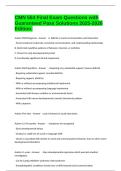
CMN 554 Final Exam Questions with
Guaranteed Pass Solutions 2025-2026
Edition.
Autism DSM Diagnosis - Answer A. Deficits in social communication and interaction
- Social emotional reciprocity, nonverbal communication, and understanding relationships
B. Restricted repetitive patterns of behavior, interests, or activities
C. Present in early developmental period
D. Functionally significant clinical impairment
Autism DSM Specifiers - Answer - Requiring very substantial support: (severe deficits)
- Requiring substantial support: (marked deficits)
- Requiring support: (deficits)
- With or without accompanying intellectual impairment
- With or without accompanying language impairment
- Associated with known condition or environmental factor
- Associated with neuro-developmental, mental, behavioral problem
- With catatonia
Autism First Year - Answer Lack of interest in social interaction
Autism 12-24 months - Answer - Symptoms are recognized
- Early developmental delays
- Gradual or rapid loss of social or language skills
- Onset is associated with decline in social and communication behaviors (rare in other neuro-
developmental disorders)
Autism 2+ years - Answer - Rare developmental regression which warrants medical
investigation
- Can be Landau-Kleffner syndrome, Rett syndrome
- Encephalopathic conditions involve loss of skills beyond social communication
, - Odd play patterns (carrying toys and not playing with them)
- Unusual communication patterns (knows alphabet but does not respond to name)
Autism Preschool - Answer - Odd and repetitive behaviors in the absence of play are more
apparent
- Difficult to differentiate neurotypical children who also have strong preferences and enjoy
repetition
- Distinction based on type, frequency, and intensity of behaviors
Autism Course - Answer - Early childhood and school years: symptoms are most marked
- Later childhood: developmental gains, increased interest in social interactions
- Adolescence: Most improve, some deteriorate behaviorally
- Adulthood: independent function possible, prone to anxiety and depression, socially naive and
vulnerable
- Old age: Little known, higher rates of co-occurring medical diagnosis
Autism Social Impairment - Answer - Social interest can increase with interventions
- Echolalia: reflects tendency toward gestalt learning style (learning in chunk)
- Tone, volume, pronouns, reciprocal language
- Idiosyncratic language that only parents understand
- Sarcasm, irony, humor, prosody, perception, social cues
Autism Intellectual Symptoms - Answer - 33% meet criteria for intellectual disability (IQ<70)
- 24% borderline (IQ 75-85)
- Strength in verbal versus perceptual reasoning with higher functioning individuals
- Can have above average skill in one area
Autism Treatment - Answer - No treatment reverses symptoms
- Interventions are tailored to person's symptoms
- 15 hours per week recommended at young age
- Applied Behavioral Analysis: examine and manipulate contingencies that create behaviors and
decrease maladaptive responses
Guaranteed Pass Solutions 2025-2026
Edition.
Autism DSM Diagnosis - Answer A. Deficits in social communication and interaction
- Social emotional reciprocity, nonverbal communication, and understanding relationships
B. Restricted repetitive patterns of behavior, interests, or activities
C. Present in early developmental period
D. Functionally significant clinical impairment
Autism DSM Specifiers - Answer - Requiring very substantial support: (severe deficits)
- Requiring substantial support: (marked deficits)
- Requiring support: (deficits)
- With or without accompanying intellectual impairment
- With or without accompanying language impairment
- Associated with known condition or environmental factor
- Associated with neuro-developmental, mental, behavioral problem
- With catatonia
Autism First Year - Answer Lack of interest in social interaction
Autism 12-24 months - Answer - Symptoms are recognized
- Early developmental delays
- Gradual or rapid loss of social or language skills
- Onset is associated with decline in social and communication behaviors (rare in other neuro-
developmental disorders)
Autism 2+ years - Answer - Rare developmental regression which warrants medical
investigation
- Can be Landau-Kleffner syndrome, Rett syndrome
- Encephalopathic conditions involve loss of skills beyond social communication
, - Odd play patterns (carrying toys and not playing with them)
- Unusual communication patterns (knows alphabet but does not respond to name)
Autism Preschool - Answer - Odd and repetitive behaviors in the absence of play are more
apparent
- Difficult to differentiate neurotypical children who also have strong preferences and enjoy
repetition
- Distinction based on type, frequency, and intensity of behaviors
Autism Course - Answer - Early childhood and school years: symptoms are most marked
- Later childhood: developmental gains, increased interest in social interactions
- Adolescence: Most improve, some deteriorate behaviorally
- Adulthood: independent function possible, prone to anxiety and depression, socially naive and
vulnerable
- Old age: Little known, higher rates of co-occurring medical diagnosis
Autism Social Impairment - Answer - Social interest can increase with interventions
- Echolalia: reflects tendency toward gestalt learning style (learning in chunk)
- Tone, volume, pronouns, reciprocal language
- Idiosyncratic language that only parents understand
- Sarcasm, irony, humor, prosody, perception, social cues
Autism Intellectual Symptoms - Answer - 33% meet criteria for intellectual disability (IQ<70)
- 24% borderline (IQ 75-85)
- Strength in verbal versus perceptual reasoning with higher functioning individuals
- Can have above average skill in one area
Autism Treatment - Answer - No treatment reverses symptoms
- Interventions are tailored to person's symptoms
- 15 hours per week recommended at young age
- Applied Behavioral Analysis: examine and manipulate contingencies that create behaviors and
decrease maladaptive responses

