

Usabo Semi-Complete Set questions well
answered to pass
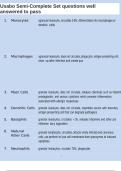
1. Monocytes agranular leukocyte, circulates 2-8%, ditterentiates into macrophages or
dendritic cells
2. Macrophages agranular leukocyte, does not circulate, phagocyte, antigen presenting cell,
clean up after infection and create pus
3. Mast Cells granular leukocyte, does not circulate, releases chemicals such as histamin
prostaglandin, and various cytokinins which promote inflammation,
associated with allergic responses
4. Dendritic Cells granular leukocyte, does not circulate, resembles neuron with branches,
antigen presenting cell that can degrade pathogens
5. Basophils granular leukocytes, circulates ~1%, releases histamine and other pro
inflamma- tory signalers
6. Natural granular lymphocyte, circulates, attacks virally infected and cancerous
Killer Cells cells, use perforin to lyse cell membrane then granzymes to induced
apoptosis.
7. Neutrophils granular leukocytes, circulate 70%, phagocytes
1/
32
,Usabo Semi-Complete Set questions well
answered to pass
8. Eosinophils
2/
32
,Usabo Semi-Complete Set questions well
answered to pass
granular leukocytes, circulate 1-6%, target parasitic infections like worms using
cyto and neurotoxic compounds, response to IgE antibodies
9. IgA antibodies mostly monomer, can form dimer, found in mucous lining and therefor
in bodily secretions, immobilizes pathogen
10. IgD Antibodies present on surface of B Cells, activates B Cells when triggered
11. IgE Antibodies found only in mammals, interacts with eosinophils, macrophages, mast
cells, and basophils to fight parasites and initiate allergic reactions.
12. IgM Antibodies found in pentamers, first to respond to antigens after infection
13. IgG Antibodies most prevalent, binds to foreign particles like bacteria and particles, only
antibody that can pass through the placenta
14. MHC I receptors on inside of cell, detect non self particles like viral and cancerous
ones, can trigger apoptosis by presenting them to cytotoxic T cells
15. MHC II found on antigen presenting cells, used to detect non self particles in the
extra
cellular space
16. Output of (per glucose)
Glycol- ysis
17. Output of
Pyru- vate
Oxidation
(per glucose)
18. Output of the
Krebs Cycle
3/
32
,Usabo Semi-Complete Set questions well
answered to pass
2 ATP in
4 ATP out
2 NADH
2 Pyruvate
2 Acetyl CoA
2 NADH
6 NADH
2 GTP/ATP
4/
32
answered to pass
1. Monocytes agranular leukocyte, circulates 2-8%, ditterentiates into macrophages or
dendritic cells
2. Macrophages agranular leukocyte, does not circulate, phagocyte, antigen presenting cell,
clean up after infection and create pus
3. Mast Cells granular leukocyte, does not circulate, releases chemicals such as histamin
prostaglandin, and various cytokinins which promote inflammation,
associated with allergic responses
4. Dendritic Cells granular leukocyte, does not circulate, resembles neuron with branches,
antigen presenting cell that can degrade pathogens
5. Basophils granular leukocytes, circulates ~1%, releases histamine and other pro
inflamma- tory signalers
6. Natural granular lymphocyte, circulates, attacks virally infected and cancerous
Killer Cells cells, use perforin to lyse cell membrane then granzymes to induced
apoptosis.
7. Neutrophils granular leukocytes, circulate 70%, phagocytes
1/
32
,Usabo Semi-Complete Set questions well
answered to pass
8. Eosinophils
2/
32
,Usabo Semi-Complete Set questions well
answered to pass
granular leukocytes, circulate 1-6%, target parasitic infections like worms using
cyto and neurotoxic compounds, response to IgE antibodies
9. IgA antibodies mostly monomer, can form dimer, found in mucous lining and therefor
in bodily secretions, immobilizes pathogen
10. IgD Antibodies present on surface of B Cells, activates B Cells when triggered
11. IgE Antibodies found only in mammals, interacts with eosinophils, macrophages, mast
cells, and basophils to fight parasites and initiate allergic reactions.
12. IgM Antibodies found in pentamers, first to respond to antigens after infection
13. IgG Antibodies most prevalent, binds to foreign particles like bacteria and particles, only
antibody that can pass through the placenta
14. MHC I receptors on inside of cell, detect non self particles like viral and cancerous
ones, can trigger apoptosis by presenting them to cytotoxic T cells
15. MHC II found on antigen presenting cells, used to detect non self particles in the
extra
cellular space
16. Output of (per glucose)
Glycol- ysis
17. Output of
Pyru- vate
Oxidation
(per glucose)
18. Output of the
Krebs Cycle
3/
32
,Usabo Semi-Complete Set questions well
answered to pass
2 ATP in
4 ATP out
2 NADH
2 Pyruvate
2 Acetyl CoA
2 NADH
6 NADH
2 GTP/ATP
4/
32

