
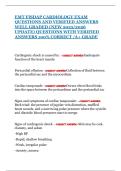
EMT FISDAP CARDIOLOGY EXAM
QUESTIONS AND VERIFIED ANSWERS
WELL GRADED (NEW 2025/2026
UPDATE) QUESTIONS WITH VERIFIED
ANSWERS 100% CORRECT /A+ GRADE
Cardiogenic shock is caused by: - CORRECT ANSWER-Inadequate
function of the heart muscle
Pericardial effusion - CORRECT ANSWER-Collection of fluid between
the pericardial sac and the myocardium
Cardiac tamponade - CORRECT ANSWER-Occurs when blood leaks
into the space between the pericardium and the pericardial sac
Signs and symptoms of cardiac tamponade: - CORRECT ANSWER-
Beck triad: the presence of jugular vein distention, muffled
heart sounds, and a narrowing pulse pressure where the systolic
and diastolic blood pressures start to merge.
Signs of cardiogenic shock: - CORRECT ANSWER--Skin may be cool,
clammy, and ashen
-High BP
-Rapid, shallow breathing
-Weak, irregular pulse
-Anxiety, nausea
, You arrive on scene to find a conscious 58YOF sitting up and
reporting severe chest pain and SOB. She is anxious and "feels
like she's going to die." Her skin is pale, cool, and clammy and
her pulse is rapid, weak, and irregular. Her breathing is
labored, with a RR of 28 breaths/min. Her SpO2 is 90%. Lung
sounds show crackles in all fields, and BP is 92/60 mmHg.
What is your differential diagnosis of the patient? - CORRECT
ANSWER-Cardiogenic shock
The heart is divided down the middle into left and right sides by
the: - CORRECT ANSWER-Septum
Which chamber of the heart receives incoming unoxygenated
blood? - CORRECT ANSWER-Atrium
Which chamber of the heart pumps oxygenated blood? - CORRECT
ANSWER-Ventricles
Normal electrical impulses begin in the: - CORRECT ANSWER-
Sinoatrial (SA) node
What characteristic allows a cardiac muscle cells to contract
spontaneously without an external stimulus? - CORRECT ANSWER-
Automaticity
The sympathetic nervous system acts on the body by: - CORRECT
ANSWER--increasing HR and RR
-constricting blood vessels in the muscles
QUESTIONS AND VERIFIED ANSWERS
WELL GRADED (NEW 2025/2026
UPDATE) QUESTIONS WITH VERIFIED
ANSWERS 100% CORRECT /A+ GRADE
Cardiogenic shock is caused by: - CORRECT ANSWER-Inadequate
function of the heart muscle
Pericardial effusion - CORRECT ANSWER-Collection of fluid between
the pericardial sac and the myocardium
Cardiac tamponade - CORRECT ANSWER-Occurs when blood leaks
into the space between the pericardium and the pericardial sac
Signs and symptoms of cardiac tamponade: - CORRECT ANSWER-
Beck triad: the presence of jugular vein distention, muffled
heart sounds, and a narrowing pulse pressure where the systolic
and diastolic blood pressures start to merge.
Signs of cardiogenic shock: - CORRECT ANSWER--Skin may be cool,
clammy, and ashen
-High BP
-Rapid, shallow breathing
-Weak, irregular pulse
-Anxiety, nausea
, You arrive on scene to find a conscious 58YOF sitting up and
reporting severe chest pain and SOB. She is anxious and "feels
like she's going to die." Her skin is pale, cool, and clammy and
her pulse is rapid, weak, and irregular. Her breathing is
labored, with a RR of 28 breaths/min. Her SpO2 is 90%. Lung
sounds show crackles in all fields, and BP is 92/60 mmHg.
What is your differential diagnosis of the patient? - CORRECT
ANSWER-Cardiogenic shock
The heart is divided down the middle into left and right sides by
the: - CORRECT ANSWER-Septum
Which chamber of the heart receives incoming unoxygenated
blood? - CORRECT ANSWER-Atrium
Which chamber of the heart pumps oxygenated blood? - CORRECT
ANSWER-Ventricles
Normal electrical impulses begin in the: - CORRECT ANSWER-
Sinoatrial (SA) node
What characteristic allows a cardiac muscle cells to contract
spontaneously without an external stimulus? - CORRECT ANSWER-
Automaticity
The sympathetic nervous system acts on the body by: - CORRECT
ANSWER--increasing HR and RR
-constricting blood vessels in the muscles

