

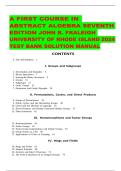
A FIRST COURSE IN
ABSTRACT ALGEBRA SEVENTH
EDITION JOHN B. FRALEIGH
UNIVERSITY OF RHODE ISLAND 2024
TEST BANK SOLUTION MANUAL
CONTENTS
0. Sets and Relations 1
I. Groups and Subgroups
1. Introduction and Examples 4
2. Binary Operations 7
3. Isomorphic Binary Structures 9
4. Groups 13
5. Subgroups 17
6. Cyclic Groups 21
7. Generators and Cayley Digraphs 24
II. Permutations, Cosets, and Direct Products
8. Groups of Permutations 26
9. Orbits, Cycles, and the Alternating Groups 30
10. Cosets and the Theorem of Lagrange 34
11. Direct Products and Finitely Generated Abelian Groups 37
12. Plane Isometries 42
III. Homomorphisms and Factor Groups
13. Homomorphisms 44
14. Factor Groups 49
15. Factor-Group Computations and Simple Groups 53
16. Group Action on a Set 58
17. Applications of G-Sets to Counting 61
IV. Rings and Fields
18. Rings and Fields 63
19. Integral Domains 68
20. Fermat’s and Euler’s Theorems 72
21. The Field of Quotients of an Integral Domain 74
,22. Rings of Polynomials 76
23. Factorization of Polynomials over a Field 79
24. Noncommutative Examples 85
25. Ordered Rings and Fields 87
V. Ideals and Factor Rings
26. Homomorphisms and Factor Rings 89
27. Prime and Maximal Ideals 94
28. Gröbner Bases for Ideals 99
iii
, VI. Extension Fields
29. Introduction to Extension Fields 103
30. Vector Spaces 107
31. Algebraic Extensions 111
32. Geometric Constructions 115
33. Finite Fields 116
VII. Advanced Group Theory
34. Isomorphism Theorems 117
35. Series of Groups 119
36. Sylow Theorems 122
37. Applications of the Sylow Theory 124
38. Free Abelian Groups 128
39. Free Groups 130
40. Group Presentations 133
VIII. Groups in Topology
41. Simplicial Complexes and Homology Groups 136
42. Computations of Homology Groups 138
43. More Homology Computations and Applications 140
44. Homological Algebra 144
IX. Factorization
45. Unique Factorization Domains 148
46. Euclidean Domains 151
47. Gaussian Integers and Multiplicative Norms 154
X. Automorphisms and Galois Theory
48. Automorphisms of Fields 159
49. The Isomorphism Extension Theorem 164
50. Splitting Fields 165
51. Separable Extensions 167
52. Totally Inseparable Extensions 171
53. Galois Theory 173
54. Illustrations of Galois Theory 176
55. Cyclotomic Extensions 183
56. Insolvability of the Quintic 185
APPENDIX Matrix Algebra 187
, 0. Sets and Relations 1
0. Sets and Relations
√ √
1. { 3, − 3} 2. The set is empty.
3. {1, −1, 2, −2, 3, −3, 4, −4, 5, −5, 6, −6, 10, −10, 12, −12, 15, −15, 20, −20, 30, −30,
60, −60}
4. {−10, −9, −8, −7, −6, −5, −4, −3, −2, −1, 0, 1, 2, 3, 4, 5, 6, 7, 8, 9, 10, 11}
5. It is not a well-defined set. (Some may argue that no element of Z+ is large, because every element
exceeds only a finite number of other elements but is exceeded by an infinite number of other elements.
Such people might claim the answer should be ∅.)
6. ∅ 7. The set is ∅ because 33 = 27 and 43 = 64.
8. It is not a well-defined set. 9. Q
10. The set containing all numbers that are (positive, negative, or zero) integer multiples of 1, 1/2, or
1/3.
11. {(a, 1), (a, 2), (a, c), (b, 1), (b, 2), (b, c), (c, 1), (c, 2), (c, c)}
12. a. It is a function. It is not one-to-one since there are two pairs with second member 4. It is not onto
B because there is no pair with second member 2.
b. (Same answer as Part(a).)
c. It is not a function because there are two pairs with first member 1.
d. It is a function. It is one-to-one. It is onto B because every element of B appears as second
member of some pair.
e. It is a function. It is not one-to-one because there are two pairs with second member 6. It is not
onto B because there is no pair with second member 2.
f. It is not a function because there are two pairs with first member 2.
13. Draw the line through P and x, and let y be its point of intersection with the line segment CD.
14. a. φ : [0, 1] → [0, 2] where φ(x) = 2x b. φ : [1, 3] → [5, 25] where φ(x) = 5 + 10(x − 1)
c. φ : [a, b] → [c, d] where φ(x) = c + (x − a)
d− c
b−a
15. Let φ : S → R be defined by φ(x) = tan(π(x − 12)).
16. a. ∅; cardinality 1 b. ∅, {a}; cardinality 2 c. ∅, {a}, {b}, {a, b}; cardinality 4
d. ∅, {a}, {b}, {c}, {a, b}, {a, c}, {b, c}, {a, b, c}; cardinality 8
17. Conjecture: |P(A)| = 2s = 2|A|.
Proof The number of subsets of a set A depends only on the cardinality of A, not on what the
elements of A actually are. Suppose B = { 1, 2, 3,· · · , s − 1} and A = { 1, 2, 3,· · · , s} . Then A has all
the elements of B plus the one additional element s. All subsets of B are also subsets of A; these
are precisely the subsets of A that do not contain s, so the number of subsets of A not containing
s is |P(B)|. Any other subset of A must contain s, and removal of the s would produce a subset of
B. Thus the number of subsets of A containing s is also |P(B)|. Because every subset of A either
contains s or does not contain s (but not both), we see that the number of subsets of A is 2|P(B)|.
ABSTRACT ALGEBRA SEVENTH
EDITION JOHN B. FRALEIGH
UNIVERSITY OF RHODE ISLAND 2024
TEST BANK SOLUTION MANUAL
CONTENTS
0. Sets and Relations 1
I. Groups and Subgroups
1. Introduction and Examples 4
2. Binary Operations 7
3. Isomorphic Binary Structures 9
4. Groups 13
5. Subgroups 17
6. Cyclic Groups 21
7. Generators and Cayley Digraphs 24
II. Permutations, Cosets, and Direct Products
8. Groups of Permutations 26
9. Orbits, Cycles, and the Alternating Groups 30
10. Cosets and the Theorem of Lagrange 34
11. Direct Products and Finitely Generated Abelian Groups 37
12. Plane Isometries 42
III. Homomorphisms and Factor Groups
13. Homomorphisms 44
14. Factor Groups 49
15. Factor-Group Computations and Simple Groups 53
16. Group Action on a Set 58
17. Applications of G-Sets to Counting 61
IV. Rings and Fields
18. Rings and Fields 63
19. Integral Domains 68
20. Fermat’s and Euler’s Theorems 72
21. The Field of Quotients of an Integral Domain 74
,22. Rings of Polynomials 76
23. Factorization of Polynomials over a Field 79
24. Noncommutative Examples 85
25. Ordered Rings and Fields 87
V. Ideals and Factor Rings
26. Homomorphisms and Factor Rings 89
27. Prime and Maximal Ideals 94
28. Gröbner Bases for Ideals 99
iii
, VI. Extension Fields
29. Introduction to Extension Fields 103
30. Vector Spaces 107
31. Algebraic Extensions 111
32. Geometric Constructions 115
33. Finite Fields 116
VII. Advanced Group Theory
34. Isomorphism Theorems 117
35. Series of Groups 119
36. Sylow Theorems 122
37. Applications of the Sylow Theory 124
38. Free Abelian Groups 128
39. Free Groups 130
40. Group Presentations 133
VIII. Groups in Topology
41. Simplicial Complexes and Homology Groups 136
42. Computations of Homology Groups 138
43. More Homology Computations and Applications 140
44. Homological Algebra 144
IX. Factorization
45. Unique Factorization Domains 148
46. Euclidean Domains 151
47. Gaussian Integers and Multiplicative Norms 154
X. Automorphisms and Galois Theory
48. Automorphisms of Fields 159
49. The Isomorphism Extension Theorem 164
50. Splitting Fields 165
51. Separable Extensions 167
52. Totally Inseparable Extensions 171
53. Galois Theory 173
54. Illustrations of Galois Theory 176
55. Cyclotomic Extensions 183
56. Insolvability of the Quintic 185
APPENDIX Matrix Algebra 187
, 0. Sets and Relations 1
0. Sets and Relations
√ √
1. { 3, − 3} 2. The set is empty.
3. {1, −1, 2, −2, 3, −3, 4, −4, 5, −5, 6, −6, 10, −10, 12, −12, 15, −15, 20, −20, 30, −30,
60, −60}
4. {−10, −9, −8, −7, −6, −5, −4, −3, −2, −1, 0, 1, 2, 3, 4, 5, 6, 7, 8, 9, 10, 11}
5. It is not a well-defined set. (Some may argue that no element of Z+ is large, because every element
exceeds only a finite number of other elements but is exceeded by an infinite number of other elements.
Such people might claim the answer should be ∅.)
6. ∅ 7. The set is ∅ because 33 = 27 and 43 = 64.
8. It is not a well-defined set. 9. Q
10. The set containing all numbers that are (positive, negative, or zero) integer multiples of 1, 1/2, or
1/3.
11. {(a, 1), (a, 2), (a, c), (b, 1), (b, 2), (b, c), (c, 1), (c, 2), (c, c)}
12. a. It is a function. It is not one-to-one since there are two pairs with second member 4. It is not onto
B because there is no pair with second member 2.
b. (Same answer as Part(a).)
c. It is not a function because there are two pairs with first member 1.
d. It is a function. It is one-to-one. It is onto B because every element of B appears as second
member of some pair.
e. It is a function. It is not one-to-one because there are two pairs with second member 6. It is not
onto B because there is no pair with second member 2.
f. It is not a function because there are two pairs with first member 2.
13. Draw the line through P and x, and let y be its point of intersection with the line segment CD.
14. a. φ : [0, 1] → [0, 2] where φ(x) = 2x b. φ : [1, 3] → [5, 25] where φ(x) = 5 + 10(x − 1)
c. φ : [a, b] → [c, d] where φ(x) = c + (x − a)
d− c
b−a
15. Let φ : S → R be defined by φ(x) = tan(π(x − 12)).
16. a. ∅; cardinality 1 b. ∅, {a}; cardinality 2 c. ∅, {a}, {b}, {a, b}; cardinality 4
d. ∅, {a}, {b}, {c}, {a, b}, {a, c}, {b, c}, {a, b, c}; cardinality 8
17. Conjecture: |P(A)| = 2s = 2|A|.
Proof The number of subsets of a set A depends only on the cardinality of A, not on what the
elements of A actually are. Suppose B = { 1, 2, 3,· · · , s − 1} and A = { 1, 2, 3,· · · , s} . Then A has all
the elements of B plus the one additional element s. All subsets of B are also subsets of A; these
are precisely the subsets of A that do not contain s, so the number of subsets of A not containing
s is |P(B)|. Any other subset of A must contain s, and removal of the s would produce a subset of
B. Thus the number of subsets of A containing s is also |P(B)|. Because every subset of A either
contains s or does not contain s (but not both), we see that the number of subsets of A is 2|P(B)|.

