1|Page
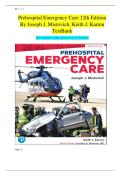
Prehospital Emergency Care 12th Edition
By Joseph J. Mistovich, Keith J. Karren
TestBank
All Chapters with Answers | A+ Graded
Te
ch
Gu
Page | 1
r u
, 2|Page
Chapter 1 Emergency Care Systems, Research, and Public Health
1)What is a primary purpose of the modern-day EMS system?
A) Provide a means of transport to and from the hospital
B) Ensure that all members of society have equal access to hospitals
C) Decrease the incidence of death and disability related to injury and illness
D) Provide emergency health care services to medically underserved areas Answer: C
Diff: 2 Page Ref: 7
Objective: 1-2
2)Most authorities agree that the modern-day EMS system evolved after the release of which document?
A) The Emergency Medical Services Act of 1973
B) The white paper "Accidental Death and Disability: The Neglected Disease of Modern Society" in
1966
C) The American Heart Association's Guidelines for Cardiac Resuscitation
D) Emergency Medical Services: Agenda for the Future, in 1996 Answer: B
Diff: 1 Page Ref: 3
Objective: 1-2
3)An Emergency Medical Responder comes to you and states that he would like to work for your
emergency ambulance service on a full-time basis. Knowing the National EMS Scope of Practice Model,
you inform him of which element?
A) He will be able to take care of only patients with non-life-threatening complaints
B) He will first need approval from your ambulance service's medical director
C) He will be able to work only with an Advanced EMT or paramedic
D) He will first have to become an Emergency Medical Technician Answer: D
Diff: 1 Page Ref: 6-7
Te
Objective: 1-1
ch
Gu
Page | 2
r u
, 3|Page
4)As defined by the National EMS Scope of Practice Model, the four levels of EMS practitioners include:
A) Ambulance drivers
B) EMS medical director
C) Paramedics
D) Emergency medical dispatchers Answer: C
Diff: 1 Page Ref: 6-7
Objective: 1-3
5)An Emergency Medical Responder (EMR) approaches you and states that he is interested in becoming
an EMT. Specifically, he asks what he will be able to do as an EMT that he cannot presently do as an
EMR. You respond by saying he will be able to:
A) Administer some medications
B) Assist in emergency childbirth
C) Use an automated external defibrillator
D) Obtain vital signs Answer: A
Diff: 1 Page Ref: 6-7
Objective: 1-5
6)You have been dispatched for a 61-year-old female in cardiac arrest. Emergency Medical Responders
(EMRs) are on scene. In your community, all EMS practitioners are trained according to the National
EMS Scope of Practice Model. Given this, which type of care do you expect the EMRs to be providing?
A) Emergency medication administration
B) Automated external defibrillation
C) Intravenous therapy
D) Reading an electrocardiogram Answer: B
Diff: 2 Page Ref: 6
Objective: 1-5
7)An EMT with your service states that she desires to become a paramedic because she wants to provide
Te
advanced care. Under the National EMS Scope of Practice Model, which one of these types of care will
she be able to provide as a paramedic that she cannot provide as an EMT?
ch
A) Automated blood pressure monitoring
Gu
Page | 3
r u
, 4|Page
B) Assistance with emergency childbirth
C) Interfacility transports
D) IV therapy Answer: D
Diff: 1 Page Ref: 7
Objective: 1-5
8)Which statement made by an EMT requires immediate intervention by a superior or the service
supervisor?
A) "I always wear my seat belt whenever I am in the patient compartment of the ambulance, unless I
have to remove it to care for a patient."
B) "I drive as fast as I can to get to the scene of an emergency, especially if a child is sick or injured
according to dispatch information."
C) "When I am driving with lights and sirens, I instruct my partner that he will need to handle all
radio communications."
D) "I put exam gloves on for every patient I contact, even if he or she does not have a known or
suspected infectious disease."
Answer: B
Diff: 1 Page Ref: 9
Objective: 1-7
9)Which statement shows that the EMT has a good understanding of her role and responsibilities related
to being an EMT?
A) "The patient's needs come before anyone else's needs."
B) "At the scene of an emergency, my responsibility is to get to the patient no matter what."
C) "My safety comes first, and then the patient's safety."
D) "As an EMT, I recognize that the public's safety comes before the safety of me or my partner."
Answer: C
Diff: 2 Page Ref: 8-9
Objective: 1-7
Te
ch
Gu
Page | 4
r u
Prehospital Emergency Care 12th Edition
By Joseph J. Mistovich, Keith J. Karren
TestBank
All Chapters with Answers | A+ Graded
Te
ch
Gu
Page | 1
r u
, 2|Page
Chapter 1 Emergency Care Systems, Research, and Public Health
1)What is a primary purpose of the modern-day EMS system?
A) Provide a means of transport to and from the hospital
B) Ensure that all members of society have equal access to hospitals
C) Decrease the incidence of death and disability related to injury and illness
D) Provide emergency health care services to medically underserved areas Answer: C
Diff: 2 Page Ref: 7
Objective: 1-2
2)Most authorities agree that the modern-day EMS system evolved after the release of which document?
A) The Emergency Medical Services Act of 1973
B) The white paper "Accidental Death and Disability: The Neglected Disease of Modern Society" in
1966
C) The American Heart Association's Guidelines for Cardiac Resuscitation
D) Emergency Medical Services: Agenda for the Future, in 1996 Answer: B
Diff: 1 Page Ref: 3
Objective: 1-2
3)An Emergency Medical Responder comes to you and states that he would like to work for your
emergency ambulance service on a full-time basis. Knowing the National EMS Scope of Practice Model,
you inform him of which element?
A) He will be able to take care of only patients with non-life-threatening complaints
B) He will first need approval from your ambulance service's medical director
C) He will be able to work only with an Advanced EMT or paramedic
D) He will first have to become an Emergency Medical Technician Answer: D
Diff: 1 Page Ref: 6-7
Te
Objective: 1-1
ch
Gu
Page | 2
r u
, 3|Page
4)As defined by the National EMS Scope of Practice Model, the four levels of EMS practitioners include:
A) Ambulance drivers
B) EMS medical director
C) Paramedics
D) Emergency medical dispatchers Answer: C
Diff: 1 Page Ref: 6-7
Objective: 1-3
5)An Emergency Medical Responder (EMR) approaches you and states that he is interested in becoming
an EMT. Specifically, he asks what he will be able to do as an EMT that he cannot presently do as an
EMR. You respond by saying he will be able to:
A) Administer some medications
B) Assist in emergency childbirth
C) Use an automated external defibrillator
D) Obtain vital signs Answer: A
Diff: 1 Page Ref: 6-7
Objective: 1-5
6)You have been dispatched for a 61-year-old female in cardiac arrest. Emergency Medical Responders
(EMRs) are on scene. In your community, all EMS practitioners are trained according to the National
EMS Scope of Practice Model. Given this, which type of care do you expect the EMRs to be providing?
A) Emergency medication administration
B) Automated external defibrillation
C) Intravenous therapy
D) Reading an electrocardiogram Answer: B
Diff: 2 Page Ref: 6
Objective: 1-5
7)An EMT with your service states that she desires to become a paramedic because she wants to provide
Te
advanced care. Under the National EMS Scope of Practice Model, which one of these types of care will
she be able to provide as a paramedic that she cannot provide as an EMT?
ch
A) Automated blood pressure monitoring
Gu
Page | 3
r u
, 4|Page
B) Assistance with emergency childbirth
C) Interfacility transports
D) IV therapy Answer: D
Diff: 1 Page Ref: 7
Objective: 1-5
8)Which statement made by an EMT requires immediate intervention by a superior or the service
supervisor?
A) "I always wear my seat belt whenever I am in the patient compartment of the ambulance, unless I
have to remove it to care for a patient."
B) "I drive as fast as I can to get to the scene of an emergency, especially if a child is sick or injured
according to dispatch information."
C) "When I am driving with lights and sirens, I instruct my partner that he will need to handle all
radio communications."
D) "I put exam gloves on for every patient I contact, even if he or she does not have a known or
suspected infectious disease."
Answer: B
Diff: 1 Page Ref: 9
Objective: 1-7
9)Which statement shows that the EMT has a good understanding of her role and responsibilities related
to being an EMT?
A) "The patient's needs come before anyone else's needs."
B) "At the scene of an emergency, my responsibility is to get to the patient no matter what."
C) "My safety comes first, and then the patient's safety."
D) "As an EMT, I recognize that the public's safety comes before the safety of me or my partner."
Answer: C
Diff: 2 Page Ref: 8-9
Objective: 1-7
Te
ch
Gu
Page | 4
r u