

BIOL 316 MIDTERM EXAM QUESTIONS
WITH 100% CORRECT ANSWERS |
LATEST VERSION 2025/2026.
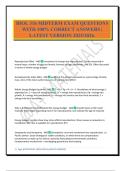
Reproduction Effort - ANS investment of energy into reproduction. Can be measured in
several ways: number of eggs per female, biomass of eggs per female, and GSI. Often discussed
in terms of whole energy budget
Gonadosomatic Index (GSI) - ANS weight of the gonads expressed as a percentage of body
mass. One of the most useful measures of reproductive effort
Whole Energy Budget Equation - ANS C = Pr + Pg + R + U + F. Breakdown of what energy is
expended on. C = input of energy (caloric), Pr = energy into reproduction, Pg = energy into
growth, R = energy into metabolism, U = energy into urinary and non-fecal excretions, F =
energy into fecal excretions
Why is it important to understand the energy budget - ANS Growth slows as fish reach
maturity (then begin expending more E for reproduction). Can indicate the age of maturity
Energy budget can also show how stress affects reproduction. Stress causes an elevation in
metabolism (R) - less E available for reproduction (Pr)
Semelparity and Iteroparity - ANS Semelparity: one time investment into reproduction. i.e.
Pacific salmon. Good strategy for stable conditions, or when there are compensatory
mechanisms to make up for failure caused by fluctuating environmental conditions.
Compensatory mechanisms = overlapping generations and straying
1 | Page @COPYRIGHT 2025/2026 ALLRIGHTS RESERVED
, Iteroparity: several investments into reproduction. Atlantic salmon. Good strategy when
environmental conditions are not stable. If unsuccessful in one attempt, can try again.
Oviparous and Viviparious - ANS Oviparous: lay eggs. Many offspring
- Fish with large numbers of eggs/offspring may recover better from overfishing
Viviparous: females release hatched young (well-nourished juveniles/young adults). Fewer
offspring
BOFFFF - ANS Big old fat fecund female fish
Bony Fish - Egg Protection and Parental Care - ANS Typically some form of parental care.
Guarding of eggs and offspring is most common form. Other parental care behaviours include
nest building, cleaning of spawning substrate, fanning eggs, internal gestation, oral brooding,
and burying eggs
Explain why most of the mortality in fish species occurs in early-life history stages (5) - ANS 1)
Rapid growth to survive - small = most susceptible to predation
2) Rapid growth is dependent on the switch from phytoplankton to larger prey (ex. Zooplankton
and prey fish). Growth is dependent upon location (prey density) - at the mercy of their
environment.
3) More susceptible to changes in pH and salinity in early life history. Can be harmed by acid-
run off, acute changes in temperature, and currents/wave actions (environmental
disturbances).
4) A lot of mortality occurs at this time due to starvation. Feeding is limited by: development of
the sensory systems and feeding apparatus (gape size), and the ability to move/swim well
enough to capture food.
2 | Page @COPYRIGHT 2025/2026 ALLRIGHTS RESERVED
WITH 100% CORRECT ANSWERS |
LATEST VERSION 2025/2026.
Reproduction Effort - ANS investment of energy into reproduction. Can be measured in
several ways: number of eggs per female, biomass of eggs per female, and GSI. Often discussed
in terms of whole energy budget
Gonadosomatic Index (GSI) - ANS weight of the gonads expressed as a percentage of body
mass. One of the most useful measures of reproductive effort
Whole Energy Budget Equation - ANS C = Pr + Pg + R + U + F. Breakdown of what energy is
expended on. C = input of energy (caloric), Pr = energy into reproduction, Pg = energy into
growth, R = energy into metabolism, U = energy into urinary and non-fecal excretions, F =
energy into fecal excretions
Why is it important to understand the energy budget - ANS Growth slows as fish reach
maturity (then begin expending more E for reproduction). Can indicate the age of maturity
Energy budget can also show how stress affects reproduction. Stress causes an elevation in
metabolism (R) - less E available for reproduction (Pr)
Semelparity and Iteroparity - ANS Semelparity: one time investment into reproduction. i.e.
Pacific salmon. Good strategy for stable conditions, or when there are compensatory
mechanisms to make up for failure caused by fluctuating environmental conditions.
Compensatory mechanisms = overlapping generations and straying
1 | Page @COPYRIGHT 2025/2026 ALLRIGHTS RESERVED
, Iteroparity: several investments into reproduction. Atlantic salmon. Good strategy when
environmental conditions are not stable. If unsuccessful in one attempt, can try again.
Oviparous and Viviparious - ANS Oviparous: lay eggs. Many offspring
- Fish with large numbers of eggs/offspring may recover better from overfishing
Viviparous: females release hatched young (well-nourished juveniles/young adults). Fewer
offspring
BOFFFF - ANS Big old fat fecund female fish
Bony Fish - Egg Protection and Parental Care - ANS Typically some form of parental care.
Guarding of eggs and offspring is most common form. Other parental care behaviours include
nest building, cleaning of spawning substrate, fanning eggs, internal gestation, oral brooding,
and burying eggs
Explain why most of the mortality in fish species occurs in early-life history stages (5) - ANS 1)
Rapid growth to survive - small = most susceptible to predation
2) Rapid growth is dependent on the switch from phytoplankton to larger prey (ex. Zooplankton
and prey fish). Growth is dependent upon location (prey density) - at the mercy of their
environment.
3) More susceptible to changes in pH and salinity in early life history. Can be harmed by acid-
run off, acute changes in temperature, and currents/wave actions (environmental
disturbances).
4) A lot of mortality occurs at this time due to starvation. Feeding is limited by: development of
the sensory systems and feeding apparatus (gape size), and the ability to move/swim well
enough to capture food.
2 | Page @COPYRIGHT 2025/2026 ALLRIGHTS RESERVED

