Robbins & Cotran 10th Ed. Pathology Test Bank | Chapter-
by-Chapter Questions & Verified Solutions
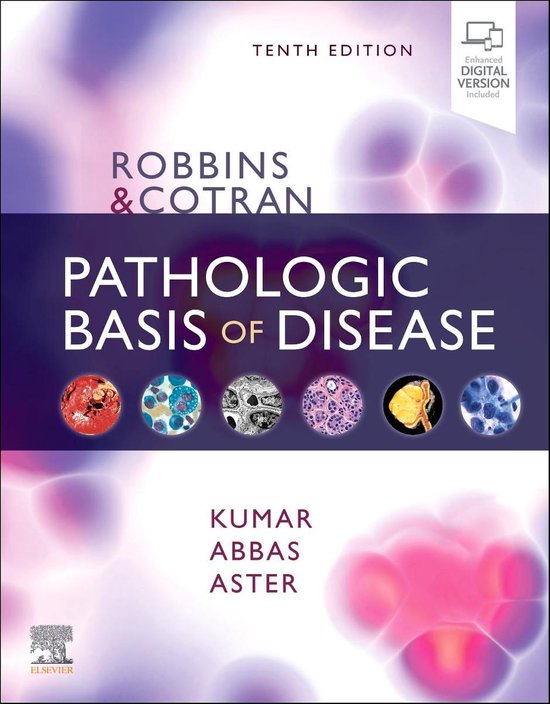
Robbins & Cotran Pathologic Basis of Disease
10th Edition
• Author(s)Vinay Kumar; Abul K. Abbas; Jon C. Aster
Chapter Reference: The Genome
Stem: A 45-year-old man’s tumor shows chromosomal
translocation creating a constitutively active transcription factor.
Which genetic mechanism most likely produced this oncogenic
activity?
A. Loss-of-function point mutation in a tumor suppressor
B. Chromosomal translocation creating a fusion gene with
constitutive activity
C. Frameshift mutation causing truncated protein and
nonsense-mediated decay
D. DNA methylation leading to promoter hypermethylation and
silencing
Correct Answer: B
,Rationale — Correct (B): Translocations can create fusion
proteins (e.g., BCR-ABL) that act as constitutively active
oncogenes driving uncontrolled growth. This matches the
mechanism described.
Rationale — A: Loss-of-function in tumor suppressors reduces
inhibition but does not generate a constitutively active
transcription factor.
Rationale — C: Frameshifts usually create truncated,
nonfunctional proteins rather than constitutively active
transcription factors.
Rationale — D: Promoter hypermethylation silences genes; it
does not create an active fusion protein.
Teaching Point: Chromosomal translocations can generate
oncogenic fusion proteins with constitutive activity.
2
Chapter Reference: The Genome
Stem: A patient’s cells show many single-strand DNA breaks
after UV exposure. Which DNA repair pathway primarily
corrects UV-induced pyrimidine dimers?
A. Base excision repair (BER)
B. Mismatch repair (MMR)
C. Nucleotide excision repair (NER)
D. Non-homologous end joining (NHEJ)
Correct Answer: C
,Rationale — Correct (C): NER removes bulky helix-distorting
lesions such as UV-induced thymine dimers and fills the gap
with DNA polymerase.
Rationale — A: BER repairs small base modifications (oxidation,
alkylation), not bulky dimers.
Rationale — B: MMR corrects replication errors (mispaired
bases, small insertion/deletion loops), not UV dimers.
Rationale — D: NHEJ repairs double-strand breaks, not UV-
induced pyrimidine dimers.
Teaching Point: Nucleotide excision repair removes bulky, helix-
distorting DNA lesions like UV dimers.
3
Chapter Reference: Cellular Housekeeping
Stem: A hereditary defect in lysosomal enzyme trafficking
causes substrate accumulation in multiple tissues. Which
cellular organelle is primarily responsible for degrading these
macromolecules?
A. Golgi apparatus
B. Proteasome
C. Lysosome
D. Peroxisome
Correct Answer: C
Rationale — Correct (C): Lysosomes contain acid hydrolases
that digest macromolecules; trafficking defects (e.g., mannose-
6-phosphate pathway) impair this degradation causing storage
, disease.
Rationale — A: Golgi modifies and sorts proteins but does not
degrade macromolecules.
Rationale — B: Proteasomes degrade ubiquitinated intracellular
proteins, not large extracellular or membrane-bound
macromolecules accumulated in lysosomal storage.
Rationale — D: Peroxisomes metabolize very-long-chain fatty
acids and detoxify, not primary macromolecule degradation in
lysosomal storage diseases.
Teaching Point: Lysosomes digest macromolecules; trafficking
defects cause lysosomal storage diseases.
4
Chapter Reference: Cellular Housekeeping
Stem: A neuron accumulates misfolded proteins due to
proteasome dysfunction. Which intracellular degradation
pathway is directly impaired?
A. Autophagy-lysosomal pathway
B. Ubiquitin–proteasome pathway
C. Endocytosis
D. Exocytosis
Correct Answer: B
Rationale — Correct (B): The ubiquitin–proteasome system
selectively degrades misfolded or short-lived cytosolic and
nuclear proteins tagged with ubiquitin.
Rationale — A: Autophagy handles bulk organelle/protein
by-Chapter Questions & Verified Solutions
Robbins & Cotran Pathologic Basis of Disease
10th Edition
• Author(s)Vinay Kumar; Abul K. Abbas; Jon C. Aster
Chapter Reference: The Genome
Stem: A 45-year-old man’s tumor shows chromosomal
translocation creating a constitutively active transcription factor.
Which genetic mechanism most likely produced this oncogenic
activity?
A. Loss-of-function point mutation in a tumor suppressor
B. Chromosomal translocation creating a fusion gene with
constitutive activity
C. Frameshift mutation causing truncated protein and
nonsense-mediated decay
D. DNA methylation leading to promoter hypermethylation and
silencing
Correct Answer: B
,Rationale — Correct (B): Translocations can create fusion
proteins (e.g., BCR-ABL) that act as constitutively active
oncogenes driving uncontrolled growth. This matches the
mechanism described.
Rationale — A: Loss-of-function in tumor suppressors reduces
inhibition but does not generate a constitutively active
transcription factor.
Rationale — C: Frameshifts usually create truncated,
nonfunctional proteins rather than constitutively active
transcription factors.
Rationale — D: Promoter hypermethylation silences genes; it
does not create an active fusion protein.
Teaching Point: Chromosomal translocations can generate
oncogenic fusion proteins with constitutive activity.
2
Chapter Reference: The Genome
Stem: A patient’s cells show many single-strand DNA breaks
after UV exposure. Which DNA repair pathway primarily
corrects UV-induced pyrimidine dimers?
A. Base excision repair (BER)
B. Mismatch repair (MMR)
C. Nucleotide excision repair (NER)
D. Non-homologous end joining (NHEJ)
Correct Answer: C
,Rationale — Correct (C): NER removes bulky helix-distorting
lesions such as UV-induced thymine dimers and fills the gap
with DNA polymerase.
Rationale — A: BER repairs small base modifications (oxidation,
alkylation), not bulky dimers.
Rationale — B: MMR corrects replication errors (mispaired
bases, small insertion/deletion loops), not UV dimers.
Rationale — D: NHEJ repairs double-strand breaks, not UV-
induced pyrimidine dimers.
Teaching Point: Nucleotide excision repair removes bulky, helix-
distorting DNA lesions like UV dimers.
3
Chapter Reference: Cellular Housekeeping
Stem: A hereditary defect in lysosomal enzyme trafficking
causes substrate accumulation in multiple tissues. Which
cellular organelle is primarily responsible for degrading these
macromolecules?
A. Golgi apparatus
B. Proteasome
C. Lysosome
D. Peroxisome
Correct Answer: C
Rationale — Correct (C): Lysosomes contain acid hydrolases
that digest macromolecules; trafficking defects (e.g., mannose-
6-phosphate pathway) impair this degradation causing storage
, disease.
Rationale — A: Golgi modifies and sorts proteins but does not
degrade macromolecules.
Rationale — B: Proteasomes degrade ubiquitinated intracellular
proteins, not large extracellular or membrane-bound
macromolecules accumulated in lysosomal storage.
Rationale — D: Peroxisomes metabolize very-long-chain fatty
acids and detoxify, not primary macromolecule degradation in
lysosomal storage diseases.
Teaching Point: Lysosomes digest macromolecules; trafficking
defects cause lysosomal storage diseases.
4
Chapter Reference: Cellular Housekeeping
Stem: A neuron accumulates misfolded proteins due to
proteasome dysfunction. Which intracellular degradation
pathway is directly impaired?
A. Autophagy-lysosomal pathway
B. Ubiquitin–proteasome pathway
C. Endocytosis
D. Exocytosis
Correct Answer: B
Rationale — Correct (B): The ubiquitin–proteasome system
selectively degrades misfolded or short-lived cytosolic and
nuclear proteins tagged with ubiquitin.
Rationale — A: Autophagy handles bulk organelle/protein