
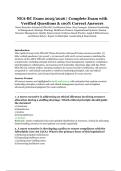
NEA-BC Exam 2025/2026 | Complete Exam with
Verified Questions & 100% Correct Answers
Nurse Executive Advanced (NEA-BC) Certification Exam | Key Concepts: Advanced Leadership
& Management, Strategic Planning, Healthcare Finance, Organizational Systems, Human
Resource Management, Quality Improvement, Evidence-Based Practice, Legal & Ethical Issues,
and Patient Safety | Expert-Verified Q&A | Leadership & Exam-Ready
Introduction
This updated 2025/2026 NEA-BC (Nurse Executive Advanced) Exam resource provides 175
fully verified questions (150 scored + 25 unscored) with 100% correct answers, matching the
structure of the ANCC NEA-BC certification exam. Content covers advanced nurse executive
competencies, including strategic decision-making, fiscal management, regulatory compliance,
interdisciplinary collaboration, and systems-level leadership. Questions align with the ANCC
NEA-BC test content outline, ensuring readiness for nurse executive certification. All answers
are graded A+ and include rationales to reinforce leadership principles, safe and ethical
management practices, and advanced professional judgment for exam success.
Answer Format
All correct answers are highlighted in bold and green, with rationales that explain executive
leadership principles, reinforce safe and ethical management practices, and strengthen
advanced professional judgment for exam readiness.
1. A nurse executive is addressing an ethical dilemma involving resource
allocation during a staffing shortage. Which ethical principle should guide
the decision?
a) Autonomy
b) Beneficence
c) Justice
d) Nonmaleficence
c) Justice
Rationale: Justice emphasizes fair and equitable distribution of resources, critical for allocating
limited staffing resources to meet patient care needs impartially.
2. A nurse executive is developing a policy to ensure compliance with the
Affordable Care Act (ACA). What is the primary focus of this legislation?
a) Reducing hospital readmissions
b) Expanding healthcare access
c) Limiting nurse staffing ratios
d) Decreasing healthcare costs
,b) Expanding healthcare access
Rationale: The ACA aims to increase healthcare access through insurance coverage expansion, a
key focus for compliance policies.
3. How should a nurse executive respond to a nurse’s unprofessional
behavior in a patient care setting?
a) Ignore the behavior to avoid conflict
b) Provide immediate corrective feedback
c) Terminate the nurse immediately
d) Delegate the issue to human resources
b) Provide immediate corrective feedback
Rationale: Prompt corrective feedback promotes accountability, maintains patient safety, and
upholds professionalism.
4. A nurse executive is mentoring a new nurse leader. Which leadership
style fosters professional growth?
a) Autocratic
b) Laissez-faire
c) Transformational
d) Transactional
c) Transformational
Rationale: Transformational leadership inspires and motivates growth through vision,
encouragement, and mentorship.
5. A nurse executive is ensuring adherence to The Joint Commission
standards. What is a primary goal of these standards?
a) Maximize hospital profits
b) Improve patient safety
c) Reduce staff training
d) Limit patient admissions
b) Improve patient safety
Rationale: The Joint Commission standards focus on enhancing patient safety and quality of
care.
6. A nurse executive discovers a breach in patient confidentiality. What is
the first action to take?
a) Notify the media
b) Conduct an internal investigation
c) Ignore the breach
d) Terminate involved staff
b) Conduct an internal investigation
Rationale: An internal investigation identifies the breach’s scope and ensures HIPAA
compliance.
7. Which action demonstrates a nurse executive’s commitment to
professional development?
,a) Reducing training budgets
b) Implementing mandatory continuing education
c) Limiting staff certifications
d) Avoiding performance reviews
b) Implementing mandatory continuing education
Rationale: Mandatory continuing education supports ongoing professional growth and
competence.
8. A nurse executive is addressing a conflict between two staff members.
What is the best approach?
a) Ignore the conflict
b) Mediate a resolution
c) Reassign one staff member
d) Discipline both parties
b) Mediate a resolution
Rationale: Mediation fosters collaboration and maintains a positive work environment.
9. How should a nurse executive ensure ethical decision-making in clinical
practice?
a) Follow personal beliefs
b) Consult an ethics committee
c) Ignore ethical concerns
d) Delegate decisions to staff
b) Consult an ethics committee
Rationale: An ethics committee provides structured guidance for ethical decisions.
10. A nurse executive is updating policies to comply with HIPAA. What is a
key requirement of HIPAA?
a) Public disclosure of patient data
b) Protection of patient health information
c) Limiting patient care access
d) Reducing staff training
b) Protection of patient health information
Rationale: HIPAA mandates safeguarding protected health information for patient privacy.
11. A nurse executive is promoting a culture of safety. What is a key
strategy?
a) Discourage incident reporting
b) Encourage open communication
c) Limit staff feedback
d) Ignore safety concerns
b) Encourage open communication
Rationale: Open communication fosters a safety culture by encouraging reporting and
addressing issues.
, 12. A nurse executive is advocating for nurses’ professional autonomy.
What is the best approach?
a) Limit decision-making authority
b) Empower nurses in clinical decisions
c) Reduce interdisciplinary collaboration
d) Ignore nurse input
b) Empower nurses in clinical decisions
Rationale: Empowering nurses enhances autonomy and improves care quality.
13. A nurse executive is addressing a whistleblower’s report of unsafe
practices. What is the first step?
a) Discipline the whistleblower
b) Investigate the report
c) Ignore the report
d) Publicize the issue
b) Investigate the report
Rationale: Investigating ensures the issue is addressed while protecting the whistleblower.
14. What is a nurse executive’s role in regulatory compliance?
a) Ignore regulations
b) Ensure adherence to standards
c) Reduce staff training
d) Limit audits
b) Ensure adherence to standards
Rationale: Compliance with regulations like those from The Joint Commission ensures quality
and safety.
15. A nurse executive is fostering diversity in the workplace. What is a key
strategy?
a) Limit hiring diversity
b) Implement inclusive hiring practices
c) Reduce cultural training
d) Ignore diversity concerns
b) Implement inclusive hiring practices
Rationale: Inclusive hiring promotes diversity and enhances workplace culture.
16. How should a nurse executive handle a staff member’s ethical lapse?
a) Ignore the lapse
b) Provide corrective education
c) Terminate immediately
d) Publicize the issue
b) Provide corrective education
Rationale: Corrective education addresses the lapse while promoting professional growth.
17. A nurse executive is ensuring compliance with OSHA standards. What is
a key focus?
Verified Questions & 100% Correct Answers
Nurse Executive Advanced (NEA-BC) Certification Exam | Key Concepts: Advanced Leadership
& Management, Strategic Planning, Healthcare Finance, Organizational Systems, Human
Resource Management, Quality Improvement, Evidence-Based Practice, Legal & Ethical Issues,
and Patient Safety | Expert-Verified Q&A | Leadership & Exam-Ready
Introduction
This updated 2025/2026 NEA-BC (Nurse Executive Advanced) Exam resource provides 175
fully verified questions (150 scored + 25 unscored) with 100% correct answers, matching the
structure of the ANCC NEA-BC certification exam. Content covers advanced nurse executive
competencies, including strategic decision-making, fiscal management, regulatory compliance,
interdisciplinary collaboration, and systems-level leadership. Questions align with the ANCC
NEA-BC test content outline, ensuring readiness for nurse executive certification. All answers
are graded A+ and include rationales to reinforce leadership principles, safe and ethical
management practices, and advanced professional judgment for exam success.
Answer Format
All correct answers are highlighted in bold and green, with rationales that explain executive
leadership principles, reinforce safe and ethical management practices, and strengthen
advanced professional judgment for exam readiness.
1. A nurse executive is addressing an ethical dilemma involving resource
allocation during a staffing shortage. Which ethical principle should guide
the decision?
a) Autonomy
b) Beneficence
c) Justice
d) Nonmaleficence
c) Justice
Rationale: Justice emphasizes fair and equitable distribution of resources, critical for allocating
limited staffing resources to meet patient care needs impartially.
2. A nurse executive is developing a policy to ensure compliance with the
Affordable Care Act (ACA). What is the primary focus of this legislation?
a) Reducing hospital readmissions
b) Expanding healthcare access
c) Limiting nurse staffing ratios
d) Decreasing healthcare costs
,b) Expanding healthcare access
Rationale: The ACA aims to increase healthcare access through insurance coverage expansion, a
key focus for compliance policies.
3. How should a nurse executive respond to a nurse’s unprofessional
behavior in a patient care setting?
a) Ignore the behavior to avoid conflict
b) Provide immediate corrective feedback
c) Terminate the nurse immediately
d) Delegate the issue to human resources
b) Provide immediate corrective feedback
Rationale: Prompt corrective feedback promotes accountability, maintains patient safety, and
upholds professionalism.
4. A nurse executive is mentoring a new nurse leader. Which leadership
style fosters professional growth?
a) Autocratic
b) Laissez-faire
c) Transformational
d) Transactional
c) Transformational
Rationale: Transformational leadership inspires and motivates growth through vision,
encouragement, and mentorship.
5. A nurse executive is ensuring adherence to The Joint Commission
standards. What is a primary goal of these standards?
a) Maximize hospital profits
b) Improve patient safety
c) Reduce staff training
d) Limit patient admissions
b) Improve patient safety
Rationale: The Joint Commission standards focus on enhancing patient safety and quality of
care.
6. A nurse executive discovers a breach in patient confidentiality. What is
the first action to take?
a) Notify the media
b) Conduct an internal investigation
c) Ignore the breach
d) Terminate involved staff
b) Conduct an internal investigation
Rationale: An internal investigation identifies the breach’s scope and ensures HIPAA
compliance.
7. Which action demonstrates a nurse executive’s commitment to
professional development?
,a) Reducing training budgets
b) Implementing mandatory continuing education
c) Limiting staff certifications
d) Avoiding performance reviews
b) Implementing mandatory continuing education
Rationale: Mandatory continuing education supports ongoing professional growth and
competence.
8. A nurse executive is addressing a conflict between two staff members.
What is the best approach?
a) Ignore the conflict
b) Mediate a resolution
c) Reassign one staff member
d) Discipline both parties
b) Mediate a resolution
Rationale: Mediation fosters collaboration and maintains a positive work environment.
9. How should a nurse executive ensure ethical decision-making in clinical
practice?
a) Follow personal beliefs
b) Consult an ethics committee
c) Ignore ethical concerns
d) Delegate decisions to staff
b) Consult an ethics committee
Rationale: An ethics committee provides structured guidance for ethical decisions.
10. A nurse executive is updating policies to comply with HIPAA. What is a
key requirement of HIPAA?
a) Public disclosure of patient data
b) Protection of patient health information
c) Limiting patient care access
d) Reducing staff training
b) Protection of patient health information
Rationale: HIPAA mandates safeguarding protected health information for patient privacy.
11. A nurse executive is promoting a culture of safety. What is a key
strategy?
a) Discourage incident reporting
b) Encourage open communication
c) Limit staff feedback
d) Ignore safety concerns
b) Encourage open communication
Rationale: Open communication fosters a safety culture by encouraging reporting and
addressing issues.
, 12. A nurse executive is advocating for nurses’ professional autonomy.
What is the best approach?
a) Limit decision-making authority
b) Empower nurses in clinical decisions
c) Reduce interdisciplinary collaboration
d) Ignore nurse input
b) Empower nurses in clinical decisions
Rationale: Empowering nurses enhances autonomy and improves care quality.
13. A nurse executive is addressing a whistleblower’s report of unsafe
practices. What is the first step?
a) Discipline the whistleblower
b) Investigate the report
c) Ignore the report
d) Publicize the issue
b) Investigate the report
Rationale: Investigating ensures the issue is addressed while protecting the whistleblower.
14. What is a nurse executive’s role in regulatory compliance?
a) Ignore regulations
b) Ensure adherence to standards
c) Reduce staff training
d) Limit audits
b) Ensure adherence to standards
Rationale: Compliance with regulations like those from The Joint Commission ensures quality
and safety.
15. A nurse executive is fostering diversity in the workplace. What is a key
strategy?
a) Limit hiring diversity
b) Implement inclusive hiring practices
c) Reduce cultural training
d) Ignore diversity concerns
b) Implement inclusive hiring practices
Rationale: Inclusive hiring promotes diversity and enhances workplace culture.
16. How should a nurse executive handle a staff member’s ethical lapse?
a) Ignore the lapse
b) Provide corrective education
c) Terminate immediately
d) Publicize the issue
b) Provide corrective education
Rationale: Corrective education addresses the lapse while promoting professional growth.
17. A nurse executive is ensuring compliance with OSHA standards. What is
a key focus?

