

Human Reproduction
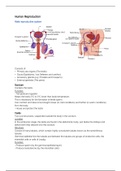
Male reproductive system
Ejaculatory duct
Cowper’s gland
(or sperm duct)
Cowper’s gland
Erectile tissue
Consists of:
. Primary sex organs (The testis)
. Ducts (Epididymis, Vas Deferens and urethra)
. Accessory glands (e.g. Prostate and Cowper’s)
. External genitalia (The penis)
Scrotum
Contains the testis.
Function:
- Temperature regulator
Keeps the testis 2°C to 3°C lower than body temperature.
This is necessary for the formation of fertile sperm.
Can contract and relax to be brought closer (in cold conditions) and further (in warm conditions)
from the body.
- House and protect the testis
Testis
Two oval structures, suspended outside the body in the scrotum.
Location
In the embryonic stage, the testis are found in the abdominal cavity, just below the kidneys and
before birth they descent into the scrotum.
Structure
Consist of many lobules, which contain highly convoluted tubules known as the seminiferous
tubules.
Germinal epithelial line the tubules and between the tubules are groups of endocrine cells, the
interstitial cells or cells of Leydig.
Function:
- Produce sperm (by the germinal epithelial layer)
- Produce testosterone (by the interstitial cells)
, Rete testis
(lose heat for temperature control)
Scrotum Lobules
(Provide nutrition, located between the germinal epithelial)
Germinal epithelial
(Secrete testosterone)
Lumen
ISCH stimulates the Cells of Leydig to secrete testosterone.
FSH stimulates the germinal epithelial to mature.
Ducts
1. Epididymis
The seminiferous tubules join to form the epididymis, a highly convoluted tubule.
Function:
- Immature sperm enter where they mature to become motile and fertile
- Immature sperm enter where they are stored
2. Vas Deferens
A muscular duct that is a continuation of the epididymis.
It leaves the scrotum, passes the through the prostate gland and enters the urethra.
Function:
Ejaculation - Pushes the mature sperm forward, by strong peristaltic waves, from the epididymis
to the urethra.
3. Urethra
Forms a common duct at the end of the uro-genital system leading to the exterior.
, Prostate gland
A plum sized gland that surrounds the urethra at the base of the bladder.
Can be surgically removed.
Function:
- Secretes a fluid that aids in the transport of sperm
- The fluid contains enzymes that make the sperm more active
Cowper’s gland
Two glands, found at the base of the penis.
Function:
- Produce an alkaline mucous-like fluid that neutralizes acidic urine that may be in the urethra
- The fluid also lubricates the urethra and external opening to protect the sperm form
mechanical damage
Seminal vesicle
Secretes sucrose that acts as nutrition for the sperm.
Ejaculatory duct
Contracts to expel sperm, assisting in ejaculation.
Ejaculation = the expulsion of semen
Penis
The urethra passes down through this external organ.
The head of the penis is very sensitive and is protected by the foreskin.
(can be removed surgically for cultural or religious reasons)
Structure: Consists of erectile tissue.
There are three sections:
1 & 2 – On the dorsal side, the corpus cavernosa
3 – On the ventral side, the corpus spongiosum
Nerve
The primary mechanism that bring about an erection is the dilation of the dorsal and central
arteries supplying blood to the penis.
Allows more blood to fill the three erectile tissue chambers, causing the penis to lengthen and
stiffen.
Erection = the stiffening of the penis
Function:
Deposits semen with sperm into the female vagina during copulation.
The human penis is distinctive:
- only mammal to have an erectile bone
- not attached to the abdominal wall
Male reproductive system
Ejaculatory duct
Cowper’s gland
(or sperm duct)
Cowper’s gland
Erectile tissue
Consists of:
. Primary sex organs (The testis)
. Ducts (Epididymis, Vas Deferens and urethra)
. Accessory glands (e.g. Prostate and Cowper’s)
. External genitalia (The penis)
Scrotum
Contains the testis.
Function:
- Temperature regulator
Keeps the testis 2°C to 3°C lower than body temperature.
This is necessary for the formation of fertile sperm.
Can contract and relax to be brought closer (in cold conditions) and further (in warm conditions)
from the body.
- House and protect the testis
Testis
Two oval structures, suspended outside the body in the scrotum.
Location
In the embryonic stage, the testis are found in the abdominal cavity, just below the kidneys and
before birth they descent into the scrotum.
Structure
Consist of many lobules, which contain highly convoluted tubules known as the seminiferous
tubules.
Germinal epithelial line the tubules and between the tubules are groups of endocrine cells, the
interstitial cells or cells of Leydig.
Function:
- Produce sperm (by the germinal epithelial layer)
- Produce testosterone (by the interstitial cells)
, Rete testis
(lose heat for temperature control)
Scrotum Lobules
(Provide nutrition, located between the germinal epithelial)
Germinal epithelial
(Secrete testosterone)
Lumen
ISCH stimulates the Cells of Leydig to secrete testosterone.
FSH stimulates the germinal epithelial to mature.
Ducts
1. Epididymis
The seminiferous tubules join to form the epididymis, a highly convoluted tubule.
Function:
- Immature sperm enter where they mature to become motile and fertile
- Immature sperm enter where they are stored
2. Vas Deferens
A muscular duct that is a continuation of the epididymis.
It leaves the scrotum, passes the through the prostate gland and enters the urethra.
Function:
Ejaculation - Pushes the mature sperm forward, by strong peristaltic waves, from the epididymis
to the urethra.
3. Urethra
Forms a common duct at the end of the uro-genital system leading to the exterior.
, Prostate gland
A plum sized gland that surrounds the urethra at the base of the bladder.
Can be surgically removed.
Function:
- Secretes a fluid that aids in the transport of sperm
- The fluid contains enzymes that make the sperm more active
Cowper’s gland
Two glands, found at the base of the penis.
Function:
- Produce an alkaline mucous-like fluid that neutralizes acidic urine that may be in the urethra
- The fluid also lubricates the urethra and external opening to protect the sperm form
mechanical damage
Seminal vesicle
Secretes sucrose that acts as nutrition for the sperm.
Ejaculatory duct
Contracts to expel sperm, assisting in ejaculation.
Ejaculation = the expulsion of semen
Penis
The urethra passes down through this external organ.
The head of the penis is very sensitive and is protected by the foreskin.
(can be removed surgically for cultural or religious reasons)
Structure: Consists of erectile tissue.
There are three sections:
1 & 2 – On the dorsal side, the corpus cavernosa
3 – On the ventral side, the corpus spongiosum
Nerve
The primary mechanism that bring about an erection is the dilation of the dorsal and central
arteries supplying blood to the penis.
Allows more blood to fill the three erectile tissue chambers, causing the penis to lengthen and
stiffen.
Erection = the stiffening of the penis
Function:
Deposits semen with sperm into the female vagina during copulation.
The human penis is distinctive:
- only mammal to have an erectile bone
- not attached to the abdominal wall



