
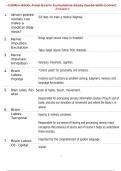
COMD: 4500, Final Exam: Cumulative Study Guide With Correct
Answers
1. Which profes-
SLP does not make a medical diagnosis.
sionals can
make a
medical diag-
nosis?
2. Nerve Brings target neuron closer to threshold.
impulses:
Excitation
Takes target neuron further from threshold.
3. Nerve
impulses:
Inhibition Voluntary movement, cognition.
4. Brain "Control panel" for personality and emotions.
Lobes:
Frontal Involves such functions as problem solving, judgment, memory and
language formulation.
5. Brain Lobes: Pari- Sense of taste, touch, movement.
etal
Responsible for processing sensory information (sense of touch and of
taste, and also our sensation of movement and where the body is in
space).
6. Brain
Lobes: Hearing & memory processes.
Temporal
Responsible for our sense of hearing and processing sensory input
(recognize the presence of sound, but of course it helps us understand
those sounds).
7. Brain Lobes: Important for the comprehension of spoken language.
Oc- cipital
Vision.
1/
50
, COMD: 4500, Final Exam: Cumulative Study Guide With Correct
Answers
Understanding and interpreting the visual world around us.
2/
50
, COMD: 4500, Final Exam: Cumulative Study Guide With Correct
Answers
8. Cranial Nerves • 12 pairs.
• Some sensory only - e.g., olfactory.
• Some sensory and motor - e.g., (facial).
• Some motor only - e.g., hypoglossal.
9. Spinal Cord • Runs through vertebrae.
• Numerous interneurons (Neurons that connect between other
neurons within the central nervous system).
• Central pattern generators (repetitive actions like walking).
• Soma of spinal nerves.
• Within the spinal cord there is gray matter, which consists of the soma
of the cell bodies of the spinal nerves.
10. Upper • Not an anatomic description, but a role in a hierarchy.
Motor
Neurons • Central nervous system - both origin and destination.
• Both direct and indirect pathways.
• Complex inter-connections.
• Originating, planning, refining movements.
11. Lower • Peripheral motor nerves.
Motor
• Origin in the brainstem or spinal cord.
Neurons
• Destination: the neuromuscular junction.
3/
50
, COMD: 4500, Final Exam: Cumulative Study Guide With Correct
Answers
16. Indirect Activa- tion Pathway
12. Descending
Mo- tor Tracts
13. Direct
Activation
Pathway
14. Direct
Activation
Pathway:
Corti-
cobulbar tract
15. Direct
Activation
Pathway:
Corti- cospinal
tract
4/
50
Answers
1. Which profes-
SLP does not make a medical diagnosis.
sionals can
make a
medical diag-
nosis?
2. Nerve Brings target neuron closer to threshold.
impulses:
Excitation
Takes target neuron further from threshold.
3. Nerve
impulses:
Inhibition Voluntary movement, cognition.
4. Brain "Control panel" for personality and emotions.
Lobes:
Frontal Involves such functions as problem solving, judgment, memory and
language formulation.
5. Brain Lobes: Pari- Sense of taste, touch, movement.
etal
Responsible for processing sensory information (sense of touch and of
taste, and also our sensation of movement and where the body is in
space).
6. Brain
Lobes: Hearing & memory processes.
Temporal
Responsible for our sense of hearing and processing sensory input
(recognize the presence of sound, but of course it helps us understand
those sounds).
7. Brain Lobes: Important for the comprehension of spoken language.
Oc- cipital
Vision.
1/
50
, COMD: 4500, Final Exam: Cumulative Study Guide With Correct
Answers
Understanding and interpreting the visual world around us.
2/
50
, COMD: 4500, Final Exam: Cumulative Study Guide With Correct
Answers
8. Cranial Nerves • 12 pairs.
• Some sensory only - e.g., olfactory.
• Some sensory and motor - e.g., (facial).
• Some motor only - e.g., hypoglossal.
9. Spinal Cord • Runs through vertebrae.
• Numerous interneurons (Neurons that connect between other
neurons within the central nervous system).
• Central pattern generators (repetitive actions like walking).
• Soma of spinal nerves.
• Within the spinal cord there is gray matter, which consists of the soma
of the cell bodies of the spinal nerves.
10. Upper • Not an anatomic description, but a role in a hierarchy.
Motor
Neurons • Central nervous system - both origin and destination.
• Both direct and indirect pathways.
• Complex inter-connections.
• Originating, planning, refining movements.
11. Lower • Peripheral motor nerves.
Motor
• Origin in the brainstem or spinal cord.
Neurons
• Destination: the neuromuscular junction.
3/
50
, COMD: 4500, Final Exam: Cumulative Study Guide With Correct
Answers
16. Indirect Activa- tion Pathway
12. Descending
Mo- tor Tracts
13. Direct
Activation
Pathway
14. Direct
Activation
Pathway:
Corti-
cobulbar tract
15. Direct
Activation
Pathway:
Corti- cospinal
tract
4/
50

