

10.1
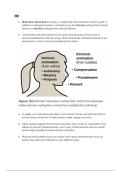
● Motivation describes the wants or needs that direct behavior toward a goal. In
addition to biological motives, motivations can be intrinsic (arising from internal
factors) or extrinsic (arising from external factors).
● Intrinsically motivated behaviors are performed because of the sense of
personal satisfaction that they bring, while extrinsically motivated behaviors are
performed in order to receive something from others.
● In reality, our motivations are often a mix of both intrinsic and extrinsic factors,
but the nature of the mix of these factors might change over time
● Other studies suggest that intrinsic motivation may not be so vulnerable to the
effects of extrinsic reinforcements, and in fact, reinforcements such as verbal
praise might actually increase intrinsic motivation
● Physical reinforcement (such as money) and verbal reinforcement (such as
praise) may affect an individual in very different ways.
,-In fact, tangible rewards (i.e., money) tend to have more negative effects on intrinsic
motivation than do intangible rewards
● culture may influence motivation
● In educational settings, students are more likely to experience intrinsic motivation
to learn when they feel a sense of belonging and respect in the classroom.
● This internalization can be enhanced if the evaluative aspects of the classroom
are de-emphasized and if students feel that they exercise some control over the
learning environment.
-Furthermore, providing students with activities that are challenging, yet doable, along
with a rationale for engaging in various learning activities can enhance intrinsic
motivation for those tasks
Theories About Motivation
William James (1842–1910) was an important contributor to early research into
motivation, and he is often referred to as the father of psychology in the United States.
James theorized that behavior was driven by a number of instincts, which aid survival
From a biological perspective, an instinct is a species-specific pattern of behavior that
is not learned.
Another early theory of motivation proposed that the maintenance of homeostasis is
particularly important in directing behavior.
According to the drive theory of motivation, deviations from homeostasis create
physiological needs. These needs result in psychological drive states that direct
behavior to meet the need and, ultimately, bring the system back to homeostasis.
A habit is a pattern of behavior in which we regularly engage.
Extensions of drive theory take into account levels of arousal as potential motivators. As
you recall from your study of learning, these theories assert that there is an optimal level
of arousal that we all try to maintain
, ● But optimal arousal level is more complex than a simple answer that the middle
level is always best. Researchers Robert Yerkes (pronounced “Yerk-EES”) and
John Dodson discovered that the optimal arousal level depends on the
complexity and difficulty of the task to be performed.
-This relationship is known as the Yerkes-Dodson law, which holds that a simple task
is performed best when arousal levels are relatively high and complex tasks are best
performed when arousal levels are lower
Self-Efficacy and Social Motives
● Self-efficacy is an individual’s belief in their own capability to complete a task,
which may include a previous successful completion of the exact task or a similar
task.
● Albert Bandura (1994) theorized that an individual’s sense of self-efficacy plays
a pivotal role in motivating behavior. Bandura argues that motivation derives from
expectations that we have about the consequences of our behaviors, and
● Motivation describes the wants or needs that direct behavior toward a goal. In
addition to biological motives, motivations can be intrinsic (arising from internal
factors) or extrinsic (arising from external factors).
● Intrinsically motivated behaviors are performed because of the sense of
personal satisfaction that they bring, while extrinsically motivated behaviors are
performed in order to receive something from others.
● In reality, our motivations are often a mix of both intrinsic and extrinsic factors,
but the nature of the mix of these factors might change over time
● Other studies suggest that intrinsic motivation may not be so vulnerable to the
effects of extrinsic reinforcements, and in fact, reinforcements such as verbal
praise might actually increase intrinsic motivation
● Physical reinforcement (such as money) and verbal reinforcement (such as
praise) may affect an individual in very different ways.
,-In fact, tangible rewards (i.e., money) tend to have more negative effects on intrinsic
motivation than do intangible rewards
● culture may influence motivation
● In educational settings, students are more likely to experience intrinsic motivation
to learn when they feel a sense of belonging and respect in the classroom.
● This internalization can be enhanced if the evaluative aspects of the classroom
are de-emphasized and if students feel that they exercise some control over the
learning environment.
-Furthermore, providing students with activities that are challenging, yet doable, along
with a rationale for engaging in various learning activities can enhance intrinsic
motivation for those tasks
Theories About Motivation
William James (1842–1910) was an important contributor to early research into
motivation, and he is often referred to as the father of psychology in the United States.
James theorized that behavior was driven by a number of instincts, which aid survival
From a biological perspective, an instinct is a species-specific pattern of behavior that
is not learned.
Another early theory of motivation proposed that the maintenance of homeostasis is
particularly important in directing behavior.
According to the drive theory of motivation, deviations from homeostasis create
physiological needs. These needs result in psychological drive states that direct
behavior to meet the need and, ultimately, bring the system back to homeostasis.
A habit is a pattern of behavior in which we regularly engage.
Extensions of drive theory take into account levels of arousal as potential motivators. As
you recall from your study of learning, these theories assert that there is an optimal level
of arousal that we all try to maintain
, ● But optimal arousal level is more complex than a simple answer that the middle
level is always best. Researchers Robert Yerkes (pronounced “Yerk-EES”) and
John Dodson discovered that the optimal arousal level depends on the
complexity and difficulty of the task to be performed.
-This relationship is known as the Yerkes-Dodson law, which holds that a simple task
is performed best when arousal levels are relatively high and complex tasks are best
performed when arousal levels are lower
Self-Efficacy and Social Motives
● Self-efficacy is an individual’s belief in their own capability to complete a task,
which may include a previous successful completion of the exact task or a similar
task.
● Albert Bandura (1994) theorized that an individual’s sense of self-efficacy plays
a pivotal role in motivating behavior. Bandura argues that motivation derives from
expectations that we have about the consequences of our behaviors, and

