Microbiology Chapter 28 – Antimicrobials
28.10 Antibacterial drugs
Antimicrobial agents main principles;
• Kill or inhibit the growth of microorganism in the host.
• They should not be easily broken down
• They should not affect the host.
• Aiming at differences between prokaryotes/eukaryotes
• No or delayed resistance development
Antimicrobial agents;
• Synthetic anti-bacterial compounds; growth factor analogues
o Isoniazid (inhibit cell wall growth)
o Quinolones (prevent the supercoiling and packaging of DNA, by DNA
gyrase)
o Sulfa drugs; block a key biosynthetic pathway
• Natural anti-bacterial compounds; antibiotics
o Eukaryotic;
▪ Beta-lactam antibiotics (penicillin)
o Prokaryotic;
▪ Aminoglycosides
▪ Macrolides
▪ tetracycline
• Semi-synthetic anti-bacterial compounds; modified antibiotics
o Cephalosporins
Important targets of antibiotics are the cell wall, ribosomes, enzymes
that facilitate nucleic acid synthesis or catalyze metabolic processes
and the cytoplasmic membrane.
The first antimicrobial drug is Salvarsan.
The cell wall as a drug target
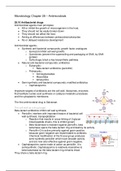
Beta-lactam antibiotics inhibit cell wall synthesis;
• Penicillin; interfere with important feature of bacterial cell
wall synthesis; transpeptidation.
o Reaction that results in cross-linking of 2-glycan
linked peptide chains, this is inhibit (groen)
o Beta-lactamase is resistant against penicillin, beta
lactamase opens the beta-lactam ring and destroy its activity.
o Penicillin G is active primarily against gram-positive
because gram-negative are impermeable to antibiotic.
Chemical modification of the N-acyl group produces
semi-synthetic penicillin which have broader activity
and are now also effective against gram-negative.
• Cephalosporins; same mode of action as penicillin. It is
semisynthetic. Cephalosporins is relatively insensitive to
beta-lactamase so the beta-lactam ring remains intact.
They share a beta-lactam ring.