How is the theme of duality explored in Jekyll and Hyde ?
Introduction:
Overarching statement:
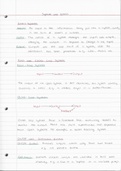
In the strange case of d Jekyll and mr Hyde by Robert Louis Stevenson, the
theme of duality is central, illustrating the inherent conflict between the
good and evil aspects of the human nature. Written in the context of
Victorian England, a highly moralistic society preoccupied with
maintaining appearances, Stevenson explores how even the most
respectable members of society harbour dark desires. Stevenson explored
this concept through the revelation that civilised behaviour and moral
integrity often mask darker and more primitive instincts within individuals
in order to exploit the fears sparked by Darwin’ theory of evolution.
Point 1: The duality of human nature is embodied in the characters of dr
Jekyll and mr Hyde. Dr Jekyll represents the ego, the part of the human
psyche that maintains a veneer of social respectability and moral
behaviour. In contrast, mr Hyde personifies the Id, the primal, instinctual
drives that crave violence and depravity. This aligns with Freudian ideas
about the conscious mind, showing hat beneath the civilised surface lurks
a darker, uncontrolled force. Stevenson uses Jekyll’s struggle to repress
his desires to reflect the Victorian era’s obsession with maintaining moral
and social standards, even as it criminalised and stigmatised behaviours
like homosexuality through the labouchere amendment in 1885.
Stevenson critiques how this forced duality led to a psychological
fragmentation that upper class individuals had to hide to preserve their
public image.
Point 2 : Stevenson uses the contrasting settings of Victorian London to
emphasise the theme of duality. Stevenson employs Dr Jekyll’s dual
environments- the respectable affluent façade of his home and the
seclusion of his laboratory- in order to illustrate a stark contrast between
his public persona and his private experiments into the depths of human
nature. He uses this dichotomy to act as a vehicle in which he can explore
the façade of the upper class and critique the hypocrisy of a highly
‘moralistic’ Victorian England. This symbolises the upper class’s façade of
respectability, masking the moral corruption and decay beneath the
surface. This explores ideas that the upper class engage in decadence and
depravity behind the veneer of their outward displays of virtuosity which
is intertwined with Max Nordau’s theory of upper class degeneration
argued that society’s elites were becoming physically and morally
Introduction:
Overarching statement:
In the strange case of d Jekyll and mr Hyde by Robert Louis Stevenson, the
theme of duality is central, illustrating the inherent conflict between the
good and evil aspects of the human nature. Written in the context of
Victorian England, a highly moralistic society preoccupied with
maintaining appearances, Stevenson explores how even the most
respectable members of society harbour dark desires. Stevenson explored
this concept through the revelation that civilised behaviour and moral
integrity often mask darker and more primitive instincts within individuals
in order to exploit the fears sparked by Darwin’ theory of evolution.
Point 1: The duality of human nature is embodied in the characters of dr
Jekyll and mr Hyde. Dr Jekyll represents the ego, the part of the human
psyche that maintains a veneer of social respectability and moral
behaviour. In contrast, mr Hyde personifies the Id, the primal, instinctual
drives that crave violence and depravity. This aligns with Freudian ideas
about the conscious mind, showing hat beneath the civilised surface lurks
a darker, uncontrolled force. Stevenson uses Jekyll’s struggle to repress
his desires to reflect the Victorian era’s obsession with maintaining moral
and social standards, even as it criminalised and stigmatised behaviours
like homosexuality through the labouchere amendment in 1885.
Stevenson critiques how this forced duality led to a psychological
fragmentation that upper class individuals had to hide to preserve their
public image.
Point 2 : Stevenson uses the contrasting settings of Victorian London to
emphasise the theme of duality. Stevenson employs Dr Jekyll’s dual
environments- the respectable affluent façade of his home and the
seclusion of his laboratory- in order to illustrate a stark contrast between
his public persona and his private experiments into the depths of human
nature. He uses this dichotomy to act as a vehicle in which he can explore
the façade of the upper class and critique the hypocrisy of a highly
‘moralistic’ Victorian England. This symbolises the upper class’s façade of
respectability, masking the moral corruption and decay beneath the
surface. This explores ideas that the upper class engage in decadence and
depravity behind the veneer of their outward displays of virtuosity which
is intertwined with Max Nordau’s theory of upper class degeneration
argued that society’s elites were becoming physically and morally