
Solution Manual: Process Dynamics and Control (Second Edition)
Dale E. Seborg, Thomas F. Edgar, Duncan A. Mellichamp
2004, John Wiley and Sons Inc.
1234567898
1.1
a) True
b) True
c) True
d) False
e) True
1.2
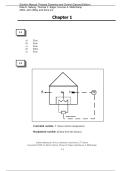
QL Q T TC
ON/OFF SWITCH
Controlled variable- T (house interior temperature)
Manipulated variable- Q (heat from the furnace)
Solution Manual for Process Dynamics and Control, 2nd edition,
Copyright © 2004 by Dale E. Seborg, Thomas F. Edgar and Duncan A. Mellichamp.
1-1
, Disturbance variable- QL (heat lost to surroundings); other possible
sources of disturbances are the loss of gas pressure and the outside door
opening.
Specific disturbances include change in outside temperature, change in
outside wind velocity (external heat transfer coefficient), the opening of
doors or windows into the house, the number of people inside (each one
generating and transmitting energy into the surrounding air), and what
other electric lights and appliances of any nature are being used.
1.3
The ordinary kitchen oven (either electric or gas), the water heater, and the
furnace (Ex. 1.2) all work similarly, generally using a feedback control
mechanism and an electronic on-off controller. For example, the oven uses
a thermal element similar to a thermocouple to sense temperature; the
sensor's output is compared to the desired cooking temperature (input via
dial or electronic set-point/display unit); and the gas or electric current is
then turned on or off depending on whether the temperature is below or
above the desired value. Disturbances include the introduction or removal
of food from the oven, etc. A non-electronic household appliance that
utilizes built-in feedback control is the water tank in a toilet. Here, a float
(ball) on a lever arm closes or opens a valve as the water level rises and
falls above the desired maximum level. The float height represents the
sensor; the lever arm acting on the valve stem provides actuation; and the
on-off controller and its set point are built into the mechanical assembly.
1.4
No, a microwave oven typically uses only a timer to operate the oven for a
set (desired) period of time and a power level setting that turns the power
on at its maximum level for a fixed fraction of the so-called duty cycle,
generally several seconds.
Thus setting the Power Level at 6 (60% of full power) and the Cook Time
to 1:30 would result in the oven running for a total of one and one-half
minutes with the power proportioned at 60% (i.e., turned on 100% for 6
seconds and off for 4 seconds, if the fixed duty cycle is 10 seconds long).
This type of control is sometimes referred to as programmed control, as it
utilizes only time as the reference variable .
1-2
, The big disadvantage of such an approach is that the operator (here the
cook) has to estimate what settings will achieve the desired food
temperature or will cook the food to the desired state. This can be
dangerous, as many people can attest who have left a bag of popcorn in
the oven too long and set the bag on fire, or embarrassing, as anyone
knows who has served a frozen meal that did not quite thaw out, let alone
cook. What good cooks do is provide a measure of feedback control to the
microwave cooking process, by noting the smell of the cooking food or
opening the door and checking occasionally to make sure it is heating
correctly. However, anyone who has used a microwave oven to cook fish
filets, for example, and blown them all over the oven, learns to be very
conservative in the absence of a true feedback control mechanism. [Note
that more expensive microwaves do come equipped with a temperature
probe that can be inserted into the food and a controller that will turn off
the oven when the temperature first reaches the desired (set point) value.
But even these units will not truly control the temperature.]
1.5
a) In steering a car, the driver's eyes are the sensor; the drivers hands and the
steering system of the car serve as the actuator; and the driver's brain
constitutes the controller (formulates the control action i.e., turning the
steering wheel to the right when the observed position of the car within its
desired path is too far to the left and vice versa). Turns in the road,
obstructions in the road that must be steered around, etc. represent
disturbances.
b) In braking and accelerating, a driver has to estimate mentally (on a
practically continuous basis) the distance separating his/her car from the
one just ahead and then apply brakes, coast, or accelerate to keep that
distance close to the desired one. This process represents true feedback
control where the measured variable (distance of separation) is used to
formulate an appropriate control response and then to actuate the
brakes/accelerator according to the driver's best judgment. Feedforward
control comes into the picture when the driver uses information other than
the controlled variable (separation distance) that represents any measure of
disturbance to the ongoing process; included would be observations that
brake lights on preceding vehicle(s) are illuminating, that cars are arriving
at a narrowing of the road, etc. Most good drivers also pay close attention
to the rate of change of separation distance, which should remain close to
zero. Later we will see that use of this variable, the time derivative of the
controlled variable, is just another element in feedback control because a
function of the controlled variable is involved.
1-3
, 1.6
a) Feedback Control : Measured variable: y
Manipulated variable: D,R, or B(schematic shows D)
b) Feedforward Control: Measured variable: F
Manipulated variable: D (shown), R or B
1-4

