ASVAB, Real ASVAB Exam.
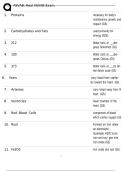
1. Proteins necessary for body's
maintenance, growth, and
repair (GS)
2. Carbohydrates and Fats used primarily for
energy (GS)
3. 212 Water boils at de-
grees fahrenheit (GS)
4. 100 Water boils at de-
grees Celsius (GS)
5. 373 Water boils at Ks on
the Kelvin scale (GS)
6. Veins carry blood from capillar-
ies toward the heart. (GS)
7. Arteries carry blood away from th
heart. (GS)
8. Ventricles lower chamber of the
heart (GS)
9. Red Blood Cells component of blood
which carries oxygen (GS
10. Rust Formed on Iron when
an electrolyte
(example: H2O) turns
iron and oxy- gen into
iron oxide (GS)
11. Fe2O3 iron oxide aka rust (GS)
1/
61
, ASVAB, Real ASVAB Exam.
12. Chemical Iron forming rust is an
example of a
process. (GS)
13. Respiration process by which animal
convert oxygen and sug- ars
into carbon dioxide
and water (GS)
14. photosynthesis process by which plants
convert carbon dioxide and
water into oxygen and
sugar (GS)
15. Inert Noble Gases Helium and neon are
ex- amples of
, and do not react
chemically. (GS)
16. Solution When sugar and water
are mixed together, they
form a , in
which the sugar
particles be- come
evenly distributed
throughout the water.
This is not chemical, as
sugar can be restored
by boiling the water.
(GS)
17. Does Not Ice (Does/Does Not) alter
2/
61
,ASVAB, Real ASVAB Exam.
the chemistry of H2O. (GS)
3/
61
, ASVAB, Real asvab
test!!!
18. O Negative Type of blood which can
be given to anybody
with- out an adverse
reaction (universal
donor) (GS)
19. Vena Cava blood enters the right atr
um of the heart from the
(GS)
20. Higher Basic substances are
on the pH
scale. (GS)
21. Lower Acidic substances are
lower on the
pH scale. (GS)
22. 7 Water is a on the pH
scale. (GS)
23. Small Intestine Digestive organ which
does the most of the
work in breaking
down food. (GS)
24. Enzymes Produced in the walls of
the small intestine, pan-
creas, and liver, which
completely breaks
down food. (GS)
25. Testes produces sperm (male re
productive system) (GS)
1. Proteins necessary for body's
maintenance, growth, and
repair (GS)
2. Carbohydrates and Fats used primarily for
energy (GS)
3. 212 Water boils at de-
grees fahrenheit (GS)
4. 100 Water boils at de-
grees Celsius (GS)
5. 373 Water boils at Ks on
the Kelvin scale (GS)
6. Veins carry blood from capillar-
ies toward the heart. (GS)
7. Arteries carry blood away from th
heart. (GS)
8. Ventricles lower chamber of the
heart (GS)
9. Red Blood Cells component of blood
which carries oxygen (GS
10. Rust Formed on Iron when
an electrolyte
(example: H2O) turns
iron and oxy- gen into
iron oxide (GS)
11. Fe2O3 iron oxide aka rust (GS)
1/
61
, ASVAB, Real ASVAB Exam.
12. Chemical Iron forming rust is an
example of a
process. (GS)
13. Respiration process by which animal
convert oxygen and sug- ars
into carbon dioxide
and water (GS)
14. photosynthesis process by which plants
convert carbon dioxide and
water into oxygen and
sugar (GS)
15. Inert Noble Gases Helium and neon are
ex- amples of
, and do not react
chemically. (GS)
16. Solution When sugar and water
are mixed together, they
form a , in
which the sugar
particles be- come
evenly distributed
throughout the water.
This is not chemical, as
sugar can be restored
by boiling the water.
(GS)
17. Does Not Ice (Does/Does Not) alter
2/
61
,ASVAB, Real ASVAB Exam.
the chemistry of H2O. (GS)
3/
61
, ASVAB, Real asvab
test!!!
18. O Negative Type of blood which can
be given to anybody
with- out an adverse
reaction (universal
donor) (GS)
19. Vena Cava blood enters the right atr
um of the heart from the
(GS)
20. Higher Basic substances are
on the pH
scale. (GS)
21. Lower Acidic substances are
lower on the
pH scale. (GS)
22. 7 Water is a on the pH
scale. (GS)
23. Small Intestine Digestive organ which
does the most of the
work in breaking
down food. (GS)
24. Enzymes Produced in the walls of
the small intestine, pan-
creas, and liver, which
completely breaks
down food. (GS)
25. Testes produces sperm (male re
productive system) (GS)