
• ¿Documento equivocado? Cámbialo gratis
  • Escrito por estudiantes que aprobaron
  • Inmediatamente disponible después del pago
  • Leer en línea o como PDF
Vender
¿Dónde estudias?
Tu idioma
Document preview thumbnail
Vista previa 2 fuera de 6 páginas
Examen

Csd 410 Basic Exam 2025

Document preview thumbnail
Vista previa 2 fuera de 6 páginas

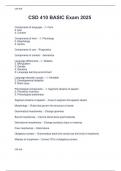
Components of language - -1. Form 2. Use 3. Content Components of form - -1. Phonology 2. Morphology 3. Syntax Components of use - -Pragmatics Components of content - -Semantics Language differences - -1. Dialects 2. Bilingualism 3. Gender 4. Genetics 5. Language learning environment Language disorder causes - -1. Heritable 2. Developmental disability 3. Brain injury Phonological components - -1. Segment streams of speech 2. Phonemic inventory 3. Phonological awareness Segment streams of speech - -Cues to segment the speech stream Morphology - -Rules that govern the structure of words Grammatical morphemes - -Change grammar Bound morphemes - -Cannot stand alone grammatically Derivational morphemes - -Change syntactic class or meaning Free morphemes - -Stand alone Obligatory context - -Grammatical adult form would use this kind of morpheme Mastery of morpheme - -Correct 75% of obligatory context CSD 410 CSD 410 Morphological building blocks - -1. Grammatical morphemes 2. Bound morphemes 3. Free morphemes Syntactic building blocks - -1. Increase utterance length 2. Increase sentence variety 3. Development of complete syntax Sentence types - -1. Declarative 2. Negative 3. Interrogative Development of complete syntax - -1. Word 2. Phrase 3. Clause 4. Sentence average morpheme length of 3.5 - -Emergence of complex sentences occurs when children have an _______ Semantic building blocks - -1. Acquire mental lexicon 2. Acquire new words rapidly 3. Semantic network Pragmatic building blocks - -1. Communication functions 2. Conversation skills 3. Sensitivity to extra-linguistic cues Types of language impairments - -1. Specific 2. Secondary 3. Acquired language disorders Specific language impairment - -Affect only language Secondary language impairment - -Results from other disorders Acquired language disorders - -Injury or illness damaging the language centers of the brain Developmental milestones of language - -1. Speech perception 2. Category formation 3. Early vocalizations 4. Awareness of actions and intentions Infant speech perception - -1. Prosodic regulations 2. Phonetic regularities CSD 410 CSD 410 3. Categorical perception of speech Examples of prosodic regulations - -1. Pitch 2. Duration 3. Intensity Categorical perception - -Telling the difference between speech and non-speech sounds Phonetic regularities - -Detecting differences in non-native speech Levels of categories - -1. Superordinate 2. Basic 3. Subordinate Perceptual and conceptual - -Category formation involves these components Perceptual - -Attributes of things Conceptual - -What to do with things Reflexive vocalizations - -Birth - 2 months Control of phonation - -1 - 4 months Expansion - -4- 6 months Control of articulation - -5 - 8 months Basic canonical symbols - -6 - 10 months Advanced forms of vocalization - -10 -18 months Foundations for language development - -1. Daily routines 2. Caregiver response 3. Infant directed speech 4. Joint reference and attention Infant directed speech - -Also known as motherese 12 months - -Age at which children normally produce first word Criteria for a true word - -1. Clear intent 2. Recognizable pronunciation 3. Used consistently and generalized across situations CSD 410 CSD 410 CSD 410 Basic research - -Refine general knowledge Applied research - -Addresses a specific problem Zones of proximal development - -1. What child can do 2. What child can do with help 3. What child can't do Behavior/Skinner - -Stimulus response and reinforcement Social interaction/Vygotsky - -Language learned through social interactions Cognitive Theory/Piaget - -Cognitive development precedes language; you need words to express Intentionality Model - -If they do X they can get Y; infer intentions Competition Model - -Find out the "right" and "wrong" way to get what you want by the attention given to you Usage-Based Theories - -Need to establish the joint attention to develop a bond and to obtain an understanding of what is useful Universal Grammar - -Born with set of grammar rules Nature Inspired - -MRI has the ability to ID what phonemes will be easy for the child to obtain Bootstrapping theories - -Figure out from context Syntactic bootstrapping theory - -Use extra linguistic context to figure out the meaning of a word Semantic bootstrapping theory - -Understand the meaning of words and figure out the syntax/structure Prosodic bootstrapping theory - -our sensitivity to acoustic (pitch, stress) to segment language Prosodic cues - -Voice inflection, pauses Phonotactic cues - -Sounds that go together Studying language acquisition and development - -1. Speech perception 2. Language production 3. Language comprehension CSD 410 Comparative adverbs - - 1. Positive 2. Comparative 3. Superlative Types of adve

Vista previa del contenido

CSD 410


CSD 410 BASIC Exam 2025
Components of language - -1. Form
2. Use
3. Content

Components of form - -1. Phonology
2. Morphology
3. Syntax

Components of use - -Pragmatics

Components of content - -Semantics

Language differences - -1. Dialects
2. Bilingualism
3. Gender
4. Genetics
5. Language learning environment

Language disorder causes - -1. Heritable
2. Developmental disability
3. Brain injury

Phonological components - -1. Segment streams of speech
2. Phonemic inventory
3. Phonological awareness

Segment streams of speech - -Cues to segment the speech stream

Morphology - -Rules that govern the structure of words

Grammatical morphemes - -Change grammar

Bound morphemes - -Cannot stand alone grammatically

Derivational morphemes - -Change syntactic class or meaning

Free morphemes - -Stand alone

Obligatory context - -Grammatical adult form would use this kind of morpheme

Mastery of morpheme - -Correct 75% of obligatory context


CSD 410

, CSD 410


Morphological building blocks - -1. Grammatical morphemes
2. Bound morphemes
3. Free morphemes

Syntactic building blocks - -1. Increase utterance length
2. Increase sentence variety
3. Development of complete syntax

Sentence types - -1. Declarative
2. Negative
3. Interrogative

Development of complete syntax - -1. Word
2. Phrase
3. Clause
4. Sentence

average morpheme length of 3.5 - -Emergence of complex sentences occurs when
children have an _______

Semantic building blocks - -1. Acquire mental lexicon
2. Acquire new words rapidly
3. Semantic network

Pragmatic building blocks - -1. Communication functions
2. Conversation skills
3. Sensitivity to extra-linguistic cues

Types of language impairments - -1. Specific
2. Secondary
3. Acquired language disorders

Specific language impairment - -Affect only language

Secondary language impairment - -Results from other disorders

Acquired language disorders - -Injury or illness damaging the language centers of the
brain

Developmental milestones of language - -1. Speech perception
2. Category formation
3. Early vocalizations
4. Awareness of actions and intentions

Infant speech perception - -1. Prosodic regulations
2. Phonetic regularities

CSD 410

Información del documento

Subido en
21 de agosto de 2025
Número de páginas
6
Escrito en
2025/2026
Tipo
Examen
Contiene
Preguntas y respuestas
$11.49

¿Documento equivocado? Cámbialo gratis Dentro de los 14 días posteriores a la compra y antes de descargarlo, puedes elegir otro documento. Puedes gastar el importe de nuevo.
Escrito por estudiantes que aprobaron
Inmediatamente disponible después del pago
Leer en línea o como PDF

Seller avatar
Los indicadores de reputación están sujetos a la cantidad de artículos vendidos por una tarifa y las reseñas que ha recibido por esos documentos. Hay tres niveles: Bronce, Plata y Oro. Cuanto mayor reputación, más podrás confiar en la calidad del trabajo del vendedor.
AlexScorer
2.5
(2)
Vendido
11
Seguidores
0
Artículos
1807
Última venta
2 meses hace


Por qué los estudiantes eligen Stuvia

Creado por compañeros estudiantes, verificado por reseñas

Calidad en la que puedes confiar: escrito por estudiantes que aprobaron y evaluado por otros que han usado estos resúmenes.

¿No estás satisfecho? Elige otro documento

¡No te preocupes! Puedes elegir directamente otro documento que se ajuste mejor a lo que buscas.

Paga como quieras, empieza a estudiar al instante

Sin suscripción, sin compromisos. Paga como estés acostumbrado con tarjeta de crédito y descarga tu documento PDF inmediatamente.

Student with book image

“Comprado, descargado y aprobado. Así de fácil puede ser.”

Alisha Student

Preguntas frecuentes