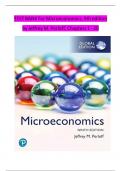
TEST BANK For Microeconomics, 9th edition
u u u u u
by Jeffrey M. Perloff, Chapters 1 - 20
u u u u u u u
,Table of contents
u u
1. Introduction
2. Supply and Demand
u u
3. Applying the Supply-and-Demand Model
u u u
4. Consumer Choice u
5. Applying Consumer Theory
u u
6. Firms and Production
u u
7. Costs
8. Competitive Firms and Markets
u u u
9. Applying the Competitive Model
u u u
10. General Equilibrium and Economic Welfare
u u u u
11. Monopoly
12. Pricing and Advertising
u u
13. Oligopoly and Monopolistic Competition
u u u
14. Game Theory u
15. Factor Markets u
16. Interest Rates, Investments, and Capital Markets
u u u u u
17. Uncertainty
18. Externalities, Open-Access, and Public Goodsu u u u
19. Asymmetric Information u
20. Contracts and Moral Hazards u u u
,Chapter u1 Introduction
1.1 Microeconomics: uThe uAllocation uof uScarce uResources
1) Microeconomics ustudies uthe uallocation uof
A) decision umakers.
B) scarce uresources.
C) models.
D) unlimited uresources.
uANSWER: B
Section: The uAllocation uof uScarce uResources
uQuestion uStatus: Old
AACSB: Analytic uthinking
2) Microeconomics uis uoften ucalled
A) price utheory.
B) decision uscience.
C) scarcity.
D) resource utheory.
uANSWER: A
Section: The uAllocation uof uScarce uResources
uQuestion uStatus: Old
AACSB: Analytic uthinking
3) Most umicroeconomic umodels uassume uthat udecision umakers uwish uto
A) make uthemselves uas uwell uoff uas upossible.
B) act uselfishly.
C) make uothers uas uwell uoff uas upossible.
D) None uof uthe
uabove.uANSWER: A
Section: The uAllocation uof uScarce uResources
uQuestion uStatus: Old
AACSB: Analytic uthinking
4) Society ufaces utrade- ‑offs ubecause uof
A) government uregulations.
B) profit umotive.
C) faceless ubureaucrats.
, D) scarcity.
uANSWER: D
Section: The uAllocation uof uScarce uResources
uQuestion uStatus: Old
AACSB: Analytic uthinking
u u u u u
by Jeffrey M. Perloff, Chapters 1 - 20
u u u u u u u
,Table of contents
u u
1. Introduction
2. Supply and Demand
u u
3. Applying the Supply-and-Demand Model
u u u
4. Consumer Choice u
5. Applying Consumer Theory
u u
6. Firms and Production
u u
7. Costs
8. Competitive Firms and Markets
u u u
9. Applying the Competitive Model
u u u
10. General Equilibrium and Economic Welfare
u u u u
11. Monopoly
12. Pricing and Advertising
u u
13. Oligopoly and Monopolistic Competition
u u u
14. Game Theory u
15. Factor Markets u
16. Interest Rates, Investments, and Capital Markets
u u u u u
17. Uncertainty
18. Externalities, Open-Access, and Public Goodsu u u u
19. Asymmetric Information u
20. Contracts and Moral Hazards u u u
,Chapter u1 Introduction
1.1 Microeconomics: uThe uAllocation uof uScarce uResources
1) Microeconomics ustudies uthe uallocation uof
A) decision umakers.
B) scarce uresources.
C) models.
D) unlimited uresources.
uANSWER: B
Section: The uAllocation uof uScarce uResources
uQuestion uStatus: Old
AACSB: Analytic uthinking
2) Microeconomics uis uoften ucalled
A) price utheory.
B) decision uscience.
C) scarcity.
D) resource utheory.
uANSWER: A
Section: The uAllocation uof uScarce uResources
uQuestion uStatus: Old
AACSB: Analytic uthinking
3) Most umicroeconomic umodels uassume uthat udecision umakers uwish uto
A) make uthemselves uas uwell uoff uas upossible.
B) act uselfishly.
C) make uothers uas uwell uoff uas upossible.
D) None uof uthe
uabove.uANSWER: A
Section: The uAllocation uof uScarce uResources
uQuestion uStatus: Old
AACSB: Analytic uthinking
4) Society ufaces utrade- ‑offs ubecause uof
A) government uregulations.
B) profit umotive.
C) faceless ubureaucrats.
, D) scarcity.
uANSWER: D
Section: The uAllocation uof uScarce uResources
uQuestion uStatus: Old
AACSB: Analytic uthinking