

Gas exchange, digestion + Mass transport
Gas
exchange
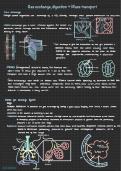
Single celled organisms exchangeO2 CO2 directly through their via diffusion.
·
can plasma membrane
TRACHEOLES
Su
↑
-
· Insects exchange gas in their tracheal
trachea and tracheoles
system . Alr enters via
-
Spiracies , travels through delivering O2
directly to every tissue .
1 TRACHE A
(Gill
Arch
z
ou
·
·
ou
ou
SPIRACLE
AIR IN
·:r
ov
fish exchange in orientation of the
gills. The
·
gill filaments +
1amellae ensures that the water
flowing over them
moves in the opposite direction to the flow of blood
of
1
through the capillaries , maintaining a diffusion
gradient .
&
g
·
plants dicotyledonus occurs in leaves . The Stomata can
open-close to allow
gas diffusion in +out of leaf .
The
mesophyll cells have a
large surface area for rapid diffusion
Gas exchange can lead to water loss . Plants control their opening of Stomata to limit this
and
xerophytes may have additional adaptations Such as : hairs, waxy cuticle ,
small leaves ,
sunken
rolled leaves .
Insects can also control water loss but
controlling open + closing of their spiracles, hair
Ground + cuticle
Waterproof +
waxy .
Human
gas exchange System
lungs
Alveolar epithelium is adapted for
gas exchange by having a
good blood Supply ,
thin walls + elastic fibres
which help recoil
Ventilation is the process of breathing in and out
Inspiration : external intercostal muscles contract , rib Cage moves up t out, diaphram contracts, volume of the thorax
is increased, pressure in the thorax decreases atmospheric pressure is than the
pulmonary
so
greater
pressure + air is forced into lungs
Expiration :
internal intercostal muscles contract , ribs more down and inwards, diaphram relaxes , volume of the
thorax is decreased pressure is than air is
,
pulmonary greater atmospheric pressure ,
forced out of the lungs
·e ·
BRONCHIOLE
~
S
Or
10w
nitedi $5000 o 11884
diashram
-
Gas
exchange
Single celled organisms exchangeO2 CO2 directly through their via diffusion.
·
can plasma membrane
TRACHEOLES
Su
↑
-
· Insects exchange gas in their tracheal
trachea and tracheoles
system . Alr enters via
-
Spiracies , travels through delivering O2
directly to every tissue .
1 TRACHE A
(Gill
Arch
z
ou
·
·
ou
ou
SPIRACLE
AIR IN
·:r
ov
fish exchange in orientation of the
gills. The
·
gill filaments +
1amellae ensures that the water
flowing over them
moves in the opposite direction to the flow of blood
of
1
through the capillaries , maintaining a diffusion
gradient .
&
g
·
plants dicotyledonus occurs in leaves . The Stomata can
open-close to allow
gas diffusion in +out of leaf .
The
mesophyll cells have a
large surface area for rapid diffusion
Gas exchange can lead to water loss . Plants control their opening of Stomata to limit this
and
xerophytes may have additional adaptations Such as : hairs, waxy cuticle ,
small leaves ,
sunken
rolled leaves .
Insects can also control water loss but
controlling open + closing of their spiracles, hair
Ground + cuticle
Waterproof +
waxy .
Human
gas exchange System
lungs
Alveolar epithelium is adapted for
gas exchange by having a
good blood Supply ,
thin walls + elastic fibres
which help recoil
Ventilation is the process of breathing in and out
Inspiration : external intercostal muscles contract , rib Cage moves up t out, diaphram contracts, volume of the thorax
is increased, pressure in the thorax decreases atmospheric pressure is than the
pulmonary
so
greater
pressure + air is forced into lungs
Expiration :
internal intercostal muscles contract , ribs more down and inwards, diaphram relaxes , volume of the
thorax is decreased pressure is than air is
,
pulmonary greater atmospheric pressure ,
forced out of the lungs
·e ·
BRONCHIOLE
~
S
Or
10w
nitedi $5000 o 11884
diashram
-

