
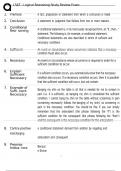
LSAT - Logical Reasoning Study Review Exam.
1. Premise A fact, proposition or statement from which a conclusion is made
2. Conclusion A statement or judgment that follows from one or more reasons.
3. Conditional
Rea- soning A conditional statement is, in its most easily recognized form, an "if...then..."
statement. The following is, for example, a conditional statement.
Conditional statements are also described in terms of suflcient and
necessary conditions.
4. Sufficient An event or circumstance whose occurrence indicates that a necessary
condition must also occur.
5. Necessary An event or circumstance whose occurrence is required in order for a
suflcient condition to occur.
6. Explain
Sufficient If a suflcient condition occurs, you automatically know that the necessary
Necessary condition also occurs. If a necessary condition occurs, then it is possible
that the suflcient condition will occur, but not certain.
7. Example of
Suffi- cient Banging my shin on the table is all that is needed for me to scream in
Necessary pain (i.e. it is suflcient), so banging my shin is considered the suflcient
condition. I cannot bang my shin on the table without screaming in pain
(screaming necessarily follows the banging of my shin), so screaming in
pain is the necessary condition. You should be fine if you can simply
remember that the antecedent (the phrase following the "if") is the
suflcient condition for the consequent (the phrase following the "then")
and the consequent is the necessary condition for the antecedent.
8. Contra-positive a conditional statement derived from another by negating and
interchanging
antecedent and consequent
9. Premise
Indica- tors Becaus
e Since
1/
22
, LSAT - Logical Reasoning Study Review Exam.
F
o
r
For example
2/
22
, LSAT - Logical Reasoning Study Review Exam.
For that reason that In that
Given that
As indicated
by Due to
Owing to
This can be seen
from We know
this by
10. Conclusion Indi-
cators Thus
Therefore
Hence
Consequently
As a result
So
Accordingly
Clearly
Must be
that Shows
11. Thirteen
Logical that
Reasoning Conclude
Types that Follows
that For this
reason
1. Must Be True / Most Supported
2. Main Point
3. Point at issue
4. Assumption
5. Justify the conclusion
6. Strengthen / support
7. Resolve the paradox
3/
22

