
• ¿Documento equivocado? Cámbialo gratis
  • Escrito por estudiantes que aprobaron
  • Inmediatamente disponible después del pago
  • Leer en línea o como PDF
Vender
¿Dónde estudias?
Tu idioma
Document preview thumbnail
Vista previa 1 fuera de 2 páginas
Examen

CS 326 Final

Document preview thumbnail
Vista previa 1 fuera de 2 páginas

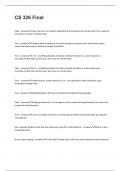
CS 326 Final False - answersType coercion is an explicit (specified by the programmer) conversion from a value of one type to a value of another type. True - answersDisplays allow accessing a non-local variable in constant time, while static chains require dereferencing an arbitrary number of pointers. True - answersIn C++, modifying headers of private member functions in a class requires to recompile all files that use the class, but never to rewrite them. False - answersIn C++, modifying headers of public member functions in a class requires to recompile all files that use the class, but never to rewrite them. True. - answersUnlike macros, inline functions in C++, use applicative order evaluation, type checking and scope rules. True - answersProlog belongs to the class of declarative programming languages. False - answersDangling references in C can appear in the context of heap allocation, but not in the context of stack allocation. True - answersIn Java, an object (instance of a class) can be created only dynamically, by using the new operator. Any computer platform with the Java interpreter specific to that platform. - answersWhat is a Java Virtual Machine? It uses static scoping. - answersC does NOT include static links in its stack activation frames because:

Vista previa del contenido

CS 326 Final

False - answers✔✔Type coercion is an explicit (specified by the programmer) conversion from a value of
one type to a value of another type.


True - answers✔✔Displays allow accessing a non-local variable in constant time, while static chains
require dereferencing an arbitrary number of pointers.


True - answers✔✔In C++, modifying headers of private member functions in a class requires to
recompile all files that use the class, but never to rewrite them.


False - answers✔✔In C++, modifying headers of public member functions in a class requires to
recompile all files that use the class, but never to rewrite them.


True. - answers✔✔Unlike macros, inline functions in C++, use applicative order evaluation, type
checking and scope rules.


True - answers✔✔Prolog belongs to the class of declarative programming languages.


False - answers✔✔Dangling references in C can appear in the context of heap allocation, but not in the
context of stack allocation.


True - answers✔✔In Java, an object (instance of a class) can be created only dynamically, by using the
new operator.


Any computer platform with the Java interpreter specific to that platform. - answers✔✔What is a Java
Virtual Machine?


It uses static scoping. - answers✔✔C does NOT include static links in its stack activation frames because:


Información del documento

Subido en
10 de agosto de 2025
Número de páginas
2
Escrito en
2025/2026
Tipo
Examen
Contiene
Preguntas y respuestas
$8.49

¿Documento equivocado? Cámbialo gratis Dentro de los 14 días posteriores a la compra y antes de descargarlo, puedes elegir otro documento. Puedes gastar el importe de nuevo.
Escrito por estudiantes que aprobaron
Inmediatamente disponible después del pago
Leer en línea o como PDF

Vendido
0
Seguidores
0
Artículos
196
Última venta
-


Por qué los estudiantes eligen Stuvia

Creado por compañeros estudiantes, verificado por reseñas

Calidad en la que puedes confiar: escrito por estudiantes que aprobaron y evaluado por otros que han usado estos resúmenes.

¿No estás satisfecho? Elige otro documento

¡No te preocupes! Puedes elegir directamente otro documento que se ajuste mejor a lo que buscas.

Paga como quieras, empieza a estudiar al instante

Sin suscripción, sin compromisos. Paga como estés acostumbrado con tarjeta de crédito y descarga tu documento PDF inmediatamente.

Student with book image

“Comprado, descargado y aprobado. Así de fácil puede ser.”

Alisha Student

Preguntas frecuentes