A&P 1 Final Exam Study Guide
Study online at https://quizlet.com/_97trw4
1. Define the terms Anatomy - the form and structure of the body and its parts—what things look like
anatomy and and where they are located
physiology. Physiology - the functions of the body and its parts—how things work and what
they do
2. Differentiate Microscopic anatomy - structures so small we need a microscope to see them
between clearly, such as cells and tissues
microscopic and Macroscopic anatomy - body parts large enough to be seen with the unaided eye,
macroscopic such as organs, muscles, and bones
anatomy.
3. Differentiate be- Regional anatomy - the study of all structures and their functions in a specific area
tween the study of the body
of regional Systemic anatomy - the study of structures and functions within specific body
anatomy and the systems
study of systemic
anatomy.
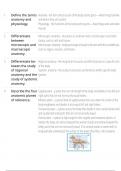
4. Describe the four Sagittal plane - a plane that runs the length of the body and divides it into left and
anatomic planes right parts that are not necessarily equal halves.
of reference. Median plane - a special kind of sagittal plane that runs down the center of the
body lengthwise and divides it into equal left and right halves.
Transverse plane - a plane across the body that divides it into cranial (head-end)
and caudal (tail-end) parts that are not necessarily equal.
Dorsal plane - a plane at right angles to the sagittal and transverse planes. It
divides the body into dorsal (toward the animal's back) and ventral (toward the
belly) parts that are not necessarily equal. If an animal stands in water with its
body partially submerged, the surface of the water describes a dorsal plane.
, A&P 1 Final Exam Study Guide
Study online at https://quizlet.com/_97trw4
5. List and describe Left - individual's left
the anatomic Right - individual's right
terms of direc- Cranial - toward the head end of the body
tion. Rostral - toward the tip of the nose (head only)
Caudal - toward the tail end of the body
Dorsal - toward the back
Ventral - toward the belly
Medial - toward the median plane
Lateral - away from the medial plane
Deep (internal) - toward the center (whole body or part)
Superficial (external) - toward the surface (whole body or part)
Proximal - toward the body (extremity)
Distal - away from the body (extremity)
Palmar - "back" of forelimb from carpus distally
Plantar - "back" of hindlimb from tarsus distally
6. List and describe Barrel - trunk of the body—formed by the rib cage and the abdomen
common region- Brisket - area at the base of the neck between the front legs that covers the cranial
al terms for the end of the sternum
body. Cannon - large metacarpal or metatarsal bone of hoofed animals
Fetlock - joint between cannon bone (large metacarpal/metatarsal) and the
proximal phalanx of hoofed animals
Flank - lateral surface of the abdomen between the last rib and the hind legs
Hock - tarsus
Knee - carpus of hoofed animals
Muzzle - rostral part of the face formed mainly by the maxillary and nasal bones
Pastern - area of the proximal phalanx of hoofed animals
Poll - top of the head between the bases of the ears
Stifle - femorotibial/femoropatellar joint—equivalent to human knee
Tailhead - dorsal part of the base of the tail
Withers - area dorsal to scapulas
, A&P 1 Final Exam Study Guide
Study online at https://quizlet.com/_97trw4
7. List the compo- The dorsal body cavity contains the brain and spinal cord, that is, the central
nents of the dor- nervous system. It consists of two parts; a somewhat spherical cranial cavity in
sal body cavity. the skull and a long, narrow spinal cavity running down the spine.
8. List the compo- It contains most of the soft organs (viscera) of the body. It is divided by the thin
nents of the ven- diaphragm muscle into the cranial thoracic cavity, also known as the thorax or
tral body cavity. chest, and the caudal abdominal cavity, also known as the abdomen.
9. List the four basic Epithelial - composed only of cells; covers and protects (surfaces), secretes
types of body tis- (glands) absorbs (intestinal lining)
sue. Connective - composed of living cells and non-living intercellular substances;
binds cells and structures together and supports the body
Muscle - movements; skeletal (voluntary), cardiac (heart), smooth (involuntary)
Nervous - composed of nerve cells (neurons) and supporting cells; transmits
information around body; coordinates and controls activities
, A&P 1 Final Exam Study Guide
Study online at https://quizlet.com/_97trw4
10. Define home- The maintenance of a dynamic equilibrium in the body
ostasis.
11. List the charac- Protons - positively charged particle
teristics of each Neutrons - a particle in the nucleus of an atom with no electric charge
of the subatomic Electrons - negatively charged particle
particles.
12. Differentiate be- Molecule - the smallest particle of a substance, composed of two or more atoms,
tween a molecule that retains the properties of the substance
and a compound. Compound - a substance made up of 2 or more elements
13. List and describe Ionic - bonding that results from the electrical attraction between cations and
the types of anions
chemical bonds Covalent - bonding that can occur when two atoms each have an unpaired electron
that may form in their outer orbitals
between ele- Hydrogen - bonding that occurs when there's a weak attraction between a slightly
ments. negative atom in a polar covalent bond and a slightly positive hydrogen atom
involved in a second polar covalent bond
14. Give the gen- Synthesis - X+Y -> XY
eral equations Decomposition - XY -> X+Y
for synthesis, de- Exchange - WX + YZ -> WY + XZ
composition, and
exchange reac-
tions.
15. Differentiate be- Organic - a compound that contains carbon
tween organic Inorganic - a compound that does not contain the element carbon or contains
and inorganic carbon bound to elements other than hydrogen
compounds.
16.
Study online at https://quizlet.com/_97trw4
1. Define the terms Anatomy - the form and structure of the body and its parts—what things look like
anatomy and and where they are located
physiology. Physiology - the functions of the body and its parts—how things work and what
they do
2. Differentiate Microscopic anatomy - structures so small we need a microscope to see them
between clearly, such as cells and tissues
microscopic and Macroscopic anatomy - body parts large enough to be seen with the unaided eye,
macroscopic such as organs, muscles, and bones
anatomy.
3. Differentiate be- Regional anatomy - the study of all structures and their functions in a specific area
tween the study of the body
of regional Systemic anatomy - the study of structures and functions within specific body
anatomy and the systems
study of systemic
anatomy.
4. Describe the four Sagittal plane - a plane that runs the length of the body and divides it into left and
anatomic planes right parts that are not necessarily equal halves.
of reference. Median plane - a special kind of sagittal plane that runs down the center of the
body lengthwise and divides it into equal left and right halves.
Transverse plane - a plane across the body that divides it into cranial (head-end)
and caudal (tail-end) parts that are not necessarily equal.
Dorsal plane - a plane at right angles to the sagittal and transverse planes. It
divides the body into dorsal (toward the animal's back) and ventral (toward the
belly) parts that are not necessarily equal. If an animal stands in water with its
body partially submerged, the surface of the water describes a dorsal plane.
, A&P 1 Final Exam Study Guide
Study online at https://quizlet.com/_97trw4
5. List and describe Left - individual's left
the anatomic Right - individual's right
terms of direc- Cranial - toward the head end of the body
tion. Rostral - toward the tip of the nose (head only)
Caudal - toward the tail end of the body
Dorsal - toward the back
Ventral - toward the belly
Medial - toward the median plane
Lateral - away from the medial plane
Deep (internal) - toward the center (whole body or part)
Superficial (external) - toward the surface (whole body or part)
Proximal - toward the body (extremity)
Distal - away from the body (extremity)
Palmar - "back" of forelimb from carpus distally
Plantar - "back" of hindlimb from tarsus distally
6. List and describe Barrel - trunk of the body—formed by the rib cage and the abdomen
common region- Brisket - area at the base of the neck between the front legs that covers the cranial
al terms for the end of the sternum
body. Cannon - large metacarpal or metatarsal bone of hoofed animals
Fetlock - joint between cannon bone (large metacarpal/metatarsal) and the
proximal phalanx of hoofed animals
Flank - lateral surface of the abdomen between the last rib and the hind legs
Hock - tarsus
Knee - carpus of hoofed animals
Muzzle - rostral part of the face formed mainly by the maxillary and nasal bones
Pastern - area of the proximal phalanx of hoofed animals
Poll - top of the head between the bases of the ears
Stifle - femorotibial/femoropatellar joint—equivalent to human knee
Tailhead - dorsal part of the base of the tail
Withers - area dorsal to scapulas
, A&P 1 Final Exam Study Guide
Study online at https://quizlet.com/_97trw4
7. List the compo- The dorsal body cavity contains the brain and spinal cord, that is, the central
nents of the dor- nervous system. It consists of two parts; a somewhat spherical cranial cavity in
sal body cavity. the skull and a long, narrow spinal cavity running down the spine.
8. List the compo- It contains most of the soft organs (viscera) of the body. It is divided by the thin
nents of the ven- diaphragm muscle into the cranial thoracic cavity, also known as the thorax or
tral body cavity. chest, and the caudal abdominal cavity, also known as the abdomen.
9. List the four basic Epithelial - composed only of cells; covers and protects (surfaces), secretes
types of body tis- (glands) absorbs (intestinal lining)
sue. Connective - composed of living cells and non-living intercellular substances;
binds cells and structures together and supports the body
Muscle - movements; skeletal (voluntary), cardiac (heart), smooth (involuntary)
Nervous - composed of nerve cells (neurons) and supporting cells; transmits
information around body; coordinates and controls activities
, A&P 1 Final Exam Study Guide
Study online at https://quizlet.com/_97trw4
10. Define home- The maintenance of a dynamic equilibrium in the body
ostasis.
11. List the charac- Protons - positively charged particle
teristics of each Neutrons - a particle in the nucleus of an atom with no electric charge
of the subatomic Electrons - negatively charged particle
particles.
12. Differentiate be- Molecule - the smallest particle of a substance, composed of two or more atoms,
tween a molecule that retains the properties of the substance
and a compound. Compound - a substance made up of 2 or more elements
13. List and describe Ionic - bonding that results from the electrical attraction between cations and
the types of anions
chemical bonds Covalent - bonding that can occur when two atoms each have an unpaired electron
that may form in their outer orbitals
between ele- Hydrogen - bonding that occurs when there's a weak attraction between a slightly
ments. negative atom in a polar covalent bond and a slightly positive hydrogen atom
involved in a second polar covalent bond
14. Give the gen- Synthesis - X+Y -> XY
eral equations Decomposition - XY -> X+Y
for synthesis, de- Exchange - WX + YZ -> WY + XZ
composition, and
exchange reac-
tions.
15. Differentiate be- Organic - a compound that contains carbon
tween organic Inorganic - a compound that does not contain the element carbon or contains
and inorganic carbon bound to elements other than hydrogen
compounds.
16.