

Escrito por estudiantes que aprobaron Inmediatamente disponible después del pago Leer en línea o como PDF ¿Documento equivocado? Cámbialo gratis 4,6 TrustPilot
logo-home
Document preview thumbnail
Vista previa 2 fuera de 14 páginas
Examen

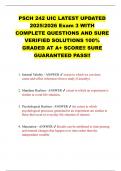
PSCH 242 UIC LATEST UPDATED 2025/2026 Exam 3 WITH COMPLETE QUESTIONS AND SURE VERIFIED SOLUTIONS 100% GRADED AT A+ SCORE!! SURE GUARANTEED PASS!!

Document preview thumbnail
Vista previa 2 fuera de 14 páginas

PSCH 242 UIC LATEST UPDATED 2025/2026 Exam 3 WITH COMPLETE QUESTIONS AND SURE VERIFIED SOLUTIONS 100% GRADED AT A+ SCORE!! SURE GUARANTEED PASS!! 1. Internal Validity - ANSWER extent to which we can draw cause-and-effect inferences from a study (Causality) 2. Mundane Realism - ANSWER extent to which an experiment is similar to a real-life situation. 3. Psychological Realism - ANSWER the extent to which psychological processes generated in an experiment are similar to those that occur in everyday life situation of interest 4. Maturation - ANSWER Results can be attributed to time passing and internal changes that happen over time rather than the independent variable. 5. Selection - ANSWER -Any factor that creates groups that are not equal at the start of the study -Always a problem when participants are not randomly assigned to treatments 6. Statistical Regression - ANSWER tendency for participants selected because of extreme scores to be less extreme on a retest 7. Attrition - ANSWER Loss of participants during a study 8. diffusion of treatment - ANSWER Changes in participants' behavior in one condition because of information they obtained about other conditions 9. Sequence effects - ANSWER Behavior in one condition is due to experience with previous conditions 10. Testing Effects - ANSWER Repeated measurement of the same individual may impact a person's subsequent scores. 11. Level of Constraint - ANSWER How much control the researcher has over the design and progression of the study 12. Archival Study - ANSWER A study in which data is collected from a variety of historical records and pre-existing sources. 13. Archival Study Advantages - ANSWER Can often rely on huge data sets, and there is no researcher influence risk. 14. Archival Study Limitations - ANSWER There are alternatives present that can explain hypotheses in a variety of cases and few ways to amend this. Combinations of statistics could also be used to limit this issue, such as baseball attendance and weather to limit bias. Additionally, sources are not always reliable, and there is no control over data collection. 15. Naturalistic Observation - ANSWER Observing and recording behavior in naturally occurring situations without trying to manipulate and control the situation. 16. Naturalistic Observation Advantages - ANSWER realistic picture of behavior, actions are pure. 17. Naturalistic Observation Limitations - ANSWER Limited scope of observation, reliable and valid measures are very difficult to create. 18. General Limitations of Low-Constraint Methods - ANSWER Limited generalizability, limited replicability, lot of room for experimenter (confirmation) bias, very limited validity of measure at times, mistaken causality. 19. Differences between Correlational lower methods of research - ANSWER Higher levels of constraint, narrower focus, more standardized procedures, control over when and how variables are measured. 20. Differences between Differential and lower methods of research - ANSWER Narrower focus, standardized procedures, control over how and when variables are measured, and *additional* control over Confounding Variables. 21. Problem Statements in Correlational Research - ANSWER Always contain at least two variables. "Is there a relationship between variable X and variable Y?" 22. Problem Statements in Differential Research - ANSWER "Does group A differ from group B on variable Y (the dependent variable)?" 23. Differences Between Correlational and Differential Studies - ANSWER Correlational observes a relationship between two variables while differential observes a relationship between two variables based on two or more pre-established groups. 24. Confounding Variables - ANSWER Variables that vary along with the independent variable. A variable that is likely to have an unwanted effect on the dependent variable. 25. How to deal with confounds in Correlational Research - ANSWER Statistically control for effects of possible confounding variables 26. How to Deal with Confounds in Differential Research - ANSWER Select appropriate comparison groups. Goal: "all else equal." 27. Limitations of Correlational Research - ANSWER Cannot draw conclusions about causality. Relies exclusively on measured variables.

Vista previa del contenido

PSCH 242 UIC LATEST UPDATED
2025/2026 Exam 3 WITH
COMPLETE QUESTIONS AND SURE
VERIFIED SOLUTIONS 100%
GRADED AT A+ SCORE!! SURE
GUARANTEED PASS!!


1. Internal Validity - ANSWER ✔ extent to which we can draw
cause-and-effect inferences from a study (Causality)


2. Mundane Realism - ANSWER ✔ extent to which an experiment is
similar to a real-life situation.


3. Psychological Realism - ANSWER ✔ the extent to which
psychological processes generated in an experiment are similar to
those that occur in everyday life situation of interest


4. Maturation - ANSWER ✔ Results can be attributed to time passing
and internal changes that happen over time rather than the
independent variable.

, 5. Selection - ANSWER ✔ -Any factor that creates groups that are
not equal at the start of the study
-Always a problem when participants are not randomly assigned to
treatments


6. Statistical Regression - ANSWER ✔ tendency for participants
selected because of extreme scores to be less extreme on a retest


7. Attrition - ANSWER ✔ Loss of participants during a study


8. diffusion of treatment - ANSWER ✔ Changes in participants'
behavior in one condition because of information they obtained
about other conditions


9. Sequence effects - ANSWER ✔ Behavior in one condition is due
to experience with previous conditions


10. Testing Effects - ANSWER ✔ Repeated measurement of the
same individual may impact a person's subsequent scores.


11. Level of Constraint - ANSWER ✔ How much control the
researcher has over the design and progression of the study


Información del documento

Subido en
2 de agosto de 2025
Número de páginas
14
Escrito en
2025/2026
Tipo
Examen
Contiene
Preguntas y respuestas
$13.99

¿Documento equivocado? Cámbialo gratis Dentro de los 14 días posteriores a la compra y antes de descargarlo, puedes elegir otro documento. Puedes gastar el importe de nuevo.
Escrito por estudiantes que aprobaron
Inmediatamente disponible después del pago
Leer en línea o como PDF

Seller avatar
Los indicadores de reputación están sujetos a la cantidad de artículos vendidos por una tarifa y las reseñas que ha recibido por esos documentos. Hay tres niveles: Bronce, Plata y Oro. Cuanto mayor reputación, más podrás confiar en la calidad del trabajo del vendedor.
Exchequer
3.2
(11)
Vendido
79
Seguidores
1
Artículos
1447
Última venta
5 días hace


Por qué los estudiantes eligen Stuvia

Creado por compañeros estudiantes, verificado por reseñas

Calidad en la que puedes confiar: escrito por estudiantes que aprobaron y evaluado por otros que han usado estos resúmenes.

¿No estás satisfecho? Elige otro documento

¡No te preocupes! Puedes elegir directamente otro documento que se ajuste mejor a lo que buscas.

Paga como quieras, empieza a estudiar al instante

Sin suscripción, sin compromisos. Paga como estés acostumbrado con tarjeta de crédito y descarga tu documento PDF inmediatamente.

Student with book image

“Comprado, descargado y aprobado. Así de fácil puede ser.”

Alisha Student

Preguntas frecuentes