
ACI CONCRETE FIELD TESTING TECHNICIAN
GRADE I EXAM GUIDE (LATEST 2025/ 2026
UPDATE) Q/A | GRADE A| 100% CORRECT
(VERIFIED ANSWERS)
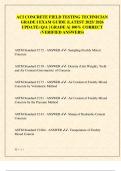
ASTM Standard C172 - ANSWER ✔✔- Sampling Freshly Mixed
Concrete
ASTM Standard C138 - ANSWER ✔✔- Density (Unit Weight), Yield
and Air Content (Gravimetric) of Concrete
ASTM Standard C173 - ANSWER ✔✔- Air Content of Freshly Mixed
Concrete by Volumetric Method
ASTM Standard C231 - ANSWER ✔✔- Air Content of Freshly Mixed
Concrete by the Pressure Method
ASTM Standard C143 - ANSWER ✔✔- Slump of Hydraulic-Cement
Concrete
ASTM Standard C1064 - ANSWER ✔✔- Temperature of Freshly
Mixed Conrete
1|Page
,ASTM Standard C31 - ANSWER ✔✔- Making and Curing Concrete
Test Specimens in the Field
[True or False]: The method of determining air content containing
lightweight aggregate is the pressure method - ANSWER ✔✔- False
(C231 & C173)
[True or False]: When making a test cylinder from concrete being used
in construction, the field technician must also measure the slump of the
concrete - ANSWER ✔✔- True (C31)
While the technician is checking the slump of the concrete, there is a
decided falling away or shearing off of concrete from one side of the
sample. What should the technician do? - ANSWER ✔✔- Disregard the
test and retest on another portion of the sample
Preparation of specimens for transport includes - ANSWER ✔✔-
Determination that at least 8 hours has elapsed since final set
If the aggregate correction factor for a given source of fine and coarse
aggregate is found to be 0.2% in a pressure air meter, and an air content
value of 5.0% is read on the gauge of the air meter testing that concrete,
what is the correct air content? - ANSWER ✔✔- 4.8%
2|Page
,Strength test specimens transported from the field to the testing
laboratory must be: - ANSWER ✔✔- Protected from Jarring, moisture
loss, freezing
Test for slump and air content must be started within How Many
Minutes After Obtaining the Final Portion of the Composite Sample -
ANSWER ✔✔- 5 minutes
The minimum size for samples to be used for strength tests is: -
ANSWER ✔✔- 1 Cubic Foot [28 Liters]
[True of False]: After a Strike Off of the measure used to determine
density, a small quantity of concrete may be added to correct a
deficiency - ANSWER ✔✔- False (C138)
For normal strength concretes, what temperature range must be
maintained for test cylinders during initial curing? - ANSWER ✔✔- 60
to 80 deg F [16 - 27 C]
[True or False]: When the concrete contains large aggregate, the testing
technician should wet-sieve the sample BEFORE making Density (unit
weight) tests for use in Yield Computations - ANSWER ✔✔- False
(C172)
3|Page
, What is the minimum amount of concrete cover in all directions around
the temperature sensor when measuring temperature? - ANSWER ✔✔-
3 inches [75mm]
[True or False]: The sides of the slump mold should be lightly tapped to
consolidate the concrete in the mold - ANSWER ✔✔- False (C143)
[True or False]: Unless specified otherwise, strength test specimens
molded from concrete having a slump less than 1 inch [25mm] must be
consolidated by vibration - ANSWER ✔✔- True (C31)
[True or False]: Test cylinders may be capped with a thin layer of
portland cement paste which is permitted to harden and cure with the
specimen - ANSWER ✔✔- True (C31)
Tamping rod should be (Multiple Choice) - ANSWER ✔✔- Flat,
Tapered, Pointed OR None of the above
Start molding Strength Test specimens within How Many Minutes after
fabricating the composite sample - ANSWER ✔✔- 15 minutes
[True or False]: Representative samples are required for use in tests
conducted for the purpose of determining compliance with the
specifications for concrete quality - ANSWER ✔✔- True (C172)
4|Page
GRADE I EXAM GUIDE (LATEST 2025/ 2026
UPDATE) Q/A | GRADE A| 100% CORRECT
(VERIFIED ANSWERS)
ASTM Standard C172 - ANSWER ✔✔- Sampling Freshly Mixed
Concrete
ASTM Standard C138 - ANSWER ✔✔- Density (Unit Weight), Yield
and Air Content (Gravimetric) of Concrete
ASTM Standard C173 - ANSWER ✔✔- Air Content of Freshly Mixed
Concrete by Volumetric Method
ASTM Standard C231 - ANSWER ✔✔- Air Content of Freshly Mixed
Concrete by the Pressure Method
ASTM Standard C143 - ANSWER ✔✔- Slump of Hydraulic-Cement
Concrete
ASTM Standard C1064 - ANSWER ✔✔- Temperature of Freshly
Mixed Conrete
1|Page
,ASTM Standard C31 - ANSWER ✔✔- Making and Curing Concrete
Test Specimens in the Field
[True or False]: The method of determining air content containing
lightweight aggregate is the pressure method - ANSWER ✔✔- False
(C231 & C173)
[True or False]: When making a test cylinder from concrete being used
in construction, the field technician must also measure the slump of the
concrete - ANSWER ✔✔- True (C31)
While the technician is checking the slump of the concrete, there is a
decided falling away or shearing off of concrete from one side of the
sample. What should the technician do? - ANSWER ✔✔- Disregard the
test and retest on another portion of the sample
Preparation of specimens for transport includes - ANSWER ✔✔-
Determination that at least 8 hours has elapsed since final set
If the aggregate correction factor for a given source of fine and coarse
aggregate is found to be 0.2% in a pressure air meter, and an air content
value of 5.0% is read on the gauge of the air meter testing that concrete,
what is the correct air content? - ANSWER ✔✔- 4.8%
2|Page
,Strength test specimens transported from the field to the testing
laboratory must be: - ANSWER ✔✔- Protected from Jarring, moisture
loss, freezing
Test for slump and air content must be started within How Many
Minutes After Obtaining the Final Portion of the Composite Sample -
ANSWER ✔✔- 5 minutes
The minimum size for samples to be used for strength tests is: -
ANSWER ✔✔- 1 Cubic Foot [28 Liters]
[True of False]: After a Strike Off of the measure used to determine
density, a small quantity of concrete may be added to correct a
deficiency - ANSWER ✔✔- False (C138)
For normal strength concretes, what temperature range must be
maintained for test cylinders during initial curing? - ANSWER ✔✔- 60
to 80 deg F [16 - 27 C]
[True or False]: When the concrete contains large aggregate, the testing
technician should wet-sieve the sample BEFORE making Density (unit
weight) tests for use in Yield Computations - ANSWER ✔✔- False
(C172)
3|Page
, What is the minimum amount of concrete cover in all directions around
the temperature sensor when measuring temperature? - ANSWER ✔✔-
3 inches [75mm]
[True or False]: The sides of the slump mold should be lightly tapped to
consolidate the concrete in the mold - ANSWER ✔✔- False (C143)
[True or False]: Unless specified otherwise, strength test specimens
molded from concrete having a slump less than 1 inch [25mm] must be
consolidated by vibration - ANSWER ✔✔- True (C31)
[True or False]: Test cylinders may be capped with a thin layer of
portland cement paste which is permitted to harden and cure with the
specimen - ANSWER ✔✔- True (C31)
Tamping rod should be (Multiple Choice) - ANSWER ✔✔- Flat,
Tapered, Pointed OR None of the above
Start molding Strength Test specimens within How Many Minutes after
fabricating the composite sample - ANSWER ✔✔- 15 minutes
[True or False]: Representative samples are required for use in tests
conducted for the purpose of determining compliance with the
specifications for concrete quality - ANSWER ✔✔- True (C172)
4|Page

